-
PERFORMANCE of CEREAL CROPS in the TANANA RIVER VALLEY of ALASKA 1985
F.J. Wooding, J.T. Hanscom, R.M. Van Veldhuizen, and A.J. Rippy
This is the seventh publication of grain perform ance trials in the Tanana River Valley. The first, published 6 years ago, included the results of spring cereal-variety tests conducted at Fairbanks and Delta Junction during the 1978 and 1979 growing seasons. Beginning in 1980, the variety-test results were annual publications. The length and content of this report is much less than for previous years. This is the result of a cost-saving measure to help cope with a shrinking budget.
-
POTATO VARIETY PERFORMANCE IN THE MATANUSKA VALLEY 1982, 1983, 1984
D.E. Carling and P. Rissi
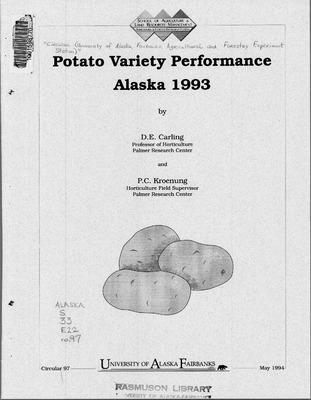
A program of field research relating to the commercial production o f potatoes was initiated in 1982 at the University of Alaska Agricultural Experiment Station ’s research center in Palmer. T he experimental fields are located at the Matanuska Research Farm on Trunk Road near Palmer. This program is a modified continuation of a potato research program initiated more than 30 years ago by D r. C .H . Dearborn. Whereas the major emphasis of D r. Dearborn ’s potato program w as variety development and testing, the major emphasis here is study o f general cultural practices, disease development and control, and the comparative evaluation (yield trials) o f potato varieties having commercial potential. Plans call for the comparative evaluation of thirty to forty named varieties or numbered selections each year. Varieties are selected for testing on the basis o f yield potential, general quality characteristics, and disease resistance. An attempt is made to include all varieties grow n commercially in the state, newly developed varieties from breeding program s in the U .S ., Canada, and elsewhere, as well as established varieties that have yet to be thoroughly tested in this environment. Commercial varieties with locally proven “ track record s ," such as Alaska 114, Bakeking, Green Mountain, and Superior will serve as a comparative base for m ore recently introduced varieites. New varieties will be tested for 4-5 years before being dropped , kept for further study, or recommended to commercial growers. Summarized in this circular are the results o f three years o f variety trials (1982, ’83, and ’84). Also included are summaries of environmental conditions at or near the experimental test site and some detailed information about several locally grown commercial varieties.
-
PERFORMANCE of CEREAL CROPS in the TANANA RIVER VALLEY of ALASKA 1984
F.J. Wooding, J.H. McBeath, S. Frost, J.T. Hanscom, R.M. Van Veldhuizen, and A.J. Rippy
This is the sixth publication in this format on grain performance trials in the Tanana River Valley. The first, published 5 years ago, included the results o f spring cereal-variety tests conducted at Fairbanks and Delta Junction during the 1978 and 1979 growing seasons. The variety-test results from the 1980, 1981, 1982, and 1983 growing seasons were annual publications. Included in this report are a weather summary, the 1984 variety-test results, and a plant-disease section.
-
PESTICIDE USE IN POTATO AND GRAIN PRODUCTION IN ALASKA, 1981
David P. Bleicher
In 1981 a survey was conducted to determine the kinds and amounts of pesticides used in the production of potatoes and small grains in Alaska as well as the manner in which they were used. Alaska has been asked by the United States Department of Agriculture to cooperate with the other states in a pesticide impact assessment program designed to aid the Environmental Protection Agency in predicting the consequences of its actions. This study was initaited to determine the importance of pesticides to the production of these crops. This compilation is not intended to present recommendations for pest management stuations in Alaska, and it should not be used as a pest-control guide. It simply reports surveyed information and should be used only as a reference to pesticide usage in 1981. Some general information is provided on the classification and application of each pesticide.
-
SUMMARY of VEGETABLE VARIETY TRIALS FAIRBANKS, ALASKA 1983
P.J. Wagner and Grant Matheke
This report summarizes the vegetable-variety evaluations of the Horticulture Department of the University of Alaska, Fairbanks, 1983. Variety trials were all conducted at the Agricultural Experiment Station's research farm at Fairbanks. The objective of this research is to select varieties of vegetables that are adapted to this environment. It also identifies types whose adaptability may be improved through development of improved cultural techniques. The selection effort is directed at finding varieties useful to both the commercial growers and home gardeners.
-
WASTE-MANAGEMENT SYSTEMS FOR DAIRY FARMS IN ALASKA
Robert F. Cullum
Manure handling is one of the most unappreciated chores associated with livestock enterprises. It is also the most difficult problem to solve in a totally satisfactory manner because physical characteristics of manure usually change with the daily weather, seasons, and ration. All handling systems have their limitations, and none works perfectly all the time. The problem of manure handling is most easily solved if cows are confined in covered housing because physical characteristics of the manure remain more uniform under cover — no surface water, less drying and freezing. Improper design of manure-handling systems may lead to higher costs for redesign than new facilities would cost. Even with new facilities, manure handling may present major problems if systems are inadequate for the particular environmental conditions of the area. In continuing efforts to improve livestock waste-handling systems, new methods and equipment are being used. Waste-system components, related closely to dairy-manure handling, deal with removal of waste from buildings and storage facilities that are separated from the livestock housing facility. The major systems provide for collection, transfer, storage, and land application, and are divided into two groups — liquid and semisolid manurehandling systems. Many manure-handling systems are used in the United States. Not all of these systems, however, are adapted to northern climates. The Alaska Department of Environmental Conservation currently has no code of practice for livestock waste facilities. The agency, however, must be notified for approval of waste-treatment systems used in livestock enterprises. The systems described in this report comply with current state codes in the northern United States and Canada, and most are adaptable to the environmental conditions of Alaska.
-
SUMMARY of VEGETABLE VARIETY TRIALS FAIRBANKS, ALASKA 1982
D.H. Dinkel, P.J. Wagner, and Grant Matheke
This report summarizes the vegetable variety evaluations of the Horticulture Department of the University of Alaska, Fairbanks, 1982. Variety trials were all conducted at the Agricultural Experiment Station’s research farm at Fairbanks. The objective of this research is to select varieties of vegetables that are adapted to this environment. It also identifies types whose adaptability may be improved through development of improved cultural techniques. The selection effort is directed at finding varieties useful to both the commercial growers and home gardeners.
-
FERTILIZING BLUEJOINT HAY MEADOWS ON THE LOWER KENAI PENINSULA
Wm. W. Mitchell, W.M. Laughlin, and G.A. Mitchell
This circular provides guidance on fertilizing native hay meadows of bluejoint reedgrass (Calamagrostis canadensis) on the lower Kenai Peninsula. It is based on a num ber o f experim ental trials conducted by the authors on Kachemak silt loam soil at various sites near Homer.
-
PERFORMANCE of CEREAL CROPS in the TANANA RIVER VALLEY of ALASKA 1982
F.J. Wooding, J.H. McBeath, S Frost, J.T. Hanscom, R.M. Van Veldhuizen, and G.M. Delucchi
This is the fourth publication in this form at on grain performance trials in the Tanana River Valley. The first, published 3 years ago, included the results o f spring cereal-variety tests conducted at Fairbanks and Delta Junction during the 1978 and 1979 growing seasons. The variety-test results from the 1980 and 1981 growing season were annual publications. Included in this report are a weather summary, the 1982 variety-test results, and a plant-disease section. In 1982, the variety-testing program at Delta Junction was moved from Lee Fett’s farm in the Clearwater area to the University o f Alaska Research Field in the Delta Barley Project area. The new site is situated on recently cleared land. This should provide a more representative basis for variety evaluation for development of new lands. Many thanks are extended to Mr. Fett for his generosity and cooperation in allowing the Agricultural Experiment Station the use o f his land for m ore than a decade.
-
SUMMARY of VEGETABLE VARIETY TRIALS FAIRBANKS, ALASKA 1981
D.H. Dinkel, P.J. Wagner, and Grant Matheke
This report summarizes the vegetable variety evaluations of the Horticulture Department of the University of Alaska, Fairbanks, 1981. Variety trials were all conducted at the Agricultural Experiment Station’s research farm at Fairbanks. The objective of this research is to select varieties of vegetables that are adapted to this environment. It also identifies types whose adaptability may be improved through development of improved cultural techniques. The selection effort is directed at finding varieties useful to both the commercial growers and home gardeners.
-
PERFORMANCE of CEREAL CROPS in the TANANA RIVER VALLEY of ALASKA 1981
F.J. Wooding, J.H. McBeath, J.T. Hanscom, R.M. Van Veldhuizen, and G.M. Delucchi
This is the third publication in this form at on grain performance trials in the Tanana River Valley. The first, published two years ago, included the results of spring cereal variety tests conducted at Fairbanks and Delta Junction during the 1978 and 1979 growing seasons. The second, published one year ago, contained the test results from the 1980 growing season. Included in this report are a weather summary, the 1981 variety-test results, and a plant-disease section. Previous work with grain variety testing has shown that individual varieties do not perform the same when grown under different conditions. The yield a variety produces can be influenced by crop rotation, soil pH, fertilizer rate, tillage practices, rainfall distribution and amount, seeding rate, planting date, and many other factors. Each variety has its own particular set of growing conditions under which it best performs. For example, in the very same field, a variety that performs well on summer-fallow land may do poorly when planted on stubble land.
-
FERTILIZER AND LIME INFLUENCE ON ENGMO TIMOTHY YIELD AND MINERAL COMPOSITION ON THE LOWER KENAI PENINSULA OF ALASKA
Winston M. Laughlin, Glenn R. Smith, Mary Ann Peters, and Paul F. Martin
Another forage to supplement the native bluejoint (Calamagrostis canadensis) in the Caribou Hills area on Alaska’s lower Kenai Peninsula is needed. Domestic grass growth has seldom been successful, although timothy (Phleum pratense) is more tolerant of the acid conditions found in this area than are many other grasses suited for use in Alaska. This report summarizes the results of three separate experiments evaluating the effects of lime and fertilizers on forage production and chemical composition of Engmo timothy on Kachemak silt loam (Typic Cryandept). A 3-year study showed that lime markedly improved growth and yield of tim othy in an area where domestic grasses had seldom survived. Ammonium phosphate nitrate, calcium metaphosphate, and treblesuperphosphate were equally effective as a source of phosphorus (P). In an adjacent 6-year study, each lime increment over 1 ton per acre increased the soil pH, forage yield, and nitrogen (N) uptake, and tended to reduce the crude-protein concentration in forage. Increasing N applications increased yields, crude-protein percentage, and N uptake. Native bluejoint gradually replaced the timothy on plots receiving less than 2 tons lime per acre, responded to the high N rate, and thrived with two cuttings per growing season. In a 5 -year study, oven-dry yields of both cuttings increased with N rates up to 120 lb N per acre with no further increase at 180 lb N per acre. Each increasing N rate each year increased the crude protein and nitrate (N 0 3 -N) concentrations of both cuttings. Nitrogen rates exceeding 60 lb N per acre increased the mean seasonal P uptake and tended to increase the P concentration. Mean seasonal potassium (K) uptake varied with N rate as follows: 120>180 and 240> 60 lb N per acre. Each increasing N increment through 180 lb N per acre increased the mean seasonal calcium (Ca) and magnesium (Mg) uptake. Increasing P rates from 75 to 150 lb per acre had no effect on forage yield. Increasing the P rate from 75 to 150 lb per acre increased the P concentration of both cuttings and the mean seasonal P and sulfur (S) uptake and depressed the mean seasonal Ca and Mg uptake. Increasing the K rate from 83 to 166 lb per acre increased the K concentration and depressed the crude-protein concentration of both cuttings as well as increasing the mean seasonal K and total N uptake. The higher K rate increased oven-dry yields of both cuttings and the mean seasonal N 0 3 -N uptake at the higher N rates. The soil became more acid from 1972 to 1976 with September pH values generally lower than those of the preceding June, particularly in the top 2 inches. The highest N application (240 lb/A) produced the greatest pH reduction. The N 0 3 -N in the soil increased with each increasing N rate. Available P increased over time, accumulated in the top 2 inches, and was greater with the heavier P application. Available K also accumulated in the top 2 inches, was greater in September than in June, and was greater where 166 lb K per acre had been used than with 83 lb. These experiments demonstrated that Engmo timothy can be grown successfully on the more acid Kachemak silt loam with lime application and proper fertilization.
-
A SUMMARY OF 1979 and 1980 SOIL FERTILITY RESEARCH IN THE DELTA -CLEARWATER AREA OF ALASKA
Frank J. Wooding and George A. Mitchell
During 1979 and 1980, soil fertility research was conducted at two locations in the Delta Clearwater area. One of the test sites, Lee F ett’s Farm, was cleared in the mid-1950s and has been in production for about 25 years. The other test site is situated on a tract of newly cleared land owned by Dennis Green. The new lands site was cleared by the traditional berm-pile method during the winter of 1978-79. This method removes much of the moss layer, and in some cases, part o f the topsoil. Land cleared by this procedure is lower in natural fertility, but has the advantage of enabling the farmer to plant a crop the first summer after clearing. In this publication, progress reports are given for several research projects involving fertilizer use and rates of application.
-
PESTICIDE USE IN ALASKA 1978
David P. Bleicher, Peter C. Scorup, and William W. Mitchell
For cooperation and assistance in the work reported here, we gratefully acknowledge Dr. William Burgoyne, State of Alaska Division of Environmental Conservation and Mr. Delon Brown, USDA, Alaska Crop and Livestock Reporting Service. We especially appreciate the efforts of numerous pesticide manufacturers, distributors, dealers, and users who took the necessary time to provide information essential for this compilation. Richard Maxwell, Agricultural Chemicals Specialist, Cooperative Extension Service, Washington State University, provided difficult to locate pesticide label information. The editors of Farm Chemicals Handbook, 1980, provided the list of preferred names as well as information regarding general application of pesticide products.
-
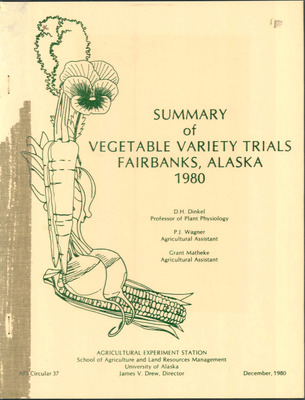
SUMMARY OF VEGETABLE VARIETY TRIALS FAIRBANKS, ALASKA 1980
D.H. Dinkel, P.J. Wagner, and Grant Matheke
This report summarizes the vegetable variety evaluations of the Horticulture Department of the University of Alaska, Fairbanks, 1980. Variety trials were conducted at the Agricultural Experiment Station’s research farm. Additional potato variety trials were conducted at Delta Junction, Alaska. The objective of this research is to select varieties of vegetables that are adapted to this environment. It also identifies types whose adaptability may be improved through development of cultural techniques. The selection effort is directed at finding varieties useful to commercial and home-garden growers. Varieties are chosen for inclusion in the variety tests on the basis of their description, their latitiude of origin, and the record of the plant-breeding program for producing kinds that have previously been found adapted. Standard recommended varieties are included for comparison. In the past, the vegetable variety evaluation program has been responsible for a continuous improvement in yields, quality, and dependability for many vegetable crops. Our philosophy is to depend upon the many existing plant-breeding programs instead of investing in an expensive, on-site, plant-breeding program. Progress can be made more rapidly by selection than by breeding.
-
Performance of Cereal Crops in the Tanana Valley of Alaska 1981
F. J. Wooding, J. H. McBeath, J. T. Hanscom, and R. M. Van Veldhuizen
This is the second publication in this format on grain performance trials in the Tanana River Valley. The first, published a year ago, included the results of spring cereal variety tests conducted at Fairbanks and Delta Junction during the 1978 and 1979 growing seasons. Because pof [sic] the rapid increase of farmland acreage in Alaska's interior, we decided to make this an annual report. Included in this report are a weather summary, the 1982 variety-test results, and a plant-disease section. At present, the variety-testing program is limited to thes [sic] sites at Fairbanks and Delta Junction. At some time in the near future, it is anticipated that the program will be expanded to include test sites in the vicinity of Salcha, Two Rivers, and Nenana. These areas where development of new lands is currently taking place, or will be in the coming years. The three additional locations would provide a representative cross section of the Tanana Valley's agicultural [sic] lands, as well as much-needed information for farmers in these developing areas.
-
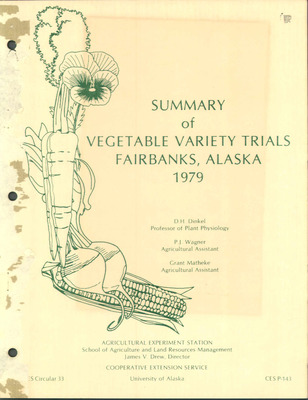
SUMMARY OF VEGETABLE VARIETY TRIALS FAIRBANKS, ALASKA 1979
D.H. Dinkel, P.J. Wagner, and Grant Matheke
This report summarizes the vegetable variety evaluations of the Horticulture Department of the University of Alaska, Fairbanks, 1979. Variety trials were conducted at the Agricultural Experiment Station’s research farm. The objective of this research is to select varieties of vegetables that are adapted to this environment. It also identifies types whose adaptability may be improved through development of cultural techniques. The selection effort is directed at finding varieties useful to commercial and home garden growers.Varieties are chosen for inclusion in the variety tests on the basis of their description, their latitude of origin, and the record o f the plant-breeding program for producing kinds that have previously been found adapted. Standard recommended varieties are included for comparison. In the past, the vegetable variety evaluation program has been responsible for a continuous improvement in yields, quality, and dependability for many vegetable crops. Our philosophy is to depend upon the many existing plant-breeding programs instead of investing in an expensive, on-site, plant-breeding program . Progress can be made more rapidly by selection than by breeding.
-
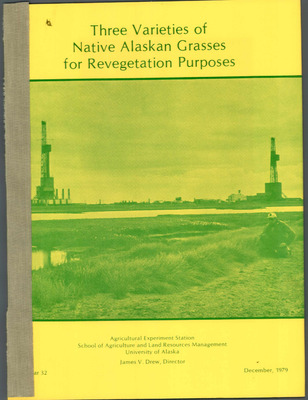
Three Varieties of Native Alaskan Grasses for Revegetation Purposes
Wm. W. Mitchell
Management objectives of some revegetation plantings encourage the use of native species. Where reinstatement of a native flora is desired, the inclusion of suitable native materials can hasten the process. Further, properly adapted native plants may provide a persistent, winterhardy cover requiring little management. The use of poorly adapted introduced grasses can result in stand decimation, such as that experienced along southcentral Alaska’s roadsides after the severe winter of 1975-1976 (Klebesadel, 1977). Tests have revealed, however, that not all indigenous materials are suitable for revegetation purposes. Some have been insufficiently winterhardy for general use, as apparently their ability to persist in their native habitat is related to the particular set of conditions in which they occur. Susceptibility to diseases or failure to persist well in a dense stand militates against the use of certain native types. Growth form also must be considered. If the objective of a planting is to maintain a fairly uniform , turf-like growth, then tall, coarse-growing plants should be avoided. Patience is required in the use of native plants in that their seedling vigor is often low compared to that of m any commercially available cultivars, and the natives may be suppressed when seeded along with more vigorous cultivars. The investigations on revegetation in conjunction with the Prudhoe Bay oil field and trans- Alaska pipeline activities have resulted in the release o f three cultivars derived from indigenous Alaskan materials. Many o f the collections for these cultivars were made prior to 1969 and some date back to 1966. The establishment of this material in small nurseries at the Palmer Experiment Station prior to the oil field activity enabled seed to be obtained for the early testing programs. The three cultivars were developed primarily for revegetation purposes and are particularly important to arctic rehabilitation efforts (Mitchell, 1978) where the need for additional material is most pressing. One cultivar, Tundra, is recommended strictly for arctic use. The other two, Alyeska and Sourdough, can be applied throughout mainland Alaska in appropriate situations. The latter two may also have application as forage grasses in areas where other available materials may be poorly adapted.
-
SUMMARY OF VEGETABLE VARIETY TRIALS FAIRBANKS, ALASKA 1978
D.H. Dinkel, L.M. Ginzton, and P.J. Wagner
This report summarizes the vegetable variety research evaluations of the Horticulture Department of the University of Alaska, Fairbanks, 1978 . Variety trials were conducted at the Agricultural Experiment Station’s research farm. The objective of this research is to select varieties of vegetables that are adapted to this environment. It also identifies types whose adaptability may be improved through development of cultural techniques. The selection effort is directed at finding varieties useful to commercial and home garden growers. Varieties are chosen for inclusion in the variety tests on the basis o f their description, their latitude o f origin, and the record o f the plant-breeding program for producing kinds that have previously been found adapted. Standard recommended varieties are included for comparison. In the past, the vegetable variety evaluation program has been responsible for a continuous improvement in yields, quality, and dependability for m any vegetable crops. Our philosophy is to depend upon the m any existing plant-breeding programs instead of investing in an expensive, on-site, plant-breeding program. Progress can be made more rapidly by selection than by breeding.
-
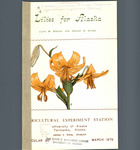
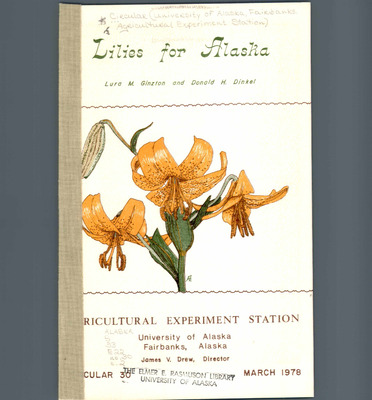
Lilies for Alaska
Lura M. Ginzton and Donald H. Dinkel
Modern hybrid lilies are among the showiest perennials that can be grown by the interior Alaska gardener. There are several groups, or classes, of lilies available, not all of which are hardy here. Within a given group, there are many cultivars, which may or may not be hardy. We will, therefore, describe for you in this circular a number of lily cultivars which have proven to be hardy at the Agricultural Experiment Station at Fairbanks, and indicate those groups of lilies in which the adventurous gardener would be most likely to find additional hardy varieties.
-
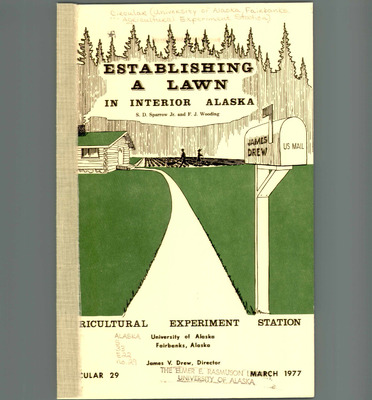
ESTABLISHING A LAWN IN INTERIOR ALASKA
S.D. Sparrow and F.J. Wooding
Lawns are often the most neglected part of homes in Interior Alaska. This is probably because many people feel that turf grasses will not do well in Alaska’s harsh climate and are not worth the trouble for the short period of the year that they can be enjoyed. However, a well-kept lawn not only improves the looks of a home and increases the value of the property, it also provides a place for outdoor recreation that is relatively free of mud and dust. Through use of adapted grass varieties and a few good management practices, lawns can be established that survive the long Alaskan winters and provide a healthy, eye-appealing turf which stays green for about four months of the year.
-

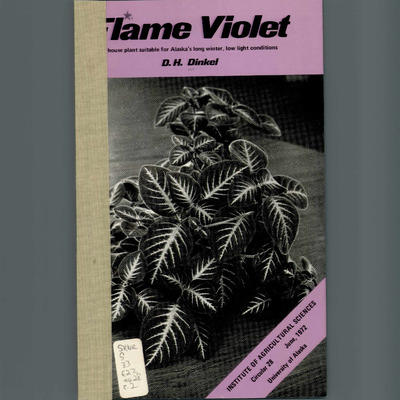
Flame Violet
D.H. Dinkel
Episcia (F la m e V iole t) has proven to be an excellent plant for office and home conditions in Alaska where sunlight is limited during the long w inters. A native of Central and South America , Episcia is a tropical pubescent creeper or trailer. T h is attractive co u sin of the African -violet in the family Gesneriaceae is suitable for pedestals, hanging baskets, or pots.
-

FUELS and HEATING SYSTEMS for Alaskan homes
Lee D. Allen
A wide variety of fuels available in Alaska, their range in cost, and a diversity of heating applications often make the selection of a fuel an important and sometimes difficult task. While cost is important, other factors such as convenience, cleanliness, and adaptability to automatic control sometimes over-ride cost considerations, especially for home heating or crop drying.
-
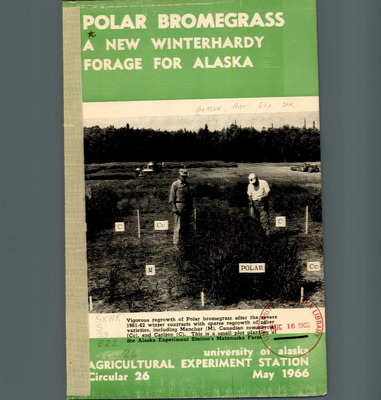
POLAR BROMEGRASS A NEW WINTERHARDY FORAGE FOR ALASKA
A.C. Wilton, H.J. Hodgson, L.J. Klebesadel, and R.L. Taylor
SMOOTH bromegrass ( Bromus inermis Leyss.) is the principal perennial forage crop grown in Alaska. Despite this, none of the varieties developed elsewhere are sufficiently winterhardy for consistently good survival in most of the State. Approximately two-thirds of Alaska's perennial grass acreage is in the Matanuska-Susitna Valley area. In two seasons since 1956 there has been widespread winterkill of bromegrass fields in the Matanuska Valley. Nearly half of the planted acreage winterkilled during 1956-57 and again in 1961-62. In other years individual fields have shown winter injury. Polar bromegrass, a new improved variety, has consistently displayed outstanding winter hardiness and forage yields in experimental tests in Alaska.
Printing is not supported at the primary Gallery Thumbnail page. Please first navigate to a specific Image before printing.