


-
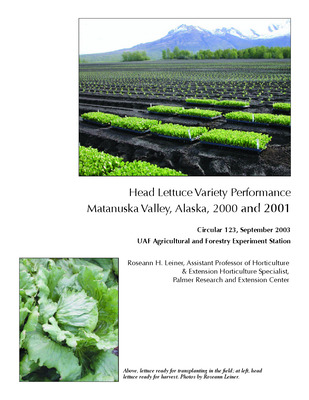
Head Lettuce Variety Performance - Matanuska Valley, Alaska 1996
Stephen M. Dofing, James L. Walworth, and Donald E. Carling
-
Annual Flower & Perennial Landscape Plant Evaluations 1995
Patricia J. Wagner, Patricia S. Holloway, Grant E.M. Matheke, Theresa MacDonald, and Eileen Van Wyne
In 1989, a systematic evaluation o f woody and herbaceous perennial landscape plants was begun at the University o f Alaska Fairbanks Georgeson Botanical Garden (64 51'N , 147°52'W). These evaluations w ere expanded to include annual flowers in 1992 and ferns in 1993. The purpose o f this research is to identify hardy perennials capable o f surviving in subarctic environments; to evaluate the ornamental potential o f perennials and annuals; and to fulfill a growing demand for information on landscape plant materials by homeowners, commercial growers, and landscapes.
-
Potato Variety Performance Alaska 1994
D.E. Carling and P.C. Kroenung
A yield trial in which 44 named varieties and one numbered selection of potatoes were compared, was conducted during the 1994 growing season at the University of Alaska Fairbanks, Agricultural and Forestry Experiment Station’s (AFES) Palmer Research Center, Matanuska Farm, located six miles west of Palmer, Alaska.
-
Identifying alkaloids in Alaska Lupinus spp. with reference to crooked calf disease
Ray Jr Grover, Lyle A. Renecker, Kip E. Panter, and Keith Van Cleve
-
Use of Alaska–Grown Whole Seed Canola in Dairy Cattle Diets-Year 2
Kirsten Randall, Stephen Dofing, and Donald J. Brainard
-
Annual Flower and Perennial Landscape Plant Evaluations 1994
Patricia J. Wagner, Patricia S. Holloway, Grant E.M. Matheke, Sally Berry, and Edie Barbour
In 1989, a systematic evaluation of woody and herbaceous perennial landscape plants was begun at the University of Alaska Fairbanks Georgeson Botanical Garden (64°51’N, 147°52’W). These evaluations were expanded to include annual flowers in 1992 and ferns in 1993. The purpose of this research is to identify hardy perennials capable of surviving in subarctic environments; to evaluate the ornamental potential of perennials and annuals; and to fulfill a growing demand for information on landscape plant materials by homeowners, commercial growers, and landscapers.
-
Potato Variety Performance Alaska 1993
D.E. Carling and P.C. Kroenung
A yield trial in which 43 named varieties and one numbered selection of potatoes were compared was conducted during the 1993 growing season at the University of Alaska Fairbanks, Agricultural and Forestry Experiment Station’s Palmer Research Center, Matanuska Farm, located six miles west of Palmer, Alaska.
-
Reindeer Calf Productivity and Survival on the Seward Peninsula, Alaska
Cheryl-Lesley B. Chetkiewicz and Lyle A. Renecker
Factors influencing calf survival are predation, insects, weather, diseases, and-ultimately-dam condition. In addition, reindeer calves on the Seward Peninsula are also subjected to annual herding and handling. The effects of any of these factors were unknown in reindeer herds on the Seward Peninsula. Our objectives were to determine the causes of mortality, particularly through purportedly high grizzly bear (Ursus arctos) predation; and to determine the survival rates of reindeer calves in one herd and provide management recommendations, based on a simple model, attempting to increase the herd numbers.
-
PRODUCING & PROCESSING REINDEER VELVET ANTLER
Ray Jr. Grover and Lyle A. Renecker
We initiated this study to develop a single small scale boiling tank and test a drying technique on samples of velvet antler.
-
Annual Flower and Perennial Landscape Plant Evaluations 1993
Patricia J. Wagner, Patricia S. Holloway, Grant E.M. Matheke, Sally Berry, and Edie Barbour
In 1989, a systematic evaluation of woody and herbaceous perennial landscape plants was begun at the University of Alaska Fairbanks Georgeson Botanical Garden (64051’N, 147°52’W). These evaluations were expanded to include annual flowers in 1992 and ferns in 1993. The purpose of this research is to identify hardy perennials capable of surviving in subarctic environments; to evaluate the ornamental potential of perennials and annuals; and to fulfill a growing demand for information on landscape plant materials by homeowners, commercial growers, and landscapers.
-
Potato Variety Performance and Commercial Potato Crop Data Summary, Alaska 1991
D. E. Carling, Wayne Vandre, P. C. Westphale, and Mary Comeau
A yield trial in which 43 named varieties and numbered selections of potatoes were compared was conducted during the 1991 growing season at the University of Alaska Fairbanks, Agricultural and Forestry Experiment Station’s Palmer Research Center, Matanuska Research Farm, located six miles west of Palmer, Alaska. Varieties with a history of commercial production in the Matanuska Valley (Alaska 114, Bake-King, Green Mountain, and Superior) are included and serve as a comparative base for newly developed varieties, numbered selections or older varieties that have not been tested at this location. Varieties that compare favorably with the above listed standards may warrant consideration by commercial growers. Nonirrigated trials have been conducted annually since 1982, whereas irrigated trials were initiated in 1985 (AFES Circulars 49, 54, 58, 65, 71, 77, and 84). These circulars are available at the AFES Offices in Fairbanks and Palmer. Included in this report are the results of abbreviated versions of the AFES potato yield trial conducted by cooperating individuals and agencies at other locations in Alaska including Delta Junction, Fairbanks, Homer, Kenai- Soldotna, and Kodiak.
-
Results from the 1992 Alaska Barley Breeding Program
Stephen M. Dofing, Charles W. Knight, and Steve A. Blake
The development of improved plant cultivars is accomplished through comprehensive plant breeding programs. Such programs: 1) evaluate promising germplasm to identify superior-performing genotypes for use as parents; 2) create new genetic recombinations from these selected parental genotypes using crossing or other means; 3) evaluate segregating progeny from the resulting families while exerting selection pressure for desirable characteristics; and 4) identify superior-performing cultivars in yield trials conducted across multiple environments. This circular documents the current status of research in cultivar development associated with the Alaska barley breeding program.
-
Photoperiodic Control of Growth and Development in ‘Nonstop’ Cultivar Series of Begonia x Tuberhybrida
Meriam G. Karlsson and Jeffrey W. Werner
Plants of Begonia x tuberhybrida ‘Nonstop’, ‘Clips’, and ‘Musical’ were exposed to 1, 2, 3, or 4 weeks of short days (SD, 9 hours day length) initiated at 3 stages of plant development (immediately upon germination, 4 or 8 weeks after germination). Prior to and succeeding short days, plants were exposed to long days (LD, 16 hours day length). Musical flowered on average 68 days, Clips 78 days and Nonstop 83 days after germination under continuous LD conditions. In Nonstop, SD for 1, 2, 3, or 4 weeks delayed plant development by an average 12 days compared to LD grown plants. One, 2, or 3 weeks of SD resulted in 1 week slower flowering and 4 weeks of SD resulted in 2 weeks later flowering in Clips. The sensitivity to SD varied with plant stage in Musical. Three or 4 weeks of SD initiated at germination or 4 weeks after germination resulted in an average delayed flowering of 13 days compared to LD plants. SD initiated 8 weeks after germination had no effect on rate of development in Musical.
-
Growth Regulator Effects in Seed Propagated Begonia x Tuberhybrida
Meriam G. Karlsson, Jeffrey W. Werner, and Jan T. Hanscom
The growth regulators chlormequat (Cycocel), paclobutrazol (Bonzi), daminozide (B-Nine) and Bayleton 25WP (triadimefon) were studied for their ability to control plant height in seed propagated tuberous begonia (‘Nonstop’ begonias). Bayleton is a fungicide used for powdery mildew control that also has growth regulator effects. Two ml growth regulator solution was evenly sprayed on each plant two weeks after transplanting. Cycocel (500 parts per million [ppm], 1 mg active ingredient [a.i.] per plant) resulted in 23% shorter plants than the control plants 15 weeks after transplant. Bonzi (5 ppm, 0.01 mg a.i. per plant) treated begonias were 65% and Bayleton (150 mg•liter-1, 0.3 mg per plant) treated plants 43% shorter than the control plants. The number of flowers and shoots was severely reduced on plants treated with Bonzi or Bayleton. BNine was ineffective at the rate of 3000 ppm (6 mg a.i. per plant) for controlling plant height of seed propagated tuberous begonia.
-
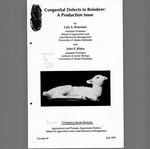
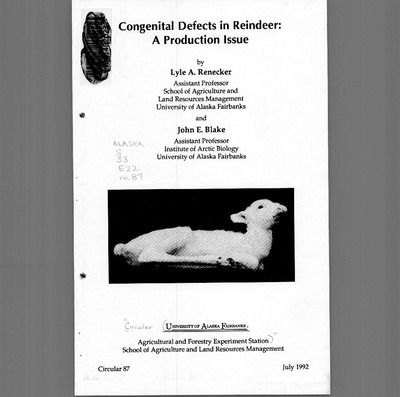
Congenital Defects in Reindeer: A Production Issue
Lyle A. Renecker and John E. Blake
High rates of female breeding success and offspring survival are the two major factors in productivity of any commercial livestock industry. To im prove breeding success and offspring survival, the herd m anager will establish selection criteria and choose which males and females will breed. The genetics or characteristics of future animals will reflect their parentage. Selection pressure is evident in both wild and captive populations of herbivores. Predators, environment, and human harvest strategies are a few forces which influence the characteristics of freeranging populations of reindeer, caribou, moose, wapiti, etc. In livestock production systems, herd managers often breed for specific characteristics such as larger body size, high birth and growth rates, leanness, etc. A single color or combination of colors has been another characteristic often selected by purebred cattle producers as well as reindeer herders.
-

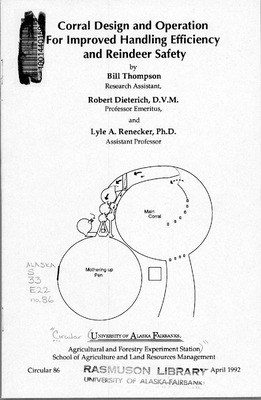
Corral Design and Operation For Improved Handling Efficiency and Reindeer Safety
Bill Thompson, Robert Dieterich, and Lyle A. Renecker
Reindeer in western Alaska have been described as a free-ranging, semi-domesticated animal. Herd management is minimal and animals are less tractable when compared to domestic livestock. Consequently, when reindeer are moved through a corral system they are more susceptible to stress. Stress can occur as a result of circumstances that are related to nutritional, social (crowding), induced psychological or physiological trauma, and parasitic problems, all of which can be interrelated. Excessive stress can reduce herd productivity by lowering reproductive rates, weight gains, survivorship, and immune response. Stress during corralling can result in trauma from overcrowding and trampling, inadequate food and water, disturbance of normal behavioral patterns, and exhaustion. Proper corral design and its operation play a vital role in both prevention of injury and the level of stress the reindeer experience.
-
Perennial Landscape Plant Evaluations 1991
Patricia J. Wagner, Patricia S. Holloway, Grant E.M. Matheke, and Sally Berry
In 1989, a systematic evaluation of woody and herbaceous perennial landscape plants was begun at the University of Alaska Fairbanks Georgeson Botanical Garden (64° 51' N, 147° 52' W). The purpose of this research is to identify hardy perennials capable of surviving in subarctic environments; to evaluate the ornamental potential of these plants; and to fulfill a growing demand for information on hardy landscape plant materials by home owners, commercial growers, and landscapers.
-
POTATO VARIETY PERFORMANCE ALASKA 1990
D.E. Carling and P.C. Westphale
A yield trial which compared 45 named varieties and numbered selections of potatoes was conducted during the 1990 growing season at the University of Alaska Fairbanks, Agricultural and Forestry Experiment Station's Palmer Research Center, Matanuska Research Farm, located six miles west of Palmer, Alaska. Varieties with a history of commercial production in the Matanuska Valley (Alaska 114, Bake-King, Green Mountain, and Superior) are included and serve as a comparative base for newly developed varieties, numbered selections or older varieties that have not been tested at this location. Varieties that compare favorably with the above listed standards may warrant consideration by commercial growers. Non-irrigated trials have been conducted annually since 1982; irrigated trials were initiated in 1985 (AFES Circulars 49,54, 58, 65, 71, and 77). These circulars are available at the AFES offices in Fairbanks and Palmer. Included in this report are the results of abbreviated versions of the AFES potato yield trial conducted by cooperating individuals and agencies at eight locations in Alaska.
-
Growing Everbearing Strawberries as Annuals in Alaska
Donald H. Dinkel, Patricia J. Wagner, and Grant E.M. Matheke
A technique for growing high-yielding, everbearing strawberries with clear polyethylene (plastic) mulch and row covers has been developed at the Agricultural and Forestry Experiment Station at Fairbanks. This technique eliminates the long delay from planting to fruiting that occurs with other culture systems and it has created an interest in commercial production and an increased home-garden effort in Alaska. The production system involves planting nursery plants each season as early as possible through clear polyethylene mulch, using row covers for the early part o f the season. Using this technique, harvest begins about July 15 and extends until freeze-up, com pared to a production season from about July 10 to July 28 for hardy types o f strawberries such as Toklat or Pioneer. This system produces clean fruit, easy to pick and relatively free from fruit rot. The harvest season can be extended in the fall by again using the row covers for frost protection.
-
Results from the 1990 Alaska Barley Breeding Program
Stephen M. Dofing, Charles W. Knight, and Steve A. Blake
The development of improved plant cultivars is accomplished through comprehensive plant breeding programs. Such programs: 1) evaluate genetically-diverse germplasm in order to identify superior-performing genotypes; 2) create new genetic recombinations from crosses or other means using selected parental genotypes; 3) evaluate segregating progeny from these families while exerting selection pressure for desirable characteristics; and 4) identify superior-performing genotypes in yield trials conducted in multiple environments. This circular documents the current status of research in cultivar development associated with the Alaska barley breeding program.
-
Results from the 1991 Alaska Barley Breeding Program
Stephen M. Dofing, Charles W. Knight, and Steve A. Blake
The development of improved plant cultivars is accomplished through comprehensive plant breeding programs. Such programs: 1) evaluate promising germplasm to identify superior-performing genotypes for use as parents; 2) create new genetic recombinations from these selected parental genotypes using crossing or other means; 3) evaluate segregating progeny from the resulting families while exerting selection pressure for desirable characteristics; and 4) identify superior-performing cultivars in yield trials conducted across multiple environments. This circular documents the current status of research in cultivar development associated with the Alaska barley breeding program.
-
Relating Mehlich 3 extractable P to Morgan and Bray 1 extractable P for Alaska soils
G. J. Michaelson, R. G. Gavlak, and C. L. Ping
-
POTATO VARIETY PERFORMANCE ALASKA 1989
D.E. Carling and P.C. Westphale
A comparative yield trial with 45 named varieties and numbered selections of potatoes was conducted during the 1989 growing season at the University of Alaska Fairbanks, Agricultural and Forestry Experiment Station's (AFES) Palmer Research Center, Matanuska Research Farm, located six miles west of Palmer on Trunk Road. Nonirrigated trials have been conducted annually since 1982 and irrigated trials were begun in 1985. Results of previous trials are recorded in AFES Circulars 49, 54, 58, 65 and 71. These circulars are available at the Agricultural and Forestry Experiment Station offices in Fairbanks and Palmer. Also included in this report are the results of abbreviated versions of the AFES potato yield trial that were conducted by cooperating individuals and agencies at six locations in Alaska. Varieties with a history of commercial production in the Matanuska Valley (including Alaska 114, Bake-King, Green Mountain and Superior) are included and serve as a comparative base for newly developed varieties, numbered selections or older varieties that have not been tested at this location. Varieties that compare favorably with the above listed standards may warrant consideration by commercial growers.
-
Record Keeping for Reindeer Herds
Alex Clarke and Robert Dieterich
Record keeping is an important tool in the management of any productive enterprise. In the area of reindeer herding, consistent and accurate record keeping can provide valuable information for making profitable herd management decisions. Making the right decisions can mean the difference between a non-productive herd and one that yields high profits. In this paper, it will be shown how keeping records can contribute to decision making and how computers can help the record keeping process.
-
Results from the 1989 Alaska Barley Breeding Program
S.M. Dofing and S.A. Blake
The development of improved cultivars of barley is accomplished through comprehensive plant breeding programs. Such programs: 1). evaluate genetically-diverse germplasm in order to identify superiorperforming genotypes; 2). create new genetic recombinations from crosses or other means using selected parental genotypes; 3). evaluate segregating progeny from these families while exerting selection pressure for desirable characteristics; and 4). identify superior-performing cultivars in yield trials conducted at multiple locations over years. This circular documents the current status of research in cultivar development associated with the Alaska barley breeding program.
Printing is not supported at the primary Gallery Thumbnail page. Please first navigate to a specific Image before printing.