-
Annual Flowering Plant Evaluations 2005
Patricia S. Holloway, Etta Gardiner, Grant EM Matheke, Jan Hanscom, Eileen Van Wyhe, and Victoria Hill
-
Annual and Perennial Herb Evaluations 2005
J. Dee King, Heather Robertson, Maggie Waite, Barbara Fay, Celese Hansen, Moira Nutter, Virginia Damron, Barbara Rondine, George Wilson, Phyllis Haggland, Olga Cook, Marsha Munsell, Patricia Holloway, Grant Matheke, and Etta Gardiner
-
Annual Vegetable Evaluations 2005
Grant E. Matheke, Etta Gardener, Patricia S. Holloway, Janice T. Hanscom, Gretchen Garcia, Gretchen Garroutte, and Justin Hogrefe
-
Annual Vegetable Evaluations 2004
Zachary Baer, Lauren Esmailka, Alexis Reifenstuhl, Etta Gardener, Jan Hanscom, Patricia S. Holloway, and Grant E. Matheke
-
Annual and Perennial Herb Evaluations 2004
Virginia Damron, Barbara Rondine, George Wilson, Barbara Fay, Olga Cook, Gretchen Kerndt, Nancy Klammer, Marilyn Askelin, Marsha Munsell, J. Dee King, Maggie Waite, Jean Coghill, Heather Robertson, Pat Holloway, Grant Matheke, and Alfreda Gardiner
-
Annual Flowering Plant Evaluations 2004
Patricia S. Holloway, Etta Gardiner, Grant E. Matheke, Jan Hanscom, Eileen Van Wyhe, and Victoria Hill
-
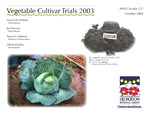
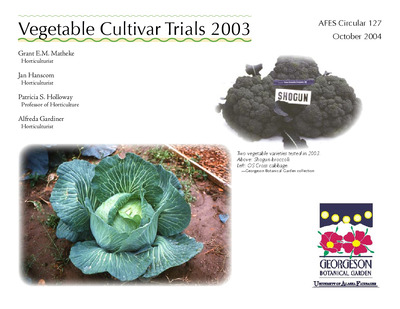
Vegetable Cultivar Trials 2003
Grant E. Matheke, Jan Hanscom, Patricia S. Holloway, and Alfreda Gardiner
-
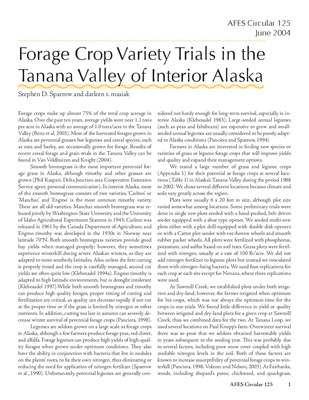
Forage Crop Variety Trials in the Tanana Valley of Interior Alaska
Stephen D. Sparrow and Darleen T. Masiak
-
Annual Flower Evaluations 2003
Patricia S. Holloway, Grant E. Matheke, Jan Hanscom, Alfreda Gardiner, Victoria Hill, and Eileen Van Wyhe
-
Annual Flowering Plant Evaluations 2002
Patricia S. Holloway, Grant E. Matheke, Jan Hanscom, Eileen Van Wyhe, and Victoria Hill
-
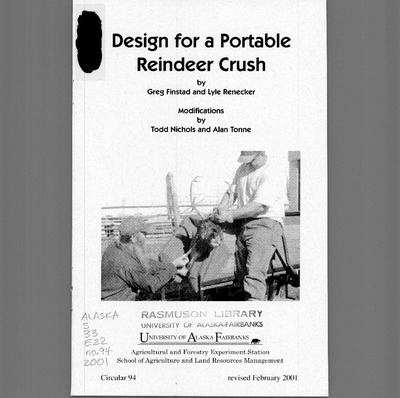
Design for a Portable Reindeer Crush
Greg Finstad and Lyle Renecker
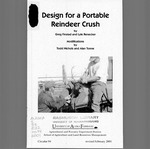
In Alaska, reindeer are managed under both free-ranging and farm conditions. W here reindeer are herded, they are handled twice yearly to harvest velvet antlers and to perform health and record-keeping duties. Under farm conditions, rein deer are handled more frequently to provide routine health care and monitor weight gain. In both types o f management there is a need to efficiently and safely restrain the animal with minimal stress to it. A pneumatic crush for red deer is manufactured in New Zealand and has been used in Alaska for years to restrain reindeer. However, this crush is both expensive and cumbersome to transport. The Reindeer Research Program at the University of Alaska Fairbanks designed a lightweight, portable reindeer crush that can be built locally. This crush can be manufactured with materials that are readily available and assembled with minimal welding and construction skills. The materials can be purchased in most areas for less than $500. The design is offered as a prototype for the builder and should be personalized and improved upon to meet the needs of each handling facility. If the crush is to be stationary, heavier materials can be incorporated into its construction and additional bracing can be added at stress points. Also, smaller or larger versions can be built to specialize in restraining calves or bulls.
-
Annual Flower Evaluations 2000
Patricia S. Holloway and Grant E.M. Matheke
The annual flower trials were planted from 30 May through 2 June, 2000 in the Perennial Landscape and All America Selections Display Garden of the Georgeson Botanical Garden (64°51/N, 147°52'W ). Fairbanks silt loam soil was fertilized with 10-20-20S (4 lbs per 100 sq feet; 195 g per sq meter) on 28 May. With the exception of dahlias, all flowers were grown as seedling transplants, and were hardened off outdoors for one week prior to transplanting. Tuberous roots of dahlias were planted in containers five weeks prior to transplanting and were hardened off.
-
Potato Variety Performance, Alaska 1999
D.E. Carling
A yield trial comparing 30 cultivars of potatoes (Solatium tuberosum L.) was conducted during the 1999 growing season at the University of Alaska Fairbanks, Agricultural and Forestry Experiment Station’s (AFES) Palmer Research Center, Matanuska Farm, located six miles west of Palmer, Alaska. Similar to 1998, this trial included irrigated but not irrigated treatments. Data from previous studies has documented the consistent need for irrigation as well as the magnitude of increases in yield that can be realized through irrigation.
-
Potato Variety Performance, Alaska 1998
D.E. Carling and M.A. Boyd
A yield trial comparing 30 cultivars of potatoes (Solarium tuberosum L.) was conducted during the 1998 growing season at the University of Alaska Fairbanks, Agricultural and Forestry Experiment S tation ’s (AFES) Palm er Research Center, Matanuska Farm, located six miles west of Palmer, Alaska. A noteworthy change in design of this trial from previous years is the elim ination of a nonirrigated treatment. This change was made in response to grower requests that more emphasis be placed in other research areas. Also, the differences in yield between irrigated and nonirrigated studies, and thus the clear need for systems to supplement rainfall, has been well established by trial results from previous years.
-
Model to Evaluate Potential Production and Income Responses of Reindeer Herds under Different Management Strategies
G.L. Finstad and A.K. Prichard
Free-range reindeer in western Alaska are managed for both velvet antler and meat production. Optimal management should maximize the income generated from both meat and antler production while managing the herd at levels below the carrying capacity of the range. Meat production precludes future antler production from harvested animals, therefore harvest decisions should reflect antler and body growth rates, current antler and meat prices, natural survival rates, and population demographics. We present a user-friendly computer model to generate estimates of net income under different harvest levels and market conditions. Input variables include sex- and agespecific survival rates, harvest levels, castration rates, antler weights, body weights, and recapture rates, as well as reproductive rates, fixed and variable costs, antler price, and meat price. Mark—Recapture analysis was used to estimate survival rates. The model was calibrated using reindeer herd records from 1984-1997. Output includes changes in herd size and composition over a thirty-year period, meat production, antler production, female: male ratio, and predicted net income. The model illustrates the sensitivity of herd size to female adult survival rates.
-

Annual Flower Plant Evaluations 1999
Patricia S. Holloway, Grant E.M. Matheke, Jacob Van Veldhuizen, Theresa MacDonald, and Eileen Van Whye
The annual flower trials were planted from 30 May through 4 June, 1999 in the Perennial Landscape and All America Selections Display Garden of the Georgeson Botanical Garden (64°51N, 147°52W). Fairbanks silt loam soil was fertilized with 1 0 -2 0 -2 0 S (4 lbs per 100 sq feet, 195 g per sq meter) on 28 May. With the exception of dahlias, all flowers were grown as seedling transplants and were hardened off outdoors for one week prior to transplanting. Tuberous roots of dahlias were planted in containers five weeks prior to transplanting and were hardened off.
-
Potato Variety Performance, Alaska 1997
D.E. Carling and M.A. Boyd
A yield trial comparing 45 cultivars of potatoes (Solanum tuberosum L.) was conducted during the 1997 growing season at the University of Alaska Fairbanks, Agricultural and Forestry Experiment Station’s (AFES) Palmer Research Center, Matanuska Farm, located six miles west of Palmer, Alaska. Varieties with a history of commercial production in the Matanuska Valley (Alaska 114, Bake-King, Green Mountain, and Superior) were included to serve as a comparative base for newly developed varieties or older named varieties that have not been tested at this location. Russet Burbank, the variety most widely grown in the United States, also was included to broaden the base of comparison although past trials have demonstrated its unsuitability for this area. Varieties that compare favorably with the above listed local standards may warrant consideration by commercial growers. Nonirrigated trials have been conducted annually since 1982 whereas irrigated trials were initiated in 1985. Results of these trials were published in AFES Circulars and are available at AFES offices.
-
Perennial Plant Trials at the Georgeson Botanical Garden
Patricia S. Holloway, Patricia J. Wagner, Grant E.M. Matheke, and Jane Gibson
Trials were begun in 1989 at the Georgeson Botanical Garden (64°51’N, 147° 52’W, elevation 475 feet; 136 meters) to evaluate the hardiness and ornamental potential of trees, shrubs, and herbaceous perennial ornamentals. Woody ornamentals are tested for 10 years, and herbaceous perennials for five years. This report is the first summary of perennials that have survived the trial period with a winter hardiness rating between zero and 2.5. Each plant in the trial is evaluated annually for winter injury and rated on a scale of zero through four. A zero rating denotes no visible injury, and four is death. A score of 2.5 and lower indicates the plant grew well in the Garden. It may have shown symptoms of winter injury but recovered in subsequent seasons. The species and cultivars listed in Table 1 are recommended for further trial throughout Interior Alaska. Plants are grown on a south-facing slope in Fairbanks silt loam soil. The plots have been cultivated since about 1910. All plants receive full sun except those located in the shade house. Plants receive supplemental irrigation, mostly hand weeding, and an annual application of 500 lb per acre (560.5 kg/ha) 10-20-20S fertilizer. Lilies receive 1500 lb (1,681.5 kg/ha) per acre of the same fertilizer. No plant receives winter protection such as mulches, wind barriers or snow fences. Weather data are compiled annually from U.S. Weather Service station (elevation 475 feet; 136 meters) located approximately 350 feet (105 meters) west of the Garden. A summary of pertinent weather statistics is shown in Table 2.
-
Annual Flower and Perennial Landscape Plant Evaluations 1996
Patricia J. Wagner, Patricia S. Holloway, Grant E. Matheke, Theresa MacDonald, and Eileen Van Wyhe
-
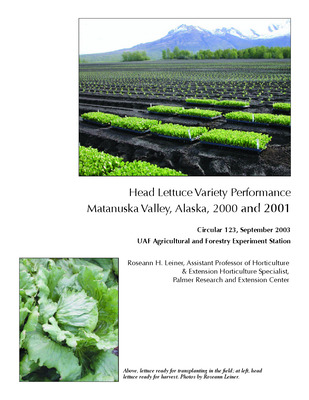
Head Lettuce Variety Performance, Matanuska Valley, Alaska 1997
James L. Walworth, Stephen M. Dofing, and Donald E. Carling
In 1995, 27 head lettuce varieties were evaluated in a replicated study at the Palmer Research Center, and two growers’ fields in the Matanuska Valley. The 15 varieties that performed best in 1995 were selected for evaluation in 1996 and 1997. The performance of those 15 varieties in 1997 is summarized in this report. Results from the 1995 and 1996 trials may be found in UAF circulars 106 and 108 respectively.
Printing is not supported at the primary Gallery Thumbnail page. Please first navigate to a specific Image before printing.