-
Vegetable Variety Trials Matanuska Valley, Alaska 1989
Raymond G. Gavlak, Don Carling, Mary Comeau, Jerry Purser, Wayne Vandre, Jim Walworth, and Catherine Wright
To remain competitive, commercial vegetable producers require updated information on the performance of new vegetable varieties under the soil and climatic conditions of southcentral Alaska. Variety trials provide the opportunity to evaluate potentially adapted plant material. Although many varieties are developed in environments considerably different from that of southcentral Alaska, some may prove to be useful to commercial growers in Alaska. The information on new varieties must be collected over several growing seasons to provide sufficient confidence in the observed performance. Additionally, each year of the performance trials, new varieties are grown with traditional or standard varieties which are used to compare the quality of the new varieties. Commercial production of new varieties should be considered after several years of variety trial work with initial plantings on a small production scale.
-
Alaska's Multibooms
Roger W. Pearson, Edwin M. Rhoades, and Carol E. Lewis
An assessment of Growth of Infrastructure Booms have been a common element in the development of frontier areas in the 19th and 20th centuries. Most commonly, the booms have been associated with resource development such as the mineral booms of the western United States. Booms usually involve some type of dramatic short- term change which has wide-ranging implications (Gilmore, 1976). Since the arrival of the Russians in Alaska, six major booms have occurred: furs, whales, salmon, minerals, military, and petroleum. Each of these booms has, to some degree, created changes in the landscape of Alaska, in particular, the infrastructural base, which in turn has facilitated subsequent development, either another major boom, or a smaller development. For example, agricultural development has been enhanced by mineral, military, and petroleum booms in Alaska. The cumulative impact on infrastructure of more than one boom, or multibooms, as it is referred to here, is the focus of this paper. One problem encountered in studying booms is that there is no general agreement on what constitutes a boom. Detailed studies of booms in communities such as Dixon’s (1978) analysis of Fairbanks and Gilmore’s multi-community work in the Great Plains—Rocky •mountain regions, contained no specific definition of the term “boom”. Yet it was clear in each study that something dramatic had occurred. More general historical studies of the Western mineral bonanzas (Greever, 1963) or the Klondike gold rush (Berton, 1958) likewise suggest a number of factors such as population rise, influx of money, resource extraction, and infrastructure expansion. But in each case, there is no specific factor or define rate of something that specifically qualifies a time period as a boom. In this study, we are concerned with dramatic change of events which have had a major impact on the geographic landscape of an area, As a framework for the initial study, we review those events which have been given attention as boom-type activities in the historical literature of Alaska (Rogers, 1962; Naske and Slotnick, 1987).
-
Quality Assessment of Reindeer Meat
R. B. Swanson, M. P. Penfield, D. Mitchell, M. J. Reimann, and H. D. Loveday
Historically, sales of exotic meats have been limited only by supply. As supply has increased in recent years, national and international exotic game markets have grown rapidly. In the United States, growth has occurred primarily in the restaurant section, although over-the-counter sales have also increased. The Alaskan reindeer industry is exploring the potential of expanding its meat sales as well as antler sales. Meat production increased from 320,000 pounds in 1987 to 432,000 pounds in 1988. This production increase is reflected in a 27 percent increase in dollar value (Alaska Crop and Livestock Reporting Service, 1989). Under current management procedures, potential meat production has been estimated at 500,000 pounds (Pearson and Lewis, 1988). Any future market expansion is likely to occur in urban Alaska and in areas outside the state (Jones, 1988).
-
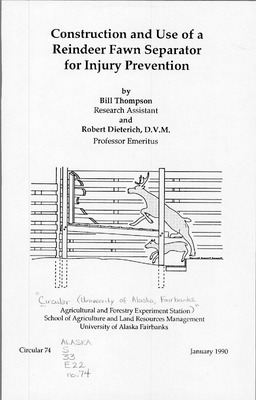
Construction and Use of a Reindeer Fawn Separator for Injury Prevention
Bill Thompson and Robert Dieterich
In 1985, members of the Applied Reindeer Research Project at the University of Alaska Fairbanks obtained and reviewed a Scandinavian instructional video1 on reindeer herding in Norway. This video described a structure that was developed and used by the Scandinavian reindeer industry to prevent injuries during corralling by segregating fawns from adults. The following is a description of how the fawn separator is built, how it works, and its current use in western Alaska.
-
Investigation on the Optimum Level of Salmon Meal for Use in Dairy Cow Diets
Paul M. Windschitl, Kirsten M. Randall, and Don J. Brainard
-
Nutrient Value of Alaskan Feedstuffs 1988
Leroy Ben Bruce and Mary Lou Herlugson
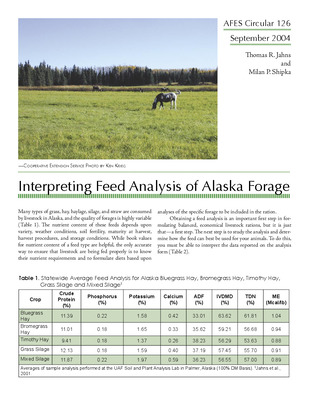
Livestock rations should be balanced for many parameters including protein, and various minerals, and energy, to ensure that all required nutrients are present in the adequate amounts and proper relationships. Energy content is the primary consideration for balancing any farm animal’s diet because it is often the most limiting factor in animal performance. In Alaska, it is extremely important to test for major nutrients and then to balance rations because: 1) Alaska has longer, colder and wetter winters than those in the lower 48 states and consequently Alaskan animals have different nutrient needs. 2) Alaskan feedstuffs tend to be more variable in nutrient content than feeds grown in other states. After energy requirements, crude protein, calcium, phosphorus, and potassium are considered - and with the energy estimate - are the basis of the standard feed analyses performed by the Agricultural and Forestry Experiment Station (AFES) Service Laboratory feed testing section. Because all of these nutrients can vary greatly in the same feed, the Palmer Animal Sciences beef unit of AFES tracks the nutrient values of feed samples submitted to the AFES Service Laboratory. A summary of these values provides an indication of the types and values of feed available in Alaska. It also shows the variability in nutrient content of feedstuffs. Hopefully, this will stimulate the use of individual nutrient analyses for feeding livestock in Alaska.
-
Potato Variety Performance
D.E. Carling and P.C. Westphale
A comparative yield trial with 24 named varieties and numbered selections of potatoes was conducted at the University of Alaska Fairbanks, Agricultural and Forestry Experiment Station’s Palmer Research Center during the 1988 growing season. The trial was conducted at the Matanuska Research Farm, located six miles west of Palmer on Trunk Road. Nonirrigated trials have been conducted annually since 1982, and irrigated trials started in 1985. Results of previous trials have been recorded in AFES Circulars 49, 54, 58 and 65. These circulars are available at the Agricultural and Forestry Experiment Station offices in Fairbanks and Palmer.
-
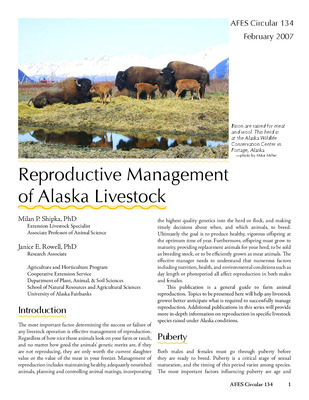
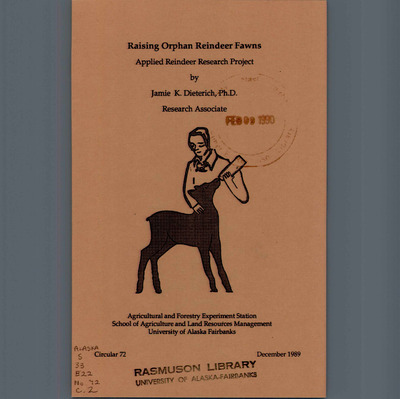
Raising Orphan Reindeer Fawns Applied Reindeer Research Project
Jamie K. Dieterich
Orphan reindeer fawns are often observed at summer handlings. Sometimes an abandoned fawn is found on the range. These fawns can be saved and raised for pets or for sale as live animals. There is an increasing demand for live reindeer to be shipped to locations outside Alaska. Tame reindeer adapted to a commercial diet can be a potential source of income for the herder as well as a rewarding project for the family. The following information is intended for reindeer herders in Alaska who do not have ready access to modem veterinary facilities or care.
-

Air Transport of Alaskan Reindeer Applied Reindeer Research Project
Robert A. Dieterich
This report describes one aspect of successful air transport developed over the past 20 years in Alaska
-
Interpretation of the phosphorous soil test for Alaska agricultural soils
Gary J. Michaelson and Chien Lu Ping
Phosphorus (P) along with nitrogen (N) and potassium (K) comprise the three macronutrients most frequently added as fertilizer for growing plants. In Alaska soils, P is often the second most limiting nutrient after N. A proper supply of plant-available P is important for root development and plant growth. To supply P to growing crops, the soil not only must contain enough P, but it must be in a form which is available for utilization by the plant. The status of P in the soil has an important influence on fertilization practices. Agricultural soils of Alaska vary considerably, not only in their total content of P and its distribution (form it occurs in), but also in the characteristics for sorption or fixation of P (Ping and Michaelson, 1986). Forms of P in the soil will affect its availability. The P-sorption character of soils will affect P fertilizer reactions in the soil and thus influence the amount of P fertilizer necessary and carry-over effects of applied P. It is essential that P soil tests and their interpretation be tailored for soils with similar P reactions. A useful P soil test must be based on both correlation of test values to plant growth and to field calibration of soil test values with yield.
-
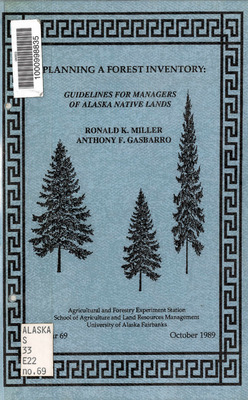
PLANNING A FOREST INVENTORY: GUIDELINES FOR MANAGERS OF ALASKA NATIVE LANDS
Ronald K. Miller and Anthony F. Gasbarro
-
Summary of Vegetable Variety Trials, Fairbanks, Alaska, 1978-1985
Patricia Wagner, Grant Matheke, Donald H. Dinkel, and Marilyn Griffith
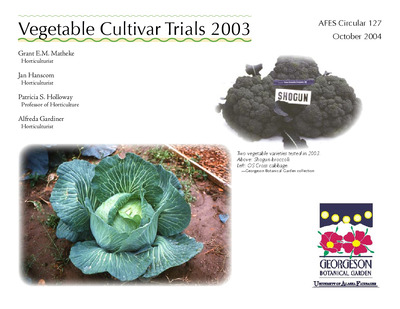
Selection of the appropriate cultivar (cultivated variety, referred to as a variety hereafter) is a major factor in determining the success or failure of that crop for commercial growers and home gardeners. Plant breeding has brought about vast improvements in crop productivity by incorporating disease resistance, increased yield potential and environmental adaptability into new varieties. Because the environment and growing season in Interior Alaska are much different from most other agricultural regions, it is difficult to predict how a new variety will perform here without actual testing. For instance, the long hours of daylight during the growing season are used to advantage by such varieties as O–S Cross cabbage and Shogun broccoli, which grow to extremely large size. However, long days may cause some varieties of crops such as radishes, beets, spinach, carrots, cauliflower and Chinese cabbage to bolt (form flower stalks) before forming a usable product. Long days may delay fruiting with some varieties of winter squash and melons. Another important aspect of the climate is the amount of heat received during the growing season (approximately 90 frost–free days in Fairbanks). Many varieties of warm–season crops such as sweet corn, tomatoes, peppers, and melons may not mature here because insufficient heat is accumulated during the growing season, even though the growing season is potentially long enough. The use of cultural techniques such as clear polyethylene row covers to increase air temperatures may enable adapted varieties to reach maturity. Soil temperature is another important factor in the adaptability of vegetable varieties to our climate. The relatively cool soil temperatures (reaching a maximum of 70 degrees Fahrenheit) are adequate for good growth with cool–season crops (in general, crops where the stems, leaves, immature flower buds or roots are eaten — for example, broccoli, lettuce and carrots), but severely limit the growth of warm–season crops (crops where, in general, the fruit is eaten). With cultural techniques such as use of clear plastic mulch to raise soil temperatures, and the use of adapted varieties, many warm–season crops can be grown here.
-
Recommended Vegetable Varieties for Interior Alaska
Patricia Wagner, Grant Matheke, and Steve Hemshrot
-
POTATO VARIETY PERFORMANCE ALASKA 1987
Donald E. Carling and Peter Rissi
A comparative yield trial with thirty-six named varieties and numbered selections of potatoes was conducted at the University of Alaska Fairbanks, Agricultural and Forestry Experiment Station’s (AFES) Palmer Research Center during the 1987 growing season. The trial was conducted at the Matanuska Research Farm, located 6 miles west o f Palmer on Trunk Road. Nonirrigated trials have been conducted each year beginning in 1982, and irrigated trials were begun in 1985. Results of previous trials have been recorded in Circulars 49, 54, and 58, available at the Agricultural and Forestry Experiment Station offices in Fairbanks and Palmer. Varieties with a history of commercial production in the Matanuska Valley (including 'Alaska 114', 'Bakeking', 'Green Mountain', 'Kennebec', and 'Superior') are included and serve as a comparative base for newly developed varieties, numbered selections, or older varieties that heretofore have not been tested at this location. Varieties that com pare favorably with the above-listed standards may warrant some consideration by commercial growers. Also included in this report are the results of abbreviated versions of the AFES potato yield trial that were conducted by cooperating individuals and agencies at nine locations throughout the state.
-
THE ROLE OF IRRADIATION IN FOOD PROCESSING: CAN IT BENEFIT ALASKA?
Ruthann B. Swanson, Carol E. Lewis, Charlotte I. Hok, Debendra K. Das, John P. Zarling, William G. Workman, and Robert R. Logan
Treatment of Alaska-produced food products by ionizing radiation may benefit the seafood and agricultural industries and the Alaskan consumer. A feasibility study to evaluate the potential social and economic benefits and risks as well as the costs of using the process in Alaska on Alaskan products is being coordinated by the Institute of Northern Engineering. A research and development project to determine effects on the quality o f Alaskan products could be the next phase in the introduction o f a new food-preservation technique to Alaska.
-
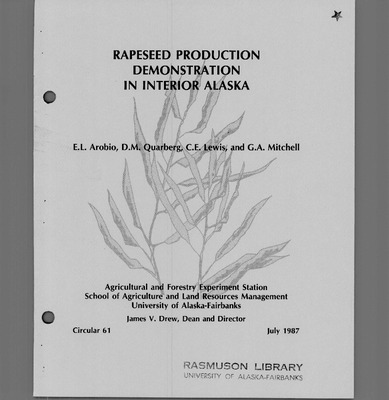
RAPESEED PRODUCTION DEMONSTRATION IN INTERIOR ALASKA
E.L. Arobio, D.M. Quarberg, C.E. Lewis, and G.A. Mitchell
Rapeseed is the oil-bearing seed from plants of the Brassica genus. It grows well in the cooler agricultural regions o f the world and for this reason has long been thought to be a promising crop for interior Alaska. Rapeseed has been grow n in India and China for thousands and in Europe for hundreds o f years (Bolton 1980). Its history in North America began in 1943 when a small quantity of seed was imported into Canada. In recent years, its production has been largely that from cultivars bred for production of seed low in erucic acid and glucosinolate content. Seed from these cultivars is referred to by the Canadian Rapeseed Industry as canola. Its qualities are desirable in the edible-oil market, the largest market for products from canola seed. Canada is now one of the world’s largest producers and is the world’s largest exporter o f rapeseed. The meal that remains after oil extraction is high in protein and is used as a supplement in livestock feeds. The whole seed can also be used as a feed supplement. Some cultivars o f rapeseed that are high in erucic acid are also grow n for use in plastics and industrial oils (Genser and Eskin 1979). In addition, forage rapeseed cultivars can be used as livestock pasture. Research concerning the production of rapeseed has been addressed by the Agricultural and Forestry Experiment Station (AFES) for several years. O f specific concern has been the selection of appropriate cultivars (Wooding et al. 1978), response to various nitrogen (N) rates, row spacings and seeding rates (Lewis and Knight 1987), performance in reduced-tillage systems in rotation with barley (Knight and Lewis 1986), the potential for frost seeding in late fall and early spring (Knight and Sparrow 1984) and response to boron (B) to enhance early seed ripening (Wooding 1985). In addition, in 1978 the Cooperative Extension Service (CES) began conducting seminars on production o f rapeseed for Alaskan farmers. In 1979 and 1980, CES employed Dr. J.L . Bolton, a rapeseed specialist from the University o f Alberta, in an extension capacity to give technical assistance to farmers on producing rapeseed (Bolton 1980).
-
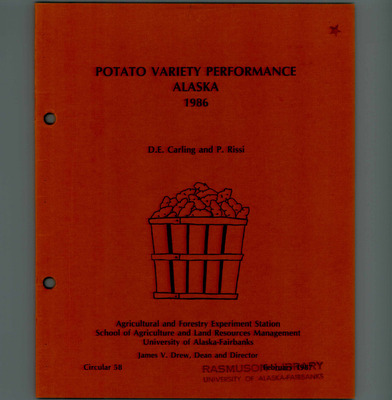
POTATO VARIETY PERFORMANCE ALASKA 1986
D.E. Carling and P. Rissi
A comparative yield trial with 44 named varieties and numbered selections of potatoes was conducted at the University of Alaska-Fairbanks, Agricultural and Forestry Experiment Station’s (AFES) Palmer Research Center during the 1986 growing season. This yield trial is the continuation of a potato variety testing program initiated in 1982. The trial again was conducted at the Matanuska Research Farm, located on Trunk Road near Palmer. Nonirrigated trials have been conducted each year beginning in 1982, but irrigated trials were not initiated until 1985. Results of previous trials are recorded in Circulars 49 and 54, available at the Agricultural and Forestry Experiment Station offices in Fairbanks and Palmer. As in past years, varieties with long production histories in Alaska (Alaska 114, Bakeking, Green Mountain, Kennebec, Superior) are included and serve as a comparative base for newly developed varieties or older varieties that in the past have escaped testing at this location. Varieties that compare favorably with the above listed standards may warrant some consideration by commercial growers. In continuance of a program that was initiated in 1985, abbreviated versions of the AFES potato yield trial were conducted at locations in various parts of the state. These off-station trials again were made possible by the willingness of cooperators to plant, tend and harvest the crop. The seven off-station sites include several where comparative testing of potato varieties has not been reported previously.
-
Alaska’s Reindeer Program 1986 Report of the University of Alaska Reindeer Program: 1986 Report the Applied Reindeer Research Project
Alan C. Epps
The University o f Alaska-Fairbanks reindeer program has existed under its current organizational framework since 1981. Program guidance across the three functions o f research, extension, and instruction continues to meet with support both internal and external to the university. The program ’s user group, the Alaska Reindeer Herders Association, is an ideal Land Grant/Sea Grant recipient for such guidance. Several major issues outlined by the Reindeer Herders Association’s first five-year plan have been addressed during the past few years. In most cases the university’s input has helped to resolve the association’s concerns. Currently a new five-year plan is being developed, and the university’s reindeer program is responding by redirecting its efforts toward emerging issues. This report identifies recent accomplishments in the reindeer program , continuing efforts, and projected areas of future effort.
-

Gardening With Annual Flowers In Interior Alaska
Pat Wagner, Marilyn Griffith, and Grant Matheke
This list of recommended annual flower varieties includes information on several hundred annual flower cultivars. The recommended varieties were selected from flowers grown in 1985 and 1986 at the Agricultural and Forestry Experiment Station Farm at the University of Alaska- Fairbanks. While this is by no means a complete listing of varieties suitable for Interior gardens, it does reflect many years of experience in annual flower production at the AFES farm. The methods used to evaluate the flowers and definitions for terms used in the listing can be found under Data Collection.
-
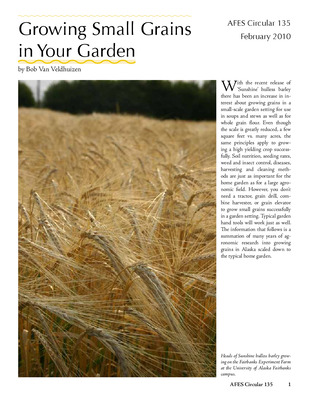
PERFORMANCE of CEREAL CROPS in the TANANA RIVER VALLEY of ALASKA 1986
F.J. Wooding, J.T. Hanscom, and R.M. Van Veldhuizen
This is the eighth publication of grain performance trials in the Tanana River Valley. The first, published 7 years ago, included the results of spring cereal-variety tests conducted at Fairbanks and Delta Junction during the 1978 and 1979 growing seasons. Beginning in 1980, the variety-test results were annual publications. This report, like last year’s, is a shorter version than the first 6 publications of the series. It reflects continued budget constraints caused by Alaska’s sagging economy.
-
A Survey of the Alaska Greenhouse Industry and Related Enterprises Results and Analysis
Deborah M. Brown, Patricia S. Holloway, and Carla A. Kirts
A list of commercial greenhouses, nurseries, interiorscape businesses, landscape contractors, florist businesses, and variety stores that sell plant products was developed in order to determine the scope of the horticulture industry in Alaska. The list identified 155 greenhouse, nursery, and interiorscape businesses along with 304 landscape contractors, 80 florist businesses, and 41 variety stores that sell plants. A questionnaire was used to determine the status of these types of enterprises including location, square footage of facilities, source of heating and lighting for greenhouses, number and type of employees, products purchased and/or produced, and total gross sales. The number of businesses responding to this survey totaled 135 and included 54 greenhouses and/or nurseries, 4 interiorscape businesses, 44 landscape contractors, 19 florists, and 14 variety stores. More than half of the greenhouse, nursery, and interiorscape businesses were started after 1976, and 40.4 percent of the businesses began as a hobby that was expanded into a commercial enterprise. Nearly all of the greenhouse operations had Quonset or even-span gable greenhouses covered with corrugated fiberglass or double-layer polyethylene. Most greenhouses were heated with natural gas or heating oil. The businesses that responded had a total of 413,476 square feet (ft2) of year-round heated greenhouse space, 266,900 ft2 of seasonally heated space, and 18,369 ft2 of nonheated space. The most commonly grown crops were flowering annual and vegetable bedding plants. The number of employees at the businesses with greenhouses was 678: 152 year-round, full-time employees; 85 year-round, part-time employees; and 441 seasonal employees, 150 of whom were hired only during the transplanting season. The estimated number of jobs available statewide in greenhouse, nursery, and interiorscape businesses totaled 1,559. Forty-four percent of the businesses with greenhouses reported gross sales of less than $25,000, while 5 businesses exceeded $1 million in gross sales. The estimated total gross sales for greenhouse, nursery, and interiorscape businesses in Alaska was $24,387,500.
-
POTATO VARIETY PERFORMANCE ALASKA 1985
D.E. Carling and P. Rissi
Comparative yield suitable, or potentially suitable, commercial production potato varieties were conducted during the 1985 growing season by the University of Alaska-Fairbanks, Agricultural and Forestry Experiment Station, Palmer Research Center. Forty names and numbered varieties were included in the 1985 trial. Numbered varieties originated in the potato-breeding program of Dr. C. H. Dearborn.
-
Observed Scarification Rates And Contract Costs For the TTS-35 Disc Trencher in Interior Alaska
Allen P. Richmond and Thomas Malone
The regeneration of interior Alaska’s commercial forest lands is mandated by Alaska’s Forest Resources and Practices Act (1979). This act requires that regeneration be established adequate to ensure a sustained yield on forested lands from which the timber has been harvested. Post-logging regeneration efforts now are aimed at exposing mineral soil for the natural seeding of white spruce. Soil exposure has been accomplished by blade scarifying with a crawler tractor which provides large seed sites or by using a Bracke-type patch scarifier which produces small seed sites of about 2 ft2. Arlidge (1967) reports that larger seedbeds have greater regeneration success than smaller ones. Some researchers have found that the regeneration of the larger plots may be too successful, requiring weeding and precommercial thinning to bring stocking to satisfactory levels (Zasada and Grigal 1978). The Alaska Division of Forestry (DOF) has not been satisfied with the cost or effectiveness of either of these site-preparation practices.
-
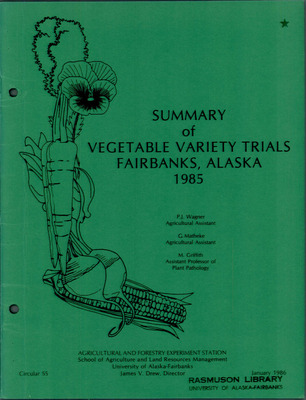
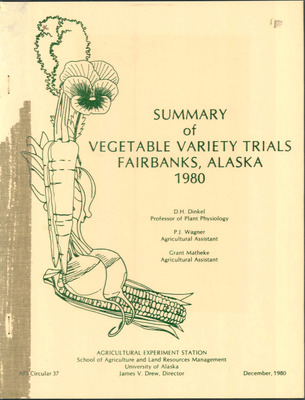
SUMMARY of VEGETABLE VARIETY TRIALS FAIRBANKS, ALASKA 1985
P.J. Wagner, G. Matheke, and M. Griffith
This report summarizes evaluations of vegetable varieties conducted by the Horticultural Research Program of the University of Alaska-Fairbanks. The objective of this research is to select varieties of vegetables that are adapted to the environment of interior Alaska. Vegetable crops whose adaptability may be improved through development of improved cultural techniques are also identified. The selection effort is directed at finding varieties useful to both commercial growers and home gardeners. Varieties are chosen for inclusion in the variety tests on the basis of their description, the latitude of origin, and the record of the plant-breeding programs for producing kinds that have previously been found adapted. Standard recommended varieties are included in the trials for comparison.
Printing is not supported at the primary Gallery Thumbnail page. Please first navigate to a specific Image before printing.