



-
Extreme Northern Acclimatization in Biennial Yellow Sweetclover (Melilotus officinalis) at the Arctic Circle
Leslie J. Klebesadel
Biennial sweetclovers (Melilotus spp.) are among the most winter-hardy of the legumes used as forage crops (Bula and Smith 1954; Gorz and Smith 1973; Hodgson and Bula 1956; Klebesadel 1971b, 1980). Common strains and cultivars of both yellow-flowered (M. officinalis [L.] Lam.) and white-flowered (M. alba Desr.) species are grown extensively in the Middle West and Great Plains areas of the United States (Gorz and Smith 1973), and the prairie provinces of Canada (Greenshields 1957). However, due to inadequate winter hardiness in Alaska of strains currently available (Hodgson and Bula 1956; Irwin 1945; Klebesadel 1971b, 1980), sweetclovers from other areas are not dependable for use as biennials in southcentral Alaska.
-
Morphological, Physiological, and Winterhardiness Comparisons Among Latitudinal Ecotypes of Biennial Sweetclover (Melilotus species) in Subarctic Alaska
Leslie J. Klebesadel
Objectives of this study were to compare, within two species of biennial sweetclover, several morphological and physiological characteristics of strains adapted to a wide range of latitudes and to relate those characteristics to winter survival and forage production in subarctic Alaska. All experiments were conducted at the University of Alaska’s Matanuska Research Farm (61.6°N) near Palmer in southcentral Alaska.
-
Seasonal Distribution of Forage Yield and Winter Hardiness of Grasses from Diverse Latitudinal Origins Harvested Four Times Per Year in Southcentral Alaska
Leslie J. Klebesadel
Relatively short growing seasons at subarctic latitudes require maximum efficiencies in production of forages during the brief growing period. This is necessary to provide adequately for livestock feeding requirements both during the growing season and for preserved forages for use during the relatively longer infeeding period. As elsewhere, forages in Alaska are utilized in several ways; these include (a) usually two harvests per year for preservation as silage, haylage, or hay, (b) more frequent harvests for green-chop feeding, and (c) pasturing rotationally or continuously. Various crop species utilized for forage differ in growth characteristics as well as in their responses to various harvest procedures and schedules; therefore it is understandable that a number of species can be advantageously employed for forage production in Alaska, each to fulfill ideally one of the several ways that forages are utilized. Another limitation affecting forage production in the far north is the modest number of useful perennial legume and grass species and strains adequately winter- hardy to persist dependably under northern climatic constraints (Klebesadel 1970, 1971, 1985; Klebesadel et al. 1964; Wilton et al. 1966).
-
Bromegrass in Alaska. I.Winter Survival and Forage Productivity of Bromus Species, Types, and Cultivars as Related to Latitudinal Adaptation
Leslie J. Klebesadel and D. J. Helm
This report summarizes seven separate field experiments, conducted over more than two decades at the University of Alaska’s Matanuska Research Farm, that compared strains within three bromegrass (Bromus) species for winter hardiness and forage production. Species were (a) smooth bromegrass (B. inermis Leyss.), (b) native Alaskan pumpelly bromegrass (B. pumpellianus Scribn.), and (c) meadow bromegrass (B. biebersteinii Roem. and Schult.), a species native to southwestern Asia.
-
Relationship of Latitude-of-Origin to Winter Survival and to Forage and Seed Yields of Wheatgrass (Agropyron species) in Subarctic Alaska
Leslie J. Klebesadel and D. J. Helm
Five field experiments evaluating and comparing numerous grasses were conducted over seven years at the Matanuska Research Farm (61.6°N) near Palmer in southcentral Alaska. Grasses were 34 strains within 14 species of wheatgrass (Agropyron) derived from various geographic areas spanning 32 degrees of latitude; also included were the intergeneric hybrid Agroelymus palmerensis Lepage, Siberian wildrye (Elymus sibiricus L.), two bromegrass (Bromus) cultivars, and one timothy (Phleum pratense L.) cultivar. They were grown in broadcast-seeded plots for forage (two cuts per year), in drilled rows for seed production, and as individual plants in rows for winter-survival determinations.
-
Performance of Indigenous and Introduced Slender Wheatgrass in Alaska, and Presumed Evidence of Ecotypic Evolution
Leslie J. Klebesadel
Objectives of this study were to evaluate forage and seed production, winter hardiness, and stand longevity of several collections of native Alaskan slender wheatgrass (Agropyron trachycaulum (Link) Malte), and to compare their performance with introduced cultivars of slender wheatgrass and standard Alaska forage grasses in other species. Eight experiments at the Matanuska Research Farm (61.6° N. Lat.) near Palmer, Alaska demonstrated the superior winter hardiness and forage productivity of indigenous Alaskan slender wheatgrass lines (collected from 62° to 67° N. Lat.) over introduced cultivars ‘Revenue’ (originating at 52° to 53° N) from Saskatchewan and ‘Primar’ (adapted at 46° to 48° N) from the Pacific Northwest.
-
Reed Canarygrass in Alaska
Leslie J. Klebesadel and Stephen M. Dofing
North American strains of reed canarygrass (Phalaris arundinacea L.) frequently sustain severe winter injury or total winterkill in southcentral Alaska. Objectives of this study were to compare reed canarygrass strains adapted to extreme northern latitudes in Europe with North American cultivars for winter-hardiness and forage production in Alaska.
-
Water Retention, Bulk Density, Particle Size, and Thermal and Hydraulic Conductivity of Arable Soils in Interior Alaska
Brenton S. Sharratt
The relative proportion of liquid, gas, and solid as constituents of soil depends on factors such as climate, biological activity, and management practices. Therefore, the physical state of soil is a dynamic process, changing with time and position in the profile. Temperature, thermal and hydraulic conductivity, density, and water content are some quantitative properties characterizing the physical state of soil. These properties are important in describing soil processes such as water and heat flow, movement of chemicals, biological activity, and erosion. Water in the soil is subject to a number of forces resulting from the attraction of the soil matrix for water and presence of solutes and gravity. The energy status of water-the sum of these forces-is termed water potential. Processes such as evaporation and plant water uptake are governed by the gradient in water potential in the soil and across the root-soil interface, respectively. The term water potential is more descriptive of the soil water status than water content as movement of water is in response to differences in water potential.
-
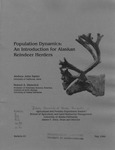
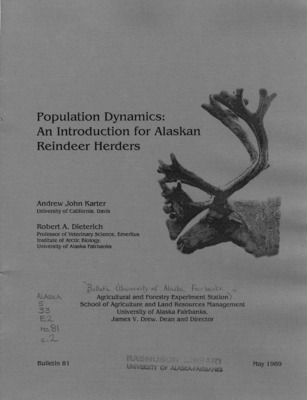
Population Dynamics: An Introduction for Alaskan Reindeer Herders
Andrew John Karter and Robert A. Dieterich
This bulletin will try to give a general background about several aspects of population dynamics that are of great importance to reindeer herders all over the world: the problems of population explosion, crash and decimation by overharvest.
-
Effects of Nitrogen and Phosphorus Fertilization on Yield and Protein Content of Oat Forage at Point MacKenzie
William W. Mitchell
One of the principal forages grown at Point MacKenzie dairy project about 40 miles southwest of Palmer in Southcentral Alaska is oats. Soils at Point MacKenzie are moderately to strongly acidic, ranging in pH from about 5.0-6.0, thus promoting the use of acid-tolerant plants such as oats. These soils have a moderately volcanic ash content whose weathered products have a high affinity for phosphorous (Ping and Michaelson, 1986; Michaelson and Ping, 1986). Soil depth varies from shallow to moderately deep and can be a critical factor during droughty periods. The research reported here is a continuance of previous work at Point MacKenzie that has provided information on yield and response of oats to fertilizer treatments (Mitchell, 1983; Michaelson et al., 1984). Two series of trials were conducted employing different nitrogen and phosphorous rates with one of the series also testing different times of harvest. This report is concerned with the effect of these treatments and crude protein content in Toral oats.
-
Yield and Quality of Timothy in Southcentral Alaska
William W. Mitchell
Timothy (Phleum pratense) is the major perennial forage seeded on strongly acidic soils in southcentral Alaska. It is an important forage grass on the Kenai Peninsula and in the Susitna Valley. Bromegrass (Bromus inermis) is more commonly used on the moderately acidic soils of the Matanuska valley. Timothy is also used to some extent in the Tanana Valley of interior Alaska. Recently it has assumed an increasingly important role in forage programs of dairy farms and hay growers in the Pt. MacKenzie Agricultural Project northwest of Anchorage.
-
Characteristics and Fertility Status of Soils and Minesoils in Selected Areas of Usibelli Coal Mine, Healy, Alaska
Chien-Lu Ping and Kevin J. Kaija
Alaska has been proven to contain not only bountiful oil and gas reserves. but also vast coal fields occurring from the southcentral coastline to the Interior and the Arctic zone to the north. Because of concerns for stable sources of energy, particularly by the energy-short, industrial nations of the Orient, more exploration and stripmining for coal can be expected in the near future. Therefore, it is important to know the consequences of large-area soil disturbances tn the subarctic and bow the effects of man's reclamation efforts and natural processes combine in reestablishing vegetative community. The culmination or synthesis of these processes is soil development and is of great importance in successful stripmine reclamation. The Usibelli Coal Mine Company in the Healy coal field, located in Interior Alaska. commenced stripmining in 1943. Its operation has been continuous, moving from area to area, for the last 40 years. Stripmining requires the excavation of overburden and subsequent redeposition, therefore the Healy operation has exposed minespoils from different strata on various topography. In 1972, the Usibelli Coal Mine company initiated a reclamation program and, over the ensuing l0 years, has seeded and fertilized over 2000 acres. Nevertheless, there remain barren areas and areas undergoing natural revegetation. Additionally, experimental trials in seeding and fertilization were started in 1980. Large areas of intact native plant communities adjoin the mined areas. The company property provides opportunities to study the processes of soil formation under different sets of conditions. The objectives of this study were to (1) characterize the soils on the mine lease area for baseline data, (2) to characterize the mine soils with various history, (3) to study the process of soil formation under different sets of conditions, and (4) to evaluate the nutrient levels of both soil and minesoils to form a basis for establishing soil-handling requirements to promote reclamation practices.
-

Weed Control in Annual Strawberries Grown with Plastic Mulch: Efficacy, Phytotoxicity, and Soil Persistence Studies
Martha Farris and Jeffery S. Conn
Cool soil temperatures in Alaska are a limiting factor for many crops. Clear plastic mulch has been shown to increase soil temperatures, and use of this mulch has allowed the production of many warm season crops farther north than they could otherwise be grown. Clear plastic mulch and row covers are used in interior Alaska to promote early growth and increase yields of strawberries.
-
Effects of Nitrogen, Lime, and Boron on Candle Rape Grown in the Trapper Creek and Pt. MacKenzie Areas of Southcentral Alaska
Winston M. Laughlin, Glenn R. Smith, and Mary Ann Peters
When growers in the Susitna Valley and later in the Pt. MacKenzie area of southcentral Alaska inquired as to the feasibility of growing rapeseed, we decided to determine the crops suitability and performance by conducting a field experiment. Bolton (1980) had attempted to predict the feasibility of producing rapeseed in Alaska's interior, but no research had been done in southcentral Alaska. We conducted one study from 1979 through 1981 on Rabideux silt loam (pH 5.1) near Trapper Creek and another from 1982 through 1984 on Kashwitna silt loam (pH 5.4) on the University of Alaska' s research tract in the Pt. MacKenzie area. The first area had been cleared prior to 197 8. This area was rototilled and roots removed in September 1978. The second area was on a tract cleared during the winter of 1981. After clearing, rotary plowing was done twice on the area. During the summer of 1981, roots were removed , and a field cultivator was used twice to loosen and bring roots to the surface.
-
Effects of Potassium, Sulfur, Nitrogen Rate, And Nitrogen Source on Bromegrass Forage Yield and Composition
Winston M. Laughlin, Glenn R. Smith, and Mary Ann Peters
Production of adequate , high-quality forage is essential for Alaska's livestock industry. Smooth bromegrass (Bromus inermis) is the dominant and most dependable perennial forage crop in the Matanuska Valley and other areas of Alaska. Four areas of Knik silt loam on the University of Alaska's Matanuska Research Farm near Palmer were seeded to bromegrass and were used over a period of 18 years to determine the need of high-yielding bromegrass for applications of potassium (K) and sulfur (S). A bromegrass field on the Woods estate two miles south of Palmer was selected in 1976 for a study comparing three rates of two nitrogen (N) sources with and without S. The soil type was Bodenburg silt loam.
-
Influence of Nitrogen Rate, Nitrogen Source, and Phosphorus Rate on Native Bluejoint Crass Yield and Composition on the Lower Kenai Peninsula
Winston M. Laughlin, Glenn R. Smith, and Mary Ann Peters
Properly managed native bluejoint grass [Calamagrostis canadensis (Michx.) Beauv .], the dominant grass on the Kenai Peninsula (Laughlin et al. 1984), is important for supplying supplemental forage for winter feeding of livestock. This 11-year study was undertaken to determine responses of native blue joint to two rates of nitrogen (N) supplied by ammonium nitrate (AN) , urea, and two rates of phosphorus (P) on Kachemak silt loam at two locations on the lower Kenai Peninsula.
-
The Economics of Barley Production in the Delta Junction Area of Interior Alaska
Carol E. Lewis, Edward L. Arobio, and Cathy A. Birklid
The discovery of oil at Prudhoe Bay on the north slope of Alaska and the subsequent initial lease sale for rights to drill for oil on state land marked the beginning of a new era in the economy of the state. Construction of the trans-Alaska pipeline to carry oil 860 miles from the northern coast to the port of Valdez brought jobs to the state and increased personal income for many residents. When oil began to flow, the state began to receive revenues from royalty oil sales. Wealth from oil revenues made it possible for the state to support the development of Alaska's renewable resources. One of the resources considered was land which had been classified as having potential for production of agricultural products . There had been attempts in the past by the Federal and state governments to increase substantially agricultural production in Alaska, but none were completely successful (Stone 1950, Burton 1971, Snodgrass et a!. 1982, Lewis et al. 1987) .
-
Revegetation Research on Coal Mine Overburden Materials in Interior to Southcentral Alaska
Wm. W. Mitchell
Plant material, and planting and fertilizer scheduling studies were conducted on coal mine overburden materials in the Nenana coal field at the Usibelli coal mine near Healy, in the Matanuska coal field at the Jonesville mine north of Anchorage, and at two test pits in the Beluga coal field west of Anchorage. With proper fertilization a number of grasses were found to maintain adequate cover for soil stabilization purposes over the five-to-seven-years of the various trials. The consistently good performers were entries of tufted hairgrass, Bering hairgrass, red fescue, hard fescue polar-grass, and Kentucky bluegrass. Most were native to Alaska. Some northern -selected materials of alfalfa did well on sites below timberline with near neutral soils. Fertilizer responses and indicated nutrient requirements indicated a preferred schedule of fertilizer applications in the first and third, and possibly fifth or sixth growing years. Seedings conducted from spring, in late May, into summer, in late July, produced equally satisfactory results.
-
Non-Market Valuation of Open Space and Other Amenities Associated with Retention of Lands in Agricultural Use
Steven D. Beasley, William G. Workman, and Nancy A. Williams
The most productive farmland in southcentral Alaska is currently under intense development pressure due to rapid population increases and consequential increases in demand for suburban housing. This study utilizes a contingent valuation iterative bidding game to estimate the willingness of Matanuska-Susitna Borough residents to pay to preserve open space and other historical/environmental amenities associated with farming activities. Determinants of consumer behavior are addressed as well as total benefits and costs of various posited development scenarios. This information may be useful to policymakers assessing actions designed to purchase development rights from Matanuska-Susitna farmers.
-
An Evaluation of Herbicides for Control of Wild Oats in Barley: Efficacy, Phytotoxicity, and Barley Variety Susceptibility Studies
Jeffrey S. Conn
The control of wild oats (Avena Jatua L.) in Alaskan spring-planted barley was investigated in a series of experiments conducted from 1981-1984. Rates and times of applications of triallate (a preemergence, soil-incorporated herbicide), diclofop, barban, and difenzoquat (postemergence herbicides) were investigated in relation to control of wild oats and barley yield in 1981-1982. Because of very high wild oats populations. none of the herbicides controlled wild oats to the point of· allowing a barley harvest. Generally, wild oats were best controlled when herbicides were applied at an early growth stage and at the highest application rates. Control of wild oats with triallate was the same whether incorporated using parallel or perpendicular passes of a spike-tooth harrow. In 1983-84 both single herbicide treatments and combinations of herbicides were studied. Barban, diclofop, and difenzoquat were applied alone or with triallate applied in the fall or spring in emulsifiable concentrate or granular formulation. Wild oats population levels were lower in these 2 years, and applications of even single herbicides provided good wild oats control. Of the individual herbicides, diclofop provided the best control of wild oats. In general, when triallate was applied in conjunction with diclofop, barban, or difenzoquat, control of wild oats was better and higher barley yields were obtained than when a single wild oats herbicide was applied. When triallate was applied in the fall, the granular formulation provided better control of wild oats than the emulsifiable formulation. In a study of the response of eight barley varieties ('Eero', 'Paavo', 'Galt', 'Otra', 'Otal', 'Datal', 'Udal', 'Weal') to high rates and late times of application of the four herbicides, none of the varieties were differentially susceptible. Diclofop decreased heights of all varieties and decreased test weights.
-
Toward the Integration of Economics and Outdoor Recreation Management
Alan Jubenville, Scott C. Matulich, and William G. Workman
The general theme of this bulletin is that improved management of public-sector recreational resources is a multidisciplinary task. To this end, we attempt to integrate elements of outdoor recreation management theory and economics. The bulletin is written for both resource managers and researchers. For the former, our intent is to emphasize the importance of being aware of economic implications-at least conceptually-of management actions that influence the character and availability of recreational opportunities. To researchers involved in developing recreation management theory, we draw attention to the parallel between recreation management theory and the traditional managerial economic model of the firm. To economists, particularly those involved in developing and applying nonmarket valuation techniques, we draw attention to the types of decisions faced by resource managers. We argue that the most important resource allocation issues are of the incremental variety, so nonmarket valuation should also yield incremental values. These values alone, however, are not sufficient economic input into rational public choice analysis. The missing link , or nexus, between outdoor recreation management theory and economic analysis is the integration of supply and demand, as called for by traditional managerial economics. Collaborative research to develop recreation supply response functions akin to agricultural production functions is an essential step that is missing from both literatures. Theoretical and applied work assume greater practical importance if they feed information into this broadened framework. It is our hope that this bulletin will bring the disciplines closer to that realization.
-
Perennial Grass Trials for Forage Purposes In Three Areas of Southcentral Alaska
William W. Mitchell
Forage trials of seeded perennial grasses were conducted at four sites in three areas of southcentral Alaska on soils with pH readings generally below 5.5 (down to 4 .35) . Three trials were at forested locations and one at a subalpine site. Each trial was sustained for three to five harvest years under a two-harvest system. 'Engmo' timothy (Phleum pratense) , the standard forage grass on strongly acidic soils in the region, equaled or, more often , exceeded the other grasses in first-harvest yields, but often was surpassed in second-harvest yields. Grasses often substantially exceeding timothy in second-harvest yields included reed canarygrass (Phalaris arundinacea) and entries of tufted hairgrass (Deschampsia caespitosa) and Bering hairgrass (D. beringensis), sometimes providing more total yield than timothy. Some red fescues (Festuca rubra) and 'Nugget' Kentucky bluegrass .(Poa pratensis) also tended to surpass timothy in second growth. Smooth bromegrass (Bromus inermis) failed at sites with soil pH below 5.3, but persisted at one site with pH varying from 5.3 to 5.7. 'Garrison' creeping foxtail (Alopecurus arundinaceus) also failed at these sites; its close relative meadow foxtail (A. pratensis), was better adapted to the strongly acidic sites. Indigenous polargrass (Arctagrostis latifolia) about equaled or surpassed timothy in yield at two of the sites, and bluejoint reedgrass (Calamagrostis canadensis) provided comparable but somewhat lower yields. Timothy tended to be higher in digestible dry matter than most grasses, but near to below average in CP, P, K, and Ca concentrations. Some deficiencies occurred in energy values (DDM) and, except for red fescue, in Ca concentrations of first-harvest herbage relative to the requirements of a growing 500-lb steer. Crude protein of second-harvest herbage was deficient for many grasses at two sites, and DDM was marginal to low for some, but especially for bluejoint reedgrass.
-
Biology and Management of White Spruce Seed Crops Reforestation in Subarctic Taiga Forests
J. Alden
Seed production is the most dramatic event in the life cycle of trees and is the first step in forest regeneration. Embryos of white spruce are fragile during germination, and they depend on vigorous seeds for survival and growth. Mortality of white spruce seeds and seedlings is high in northern forests because climate and microhabitat are often unfavorable for seed germination and seedling establishment. Large quantities of high-quality seed are required for natural and artificial regeneration of white spruce forests at high latitudes. The first chapter of this bulletin describes the reproductive process of white spruce and factors that affect cone and seed production and seed quality. Knowledge of the reproduction cycle and factors that affect seed production and quality of white spruce is essential for forecasting and managing seed crops. Evidence that white spruce is a genetically variable species in northern forests is summarized in the second chapter. This chapter includes recommendations for maintaining the gene pool of natural populations and for seed transfer in afforesting sites that do not have endemic populations. A procedure for delineating planting zones for adapted seed sources is described as an alternative for provisional seed zones that only reduce the risk of maladaptation from long-range seed transfer . The final chapter outlines steps in harvesting white spruce seed crops and can be used as a working manual . Practical procedures are described for evaluating quality and quantity of white spruce seed crops , certifying the geographic origin of seed parents , collecting cones , and processing seeds to mainatin viability for many years. The genetic structure of white spruce and the environment-embryology relationships that effect seed production and maturation have not been studied in detail . The need for research in the areas of genetics, biochemistry, physiology, and ecology is discussed in each chapter. The results of such research will help to improve seed yields and make the management of white spruce crops more profitable in Alaska and Yukon.
-
Protein Content and Nutritional Value of Grains Grown in Interior Alaska
F.M. Husby and F.J. Wooding
This report is presented in three sections: (1) agronomic factors influencing protein content of grains, (2) influence of cultural technique on protein quality and nutritional value of 'Finnaska' barley for growing pigs, and (3) summary and conclusions.
-
An Economic Analysis of Fluid Milk Processing in Alaska
Wayne C. Thomas and O. E. Schock
Alaskan fluid milk is processed for market by a two-firm industry. In Delta Junction, the Northern Lights Dairy obtains milk from two producers and services an Interior market from Delta to Fairbanks. In Anchorage , Matanuska Maid (M-M) obtains milk from II producers and markets its products largely in southcentral Alaska and , to a less extent, in Fairbanks. Direct competition between the two is minimal. The principal source of competition is preprocessed fluid milk shipped in from Puget Sound.
Printing is not supported at the primary Gallery Thumbnail page. Please first navigate to a specific Image before printing.