-
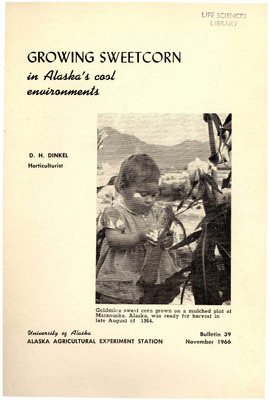
Growing Sweetcorn in Alaska's Cool Environments
D. H. Dinkel
Sweet corn can be grown in Alaska's cool environments by employing clear polyethylene mulch to raise soil temperatures. Rows should be run north and south, spaced about 5 feet apart for 4-foot wide mulch. Weeds can be controlled under clear polyethylene mulch by spraying with atrazine after seeding and before mulching.
-
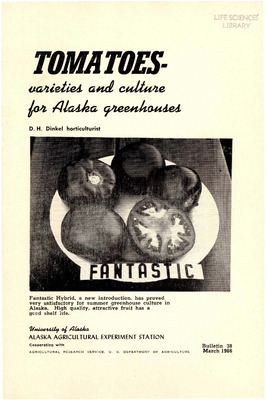
Tomatoes: Varieties and Culture for Alaska Greenhouses
D. H. Dinkel
Since 1949 considerable effort has been expended in finding tomato varieties satisfactory for summer production under glass in Alaska. At the same time needed cultural practices were developed from experience. These studies were focused chiefly on the demands of small , home-operated greenhouses, of which a great number have from time-to-time existed in the State. In late 1965 a large commercial greenhouse, planned for year-round production, started operations in the Kenai Peninsula. Little or no experience has accumulated in Alaska about winter production of fruit in such a structure. Information on adapted summer varieties may or may not prove helpful.
-
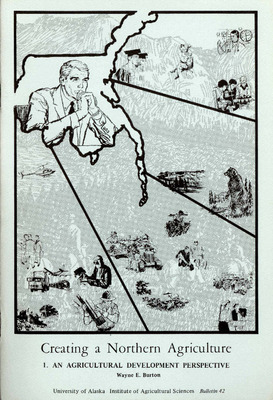
Creating a Northern Agriculture. I. An Agricultural Development Perspective
Wayne E. Burton
Alaskans now face a time of decision with regard to agriculture. In the past, national and state bureaucracies have largely ignored agriculture. It has existed merely as a foreign intrusion into the northern ecosystem, with its scope and success pitifully limited. While rural areas have needed agriculture for subsistence, urban Alaska has had no such need, so it is easy for "natural status" environmental interests to hamper the genesis of an agricultural environment. The public must realize that a planned development based on a new perspective can prevent discordant effects on the Alaska wilderness.
-
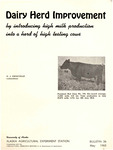
Dairy Herd Improvement
W. J. Sweetman
Milk and milk fat production have both been improved by crossing good Holstein or Red Dane bulls with Guernsey cows ( 1). The mature equivalent production ( M. E. ) for 365 days, 3 times milking of Holstein-Guernsey crosses is reported at 17,186 pounds of milk and 805 pounds of fat compared with their dams average of 10,897 pounds of milk and 555 pounds of fat. The Dane- Guernsey crosses averaged 18.149 pounds of milk and 803 pounds of fat as against their clams average of l].] 63 pounds of milk and 546 pounds of fat.
-
Financing Alaska's Farms
A. Dale Saunders
Analysis of financial records made available by 93 Alaska farmers and homesteaders and information provided by financing agencies shows that farm credit in 1960 had improved considerably since mid-decade. Although ample credit seemed available for existing production levels, little risk money was at hand for setting up new farms. If Alaska continues to grow at the 1960 rate an annual expansion of farm credit resources of $500,000 to $750,000 appears needed. A major problem facing lenders is to coordinate credit extension between agencies, observing limitations imposed by market demands for local products. Major complaints voiced by borrowers are that terms are still too short and that interest rates are excessive.
-
Chemical Sprout Control of Alaska Potatoes.
Curtis H. Dearborn
POTATOES sprout in 11 to 15 weeks after harvest if placed in storage where 'temperatures average 40° F or above. Prior to this, growth regulating substances within the tubers prevent sprouting. If potatoes are stored at room temperature (70° F or higher) their dormant period will be shorter, although differences in varieties are observed. Varieties also differ in habit of sprout growth*. Some develop long sprouts that are relatively easy to remove. Even so, a new crop of sprouts will grow again from the same eyes if storage temperatures remain above 40oF for ten days or more. In addition to the expense of desprouting, potatoes lose weight and their market appeal. Potatoes can be and are stored at 30° to 36° for nearly a year with very little sprouting. Cold storage at this temperature range has some disadvantages. For example, starches are converted to sugar within the tubers. These sugars give cooked potatoes a sweet taste objectionable to some people. Potatoes with a high sugar content are not suitable for chipping and french frying. Sometimes they can be reconditioned by storing at 60° to 70° for a month or more but this warmer environment starts sprouting. Potatoes sprouting extensively in bins (as illustrated in Figure 1) cannot be ventilated properly because sprouts fill the air spaces between tubers. Lack of air movement through the bin causes a low oxygen supply and black heart or b1ack patches soon appear within tubers (Figure 2). Sprouting is costly to Alaskans in that it reduces the number of potatoes meeting U.S. No. 1 grade and therefore reduces farm income.Sprouting is costly to Alaskan's potato industry because it weakens Alaska's competitive position for summer markets. Summer im}:orts of dormant potatoes often capture a large segment of the Alaskan potato market. When these studies were begun, workers in other regions (2, 4, 5, 9) had demonstrated several methods of chemical sprout control. These methods included field spraying of tops, dusfng or dipping of tubers moving into storage, and gas treatment with volatile substances distributed within binned potatoes. Chemicals that had given the best control were methyl ester of naphthaleneacetic acid (MENA), indoleacetic acid (IA), maleic hydrazide (MH) and isopropyl N-(3 chlorophenyl) carbamate (CIPC). In other states MH has become so popular that it has been recently sprayed from an airplane ( 1) and CIPC has been released as an aerosol or vapor (6) within the storage. Some evidence has been presented (3) showing that healing of tender skins and healing of tuber bruises is delayed by sprout inhibitors. Unwashed potatoes frequently carry enough mud or wet soil into storage to inhibit good air movement through the bin. While washing prior to storage eliminates this particular problem, little is known about the storage characteristics of washed treated tubers (10). The objectives of these sh1dies were to learn (1) if sprout inhibitor chemicals used in other regions also inhibit Sf)routing of potatoes grown in Alaska's environment, (2) what effect snrout inhibitors have on yield and quality, (3) when and at what rate the chemical should be applied, (4) how sprout inhibitor treated potatoes store at different temperatures, (5) if washing fieldtreated potatoes prior to storage influences keeping ability or modifies sprout inhibitor action.
-
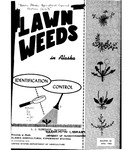
Lawn Weeds in Alaska
L.J. Klebesadel
Many different kinds of plants usually grow in close association with each other in nature. Woodlands, roadsides, mountain slopes, marshlands-almost all places not closely attended by man have their own complex plant associations. A lawn comprised of only one or a few grass species is an unnatural, artificial situation. Accordingly, lawns can be kept attractive only by diligent efforts to eliminate undesirable plants and to prevent the natural invasion of turfs by unwanted plants. This battle must be renewed each year. Knowledge of the habits and weaknesses of weeds enables the lawnkeeper to vanquish these foes in every encounter, usually with little expenditure of effort.
-
Fertilizer Practices for Bromegrass
Winston M. Laughlin
Smooth Bromegrass (Bromus inennis Leyss.) is the dominant and mos t dependable perennial forage crop grown in Alaska. Preliminary studies of the influence of fertilizers upon crude protein yields of bromegrass in Alaska were reported in 1953 ( 5) .1 Several additional fertilizer experiments on bromegrass stands established from northern-grown commercial seed have been conduct ed from 1952 to 196 0 and are reported here.
-
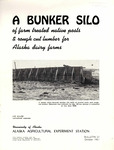
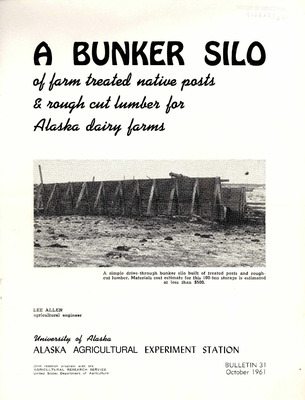
A Bunker Silo for Alaska Farms
Lee Allen
Farm storage of silage is essential in Alaska. Weather conditions make it nearly impossible to dry hay after early July. Economy of construction without sacrificing structural stability has been achieved in this bunker type silo. Locally available materials and simple construction technique s a r e all that are needed to produce an adequate bunker silo. Braced poles support the walls and absorb lateral loads, with the floor being subjected to simple vertical loading. Silos of this type serve the beginning dairy farmer until he is financially able to provide more convenient storage wherein less spoilage may be anticipated.
-
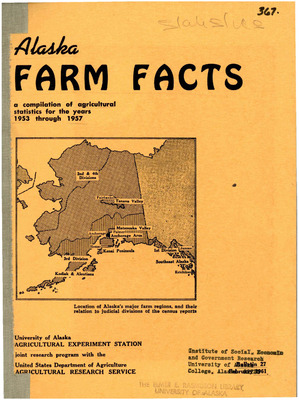
Alaska Farm Facts
N/A N/A
This publication brings together agricultural statistics for the five years of 1953 through 1957, and compares them with the 1950 Census of Agriculture. Information on population, retail food prices, transportation charges, military purchases, and farm p-rices is included. This compilation provides a fairly complete picture of the size, and certain changes and trends in Alaska's food producing industry. It may suggest adjustments needed to meet changing times, and will serve as a basis of comparison for future years.
-
Performance of 127 Potato Varieties in Alaska, 1951-1959
Curtis H. Dearborn
Potato varieties familiar to growers in other states behave differently when grown in this northern region. Geologically young soils, low soil temperatures, low moisture and many hours of daylight during the growing season provide an environment different from that in which many potato varieties were originally evaluated. The purpose of this bulletin is to show how potato varieties respond when grown in Alaska. It also describes and illustrates desirable and undesirable features of those varieties evaluated in Alaska. Of 127 varieties grown in the Matanuska and Tanana* valleys, only six are reooiiiD8nded. Two of these were developed especially for Alaska. Three other special purpose potatoes are also described. A condition unique to Alaska is its relative freedom from insects and diseases. Because of this nearly pest-tree environment, pesticide foliage sprays and dusts have not been used. Abnormalities of potato tops and tubers have been a response to local environmental conditions or to viruses contained in the seed pieces. Although vine growth habits are important, little mention is made of them. Vines of most imported patatoes conform quite well to descriptions published when a particular potato was originally introduced. The vine characteristics of healthy plants have been very uniform within varieties. Disease response is mentioned only when a variety shows marked resistance or susceptibility.
-
Better Forage for Alaska's Dairy Industry with Particular Reference to the Matanuska Valley.
W. J. Sweetman and A. L. Brundage
Dairy farming is well adapted to Alaska's environment. Continued expansion of dairying supplements other primary economic growth and development. High quality grass hay and grass and oat-pea silage can be efficiently grown in Alaska's Matanuska and Tanana Valleys and in other favorable sites. These roughages, supplemented by locally grown grain, can supply most nutrients needed by Alaska's dairy industry. Much skill is needed to grow good roughage. This report summarizes the results of forage research conducted in Alaska since 1948, and interprets them in terms of farm practices.
-
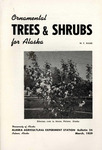
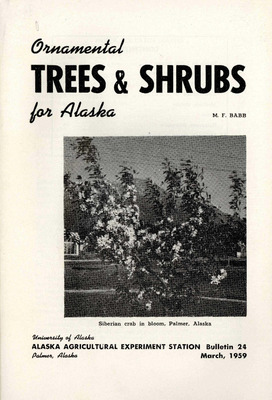
Ornamental Trees and Shrubs for Alaska
M. F. Babb
This bulletin summarizes findings from a nine year study of woody ornamentals in Alaska. Those familiar with such materials recognize that such a brief period of experimentation yields no hard and fast conclusions, even though supplemented by critical observation. and by the experience of those who have the advantage of a longer residence here.
-
Performance of Fifty-Eight Tomato Varieties Under Greenhouse Culture in Alaska, 1949-1958
M. F. Babb
Tomato variety evaluations herein reported were undertaken to discover those most suitable for greenhouse culture in Alaska. Findings are presented in table 1. They are listed as total yields, and yields of U.S.No.l grade fruits per plant. Because the individual plant yields are greatly influenced by spacing, yields per square foot of greenhouse area are also reported. Yields per square foot can be compared with results of similar tests made elsewhere. They provide a standard by which potential growers may predict yields that might be grown in their own greenhouses.
-
Propagation of Woody Plants by Seed
M. F. Babb
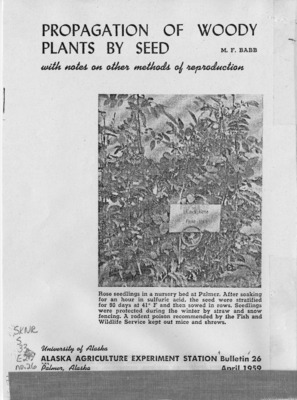
A majority of the plants discussed in his publication are usually propagated by seed sown in the fall, or stratified in preparation for spring sowing. However, the seed of some may be planted without special treatment and still others are normally propagated by vegetative means. Table 1 indicates the general methods by which the species of each genera may be propagated. No attempt has been made to make this table all-inclusive. Some genera are of limited usefulness in Alaska. The table actually represents material acquired by the Alaska Agricultural Experiment Station, or sent sent to the Station for evaluation during the past eight years.
-
Tree Fruits for Alaska
M. F. Babb
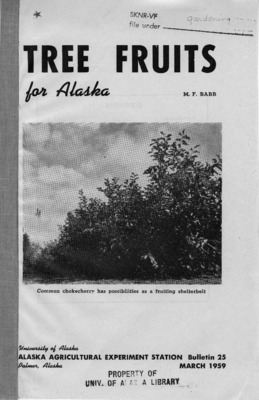
This circular has been prepared with three major objectives in mind. 1) to define areas in which tree fruit culture is possible in Alaska and the types of fruit that can be grown in each, 2) to name and describe the varieties that at the present time seem more desirable for planting in Alaska, and 3) to point out the m?-in problems limiting tree fruit culture and suggest, rather than discuss, the probable means by which they may one day be solved. Fulfilling the first two of these objectives was a relatively simple matter, since it was only a matter of defining and description. But the third objective was not-and is not-so easy of attainment. In what may be an oversimplification, it has been stated that there are two main problems, winter hardiness and earliness of maturity, and methods have been indicated by which, it is believed, each may be overcome. However the very problems themselves are not as simple as they have been made to appear. That of winter hardiness is one of the most widely debated and investigated subject in plant science. And the characterization of the second as "earliness of maturity" makes it sound too simple, for actually the factor involved, as it applies to fruit growing in Alaska is aiding or hastening natural earliness of maturity. This is a far more complex matter. In describing the solutions of these problems, mention has been made of such factors as pruning and training, fertilization, furnishing protection to increase available heat, and limiting the water supply to the trees during the period of fruit maturation. Each of these subjects has also been the subject of numerous investigations and some of them have been the subject of textbooks. The discussion of them here has been limited to simple statements as to their merit in achieving specific objectives. Most of the statements made are based on research in Alaska. In one particular, however, they have knowingly been extended beyond the domain of research-supported conclusion. This is in advocating the withholding Qr decreasing water available to the trees during the maturation of the fruit. Some will disagree with this recommendation, for it runs counter to what is considered good orchard management in commercial fruit producing regions of the world. In these an ample water supply is advocated for this period to increase fruit size and heighten, though not to increase, coloration. In Alaska both considerations should be waived in favor of obtaining reasonable yields of fruit, suitable for culinary purposes.In all three regions of Alaska where tree fruit production is at all possible, lack of winter hardiness in the trees and failure of fruit to mature properly are the two chief limiting factors.
-
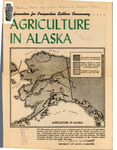
Agriculture in Alaska
Lenora Hedla
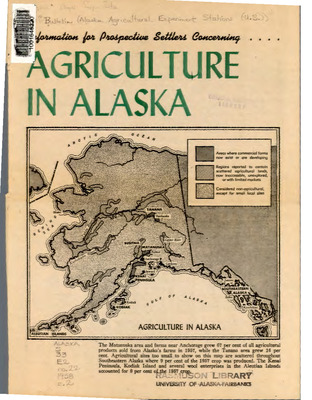
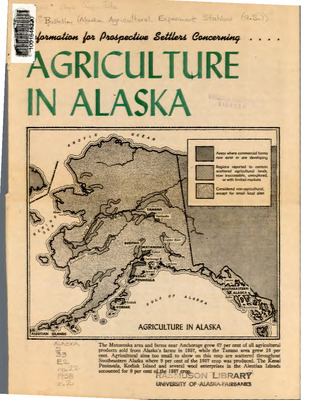
Alaska's agriculture is a growing industry. In 1957 some $4 Y2 million worth of food and feed grown by 200 full-time and 350 part-time farmers brought nearly $9 million in the market place. Crop volume doubled between 1950 and 1955. While Alaskan agriculture has been rapidly expanding, growers have been also keeping abreast of Stateside grading and packaging practices. They now offer homegrown products of the highest quality. A few farms are as modern as any in the States. Some farmers net $10,000 year or more, although the average is closer to $4,000 because many farms are small and others are in early stages of development.
-
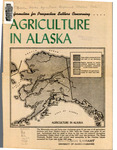
Information for prospective settlers concerning agriculture in Alaska
N/A N/A
ALASKA'S agriculture is a growing industry. In 1957 some $4 1/2 million worth of food and feed grown by 200 full-time and 350 part-time farmers brought nearly $9 million in the market place. Crop volume doubled between 1950 and 1955. While Alaskan agriculture has been rapidly expanding, growers have been also keeping abreast of Stateside grading and packaging practices. They now offer homegrown products of the highest quality. A few farms are as modern as any in the States. Some farmers net $10,000 year or more, although the average is closer to $4,000 because many farms are small and others are in early stages of . development.
-
Performance of Fifty-Five Potato Varieties in Alaska's Matanuska Valley.
M. F. Babb and C. H. Dearborn
This bulletin reports the results of potato variety trials conducted at the Matanuska Experiment Station during 1948, 1949, 1950, and 1951. They were conducted for the purpose of determining the value of the more common commercial seedlings, for culture in Alaska or for use as parental material in potato breeding. The publication of the results of these tests has been unavoidably delayed. They are being published now, however, because the information they contain is as pertinent as it was at the time the tests were conducted and of as great value to growers, potato buyers and other research workers. Arctic Seedling was at that time - and still is - the most commonly grown variety in Alaska. Several serious defects detract from its popularity with the public, with buyers and with growers. It is late maturing and frequently fails to mature its tubers in certain growing areas. Its large tops interfere with cultural and harvesting operations and the thin skin of the tubers feathers badly in handling. When grown on some soils, at least, the flesh of the tubers tends to darken on cooking.
-
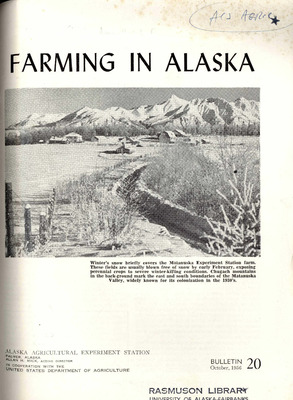
Farming in Alaska.
Richard A. Andrews and Hugh A. Johnson
An analysis of commercial farming in Alaska has long been needed. This report may supply helpful information. It spans the yea rs from 1949 to 1954, a time of rapid development and growth. T he study analyzes detailed information supplied by 75 to 85 farmers in the Matanuska Valley and by 15 to 30 others in the Tanana Valley. In 1952, records were also obtained from 19 farmers in the Kenai Peninsula. These record s are estimated to cover about 60 per cent of all commercial farming activity in these particular areas during the period. Information on farming in areas outside the Kenai Peninsula and the Railbelt was gathered from mailed questionnaires supplemented by personal observations. Data for 1949 and 1950 were collected by Clarence A. Moore and were first summarized in his Mimeographed Circular 1, Alaska Farms : Organization and Practices in 1949, and Bulletin 14, Farming in the Matanuska and Tanana Valleys of A laska, both published by the Alaska Agricultural Experiment Station. The authors are grateful to the farmers, agencies and others whose help made this work possible.
-
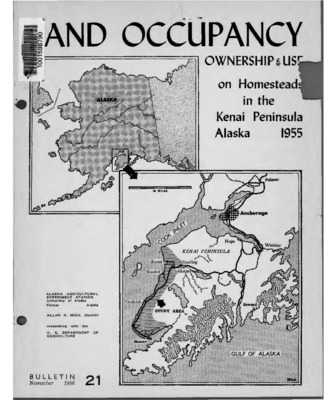
Land Occupancy, Ownership and Use on Homesteads In Alaska's Kenai Peninsula, 1955.
Hugh A. Johnson and Robert J. Coffman
The Kenai Peninsula is an Alaskan Mecca for many venturesome families newly arrived from the States. They flock there each year searching for " free" land and fresh opportunity in a new country. Business at the Anchorage Land Office continues briskly as new frontiersmen apply for the right to enter the public domain. Numerous applications for homestead entry are still filed despite a recent change in the Homestead Act requiring cultivation by all entrymen, whether veteran or not, and d~spite the fact that accessible agricultural land along the Peninsula's roads has already been culled over. Most new arrivals know little about pioneering or Alaskan conditions. They often have no experience in rural living. All too many find that Alaska is a hard bargain~r, taking their savings and their hopes and giving them in return a bit of land which they are powerless to use. Settlement continues to outpace farm development and even interest in farm development. On the other hand, interest in farm development is also definitely increasing.
-
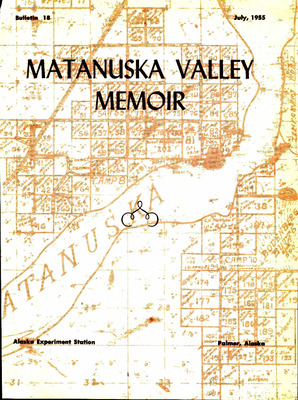
Matanuska Valley Memoir
Hugh A. Johnson and Keith L. Stanton
The Matanuska Valley was created through action of ice, water and wind. When the last glaciers retreated up the Susitna, the Knik and the Matanuska valleys, vegetation began cove ring the scars, Over several centuries a dense growth of trees and brush screened the land from Knik Arm to the mountain slopes of the Talkeetna range . Here and there a lake broke the uniform forest mantle. A salt marsh at the mouth of the Matanuska River kept the rank undergrowth from reaching tide water, A few low spots near the Little Susitna and other swampy areas supported a thick cover of moss or grass. The Valley, which really isn't a valley at all but a reworked foreland, rises from the Matanuska River in a series of benches ranging in width from a few hundred feet to more than a mile. Some areas are flat, others are rolling. Soil depth varies from eight feet in thickness for the region bordering the Matanuska River to a few inches in sections west of Wasilla. The soil mantle, of windblown loessial materials, is of relatively new geologic development, The Valley is bounded by the Chugach Mountains on the east, the Talkeetnas on the north, the Susitna Valley on the west and Knik Arm on the south. Winters are long but usually not unduly severe; summers cool and relatively moist, To this country came trappers, prospectors and traders in closing years of the nineteenth century. Hordes of insects, difficult trails, sparse population and great distance s from supply points discouraged many potential residents, Those who stayed were interested primarily in the Willow Creek gold field or the Matanuska coal deposits. Another generation, an uneasy international situation and social crises within the United States were required before the Matanuska Valley and the rest of Upper Cook Inlet were ripe for use. This history of the Valley is designed to trace the many human elements affecting the ebb and flow of agricultural development here. It brings into focus many problems that must be solved before new areas in Alaska can be settled satisfactorily.
-
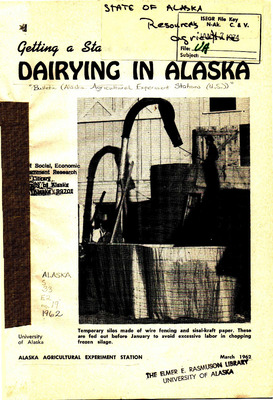
Getting a start in dairying in Alaska
William J. Sweetman and C. Ivan Branton
Dairying in Alaska probably will always be confined to areas where milk can reach city markets readily. The demand £or fresh milk, even at present prices, exceeds the supply. Probably the dairy farmer always will be able to produce milk in competition with fluid mlik shipped in from the States if he is a good manager and has high producing cows. A farmer with low producing cows can show a profit at present prices, but if the price of milk dropped two dollars or more per hundred, he would have a tough time making both ends meet. It is doubtful if other dairy products can be produced in Alaska to compete with stateside prices.
Printing is not supported at the primary Gallery Thumbnail page. Please first navigate to a specific Image before printing.