
-
Postemergence Broadleaf Weed Control in Barley
Jeffery S. Conn and John A. DeLapp
Experiments were conducted from 1981-1983 to determine the efficacy and phytotoxicity of postemergence herbicides used to control broadleaf weeds in spring-planted barley. The following herbicides were evaluated: MCPA amine (0.37, 0.75, 1.5 lb/A, active ingredient), 2,4-D amine (0.25, 0.5, 1 lb/A), bromoxynil (0.21, 0.43, 0.86 lb/A), and metribuzin (0.11, 0.21, 0.43, 0.86 lb/A). In 1982 and 1983, three additional herbicides were included: dinoseb (0.25, 0.5, 1 Ib/A), dicamba (0.09, 0.18, 0.36 lb/A), and chlorsulfuron (0.04, 0.07, 0.14 lb/A). Weed control was determined through measurements of weed biomass in each herbicide and control plot. Phytotoxicity was measured by barley yield and test weight in all years, and additionally by germination of seed produced in 1982. None of the herbicides except dicamba in 1982 significantly reduced the yield or test weights of barley below that of the control. Common lambsquarters was the only weed present in 1981 and 1982. Bromoxynil and metribuzin provided both early-and late-season control MCPA, 2,4-D, and j dinoseb took longer to control common lambsquarters but provided adequate control by midseason. Dicamba did not control common lambsquarters as well as the other herbicides. In 1983, prostrate knotweed was also present at the study site. None of the herbicides significantly reduced the number of prostrate knotweed below that of the control Germination of 'Galt' barley was not \, affected by treating parent plants with any of the herbicides tested. The following barley varieties were screened for susceptibility to metribuzin injury in 1982: Galt, Lidal, Weal, Otal, Datal, Eero, Paavo, Otra, and Klondike. Only 'Klondike' was highly sensitive to metribuzin.
-
An Evaluation of Herbicides for Broadleaf-Weed Control in Rapeseed: Efficacy, Phytotoxicity, and Soil Persistence Studies
Jeffery S. Conn and Charles W. Knight
At the recommended rates (1.0 lb/A for trifluralin, ethalfluralin, EL5261; 0.75 lb/A for dinitramine; 1.2 lb/A for nitrofen), none of the herbicides we evaluated in these studies reduced rapeseed stands, yields, or test weights. However, at higher rates (1. 5, 3.0 lb A), dinitramine reduced rapeseed stands, but this did not result in decreased yields. None of the other herbicides reduced rapeseed stand, yield, or test weights when applied at up to four times the recommended rate. No trifluralin residues were detected in rapeseed whole-plant or seed samples. All of the herbicides provided adequate control of common lambsquarters (Chenopodium album L.). Corn spurry (Spergula arvensis L.) was controlled by trifluralin. ethalfluralin. EL-5261, and nitrofen. All of the herbicides except nitrofen controlled chickweed [Stellaria media (L.) Cyrillo]. In 1979, 51 per cent of the trifluralin applied remained at the end of the growing season in one study while 26 per cent remained in another study. The rate of degradation at three sites in 1979 were as follows (greatest to least); Delta Junction, Matanuska Valley, Fairbanks. Degradation rates of trifluralin were not significantly different in three soil types or at two different application rates. Trifluralin showed no signs of leaching through the soil profile. In 1981, 25 per cent of the trifluralin, 8 per cent of the ethalfluralin, and 24 per cent of the EL-5261 applied remained at the end of the growing season. Despite the relatively long persistence of these preplant, incorporated herbicides, yields and test weights of barley planted in succeeding years were not reduced. A benefit of these persistent residues was control of broadleaf weeds in the succeeding barley crop.
-
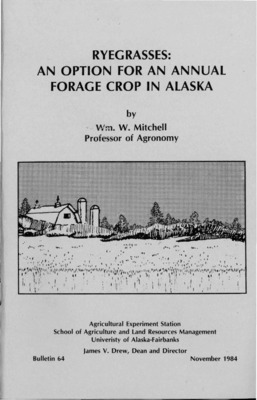
Ryegrasses: An Option for an Annual Forage Crop in Alaska
William W. Mitchell
Annuals are often planted for a forage crop in Alaska, often on land that is being renovated or on newly cleared land, thus providing a longer opportunity for worldng the soil before seeding a perennial. Oats (Avena sativa) and barley (Hordeum vulgare) , sometimes seeded with a legume, are the most important annuals used for forage in Alaska. Cereals can provide a high-yield , late-summer forage crop, stored as hay or silage. Ryegrass (Lolium), another annual not now in significant use in Alaska , affords an option that merits consideration in forage programs.
-
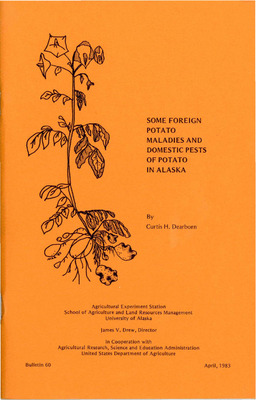
Some Foreign Potato Maladies and Domestic Pests of Potato in Alaska
Curtis H. Dearborn
Disease-free potato seed pieces, or potatoes grown from true seed derived from seedballs grown in Alaska, produce potato crops in Alaska free from most serious pests that afflict potatoes grown in other states and countries. Precautions are offered to aid in maintaining this relatively clean, potato-growing environment. Maladies indigenous to Alaska are potato scab, Streptomyces scabies; black scurf, Rhizoctonia so/ani; silver scurf, Spondylocladium atrovirens; leak, Pythium spp.; skin spot, oa·spora pustulans; and Fusarium spp. Of these only scab and black scurf are significant. Photographs to acquaint Alaskans with serious diseases, insects, and nematodes of other potato-growing regions of the world are presented. Illustrations of symptoms of maladies indigenous to Alaska are included as well as photographs of serious, introduced potato troubles that could be eradicated if a reasonable degree of persistence were exercised.
-
Representative Rivers: An Experimental Research Program in River Recreation Management
Alan Jubenville
Earlier attempts at synthesizing research needs and priorities were not fruitful. It became an exercise in which I subconsciously tried to produce a document that was acceptable through peer review. I styled my writing and format after other analyses that I had read. It seemed the natural thing to do - to look just like the others so mine would be accepted. At the same time, I tried to be different. It became a matter of shifting chairs around the table, but somehow the dinner still looked the same. I did not really realize what I was doing until Drs. Workman and Becker, in separate reviews, pointed out the problem. They simply said I was not covering new ground or even looking critically at river-recreation management. The second attempt was more progressive in terms of reviewing previous research and management theory, and proposing a new approach to river recreation management research; but it was too disjointed to be effective in communicating the problems of present research and means of overcoming those problems. At least one thing became clear - most of the research done in recreation, particularly river recreation, was based on survey research designs which required a lot of data-crunching and liberal interpretation. As reproved by W. G. Workman, "Torture the data until nature confesses." In fact, much of the belief in the process of survey research appears to be related to the apparent ability to overcome inadequacies of research design by simply increasing sample size and then manipulating that data until some significant relationship is noted .
-
Forage Yield and Quality of Cereals at Pt. MacKenzie
William W. Mitchell
This report presents the results of three field tests conducted during 1982: two at the University of Alaska research tract in the Pt. MacKenzie project area and one at the Palmer Research Center. One trial at Pt. MacKenzie compared seven oat and barley varieties, harvested simultaneously for yield and quality. A second trial obtained yield and quality information on an oat variety harvested at different stages. A stage-of-harvest experiment also was conducted with barley at Palmer for comparative purposes.
-
Observations on Plant and Tuber Growth of Potato in Alaska
Curtis H. Dearborn
Several phenotypic characteristics that otherwise would be diffult to observe under field conditions in temperate-zone latitudes are amplified in Alaska at 61° 34' and north. At this latitude, the growing season for potato is marked by cool temperatures at its beginning and end as well as long daylight periods. Characteristics that have been observed include: rosetting, skirts-up, leaf color change, wet leaf, perforated leaf, fasciation, inverted leaf, flowering, stolon plant production, double tuber, second growth, stolon extension, tuber constriction, eye depth, heat sprout, cracking, tuberization, frost resistance, fruit set, sprout tuber, and sprout necrosis. Stolon plant production and tuberization have been noted for samples of 27 Solanum species. Numerous plant- and tuber-growth manifestations are shown. Seed tubers of potato varieties stored over winter under identical conditions manifest significant differences in their capacity to generate a top following field planting. Stolon growth, stolon plant development, and tuberization indicate that a delicate physiological balance exists in some clones relative to the Alaskan environment. Changes in tuber shape, eye depth, and second growth are manifestations of environmental changes of rather short duration. Possibly heat sprout results from damage to the potato by particular foreign bodies. Iopride showed the least rosetting and this character is conspicuous in some of its progeny. Leaves of some clones dosed in toward the stem during light conditions approximating twilight. A few clones exhibited inverted leaf as a growth response to low light intensity while two clones lost their green color at the apex. Perforated leaf of potato and fireweed in the Matanuska Valley has been traced to aphid-feeding injury. Plants grown from tubers of potatoes with perforated leaves did not exhibit the perforated-leaf condition.
-
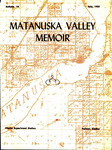
Matanuska Valley Memoir
Hugh A. Johnson and Keith L. Stanton
The Matanuska Valley was created through action of ice, water and wind. When the last glaciers retreated up the Susitna. the Knik and the Matanuska valleys, vegetation began covering the scars. Over several centuries a dense growth of trees and brush screened the land from Knik Arm to the mountain slopes of the Talkeetna range. Here and there a lake broke the uniform forest mantle. A salt marsh at the mouth of the Matanuska River kept the rank undergrowth from reaching tidewater. A few low spots near the Little Susitna and other swampy areas supported a thick cover of moss or grass. The Valley, which really isn't a valley at all but a reworked foreland, rises from the Matanuska River in a series of benches ranging in width from a few hundred feet to more than a mile. Some areas are flat, others are rolling. Soil depth varies from eight feet in thickness for the region bordering the Matanuska River to a few inches in sections west of Wasilla. The soil mantle, of windblown loessial materials, is of relatively new geologic development. The Valley is bounded by the Chugach Mountains on the east, the Talkeetnas on the north, the Susitna Valley on the west and Knik Arm on the south. Winters are long but usually not unduly severe; summers cool and relatively moist. To this country came trappers, prospectors, and traders in closing years of the nineteenth century. Hordes of insects, difficult trails, sparse population and great distances from supply points discouraged many potential residents. Those who stayed were interested primarily in the Willow Creek gold field or the Matanuska coal deposits. Another generation, an uneasy international situation and social crises within the United States were required before the Matanuska Valley and the rest of Upper Cook Inlet were ripe for use. This history of the Valley is designed to trace the many human elements affecting the ebb and flow of agricultural development here. It brings into focus many problems that must be solved before new areas in Alaska can be settled satisfactorily.
-
Participation, Preferences, and Characteristics of Outlying-Cabin Users in Alaska National Forests
Alan Jubenville, William G. Workman, and Wayne C. Thomas
The development and management of public-use cabins have been planned, or at least considered, by several federal and state agencies in Alaska. This bulletin reports the results of a pilot study of the cabin program of the U.S. Forest Service. There are problems of aggregated data which did not allow for detailed analysis; however, the report does provide an overview of the Forest Service outlying cabin program-who uses it, how they use it, and how they feel about it. The manager should be careful in applying the results without consideration of the total recreational spectrum, i.e., where the cabin program fits within this spectrum, and its cost in terms of other recreation opportunities that may be specified. It is the opinion of the authors that it would be unwise to simply mass reproduce the outlying cabin program in all areas having periods of inclement weather. The study sampled only cabin users-not all users or potential users of the particular landscape setting. To over-emphasize an expanded cabin program would reduce the continuum of opportunities. While subsequent studies of the cabin user population would likely find this group to prefer the new program, the users who did not prefer it or who were unwilling to adopt to new conditions would have been displaced. Thus, while the results have some direct applicability, it is also important to consider the maintenance of the continuum of recreational opportunities, only one portion of which is covered by outlying cabins.
-
The Agricultural Potential of the Middle Kuskokwim Valley
John S. Lewis
Alaskans are concerned with the production of food . This is evident from the concern which has been expressed over the subsistence issue within the current Alaska lands legislation. The debate ponders who shall harvest the state's natural game resource and how the resource shall be harvested. Although this question is not settled , one point is coming to the fore: the game resource alone is not sufficient to satisfy the food needs of Alaska's growing rural population. In recent months, interest has been expressed in the agricultural potential of the lands in areas of Alaska which are removed from major population centers and from connecting surface transportation routes. One area in particular in southwestern Alaska has made significant progress in agricultural development. The Kuskokwim Native Association has maintained a community garden since 1976 in Aniak on the Kuskokwim River (Figure 1) (Lewis, Thomas, and Wooding, 1978). This effort could be expanded using existing transportation corridors to supply not only the Kuskokwim River valley, but also several villages located away from the river. The objective of this study is to provide an economic evaluation of the feasibility of producing and marketing vegetables in the Kuskokwim River valley area. Major considerations were the availability of markets, transportation, and a method of product distribution. All were based on production capability of the area and the capacity and time factors pertaining to vegetable storage.
-
Eskimos, Reindeer, and Land
Richard O. Stern, Edward L. Arobio, Larry L. Naylor, and Wayne C. Thomas
The following report is based on an interdisciplinary research study undertaken to investigate the social, economic, and cultural aspects of reindeer herding in northwestern Alaska. The primary purpose of the research project was to gather data on the past and present reindeer herding practices of the region, but also to seek information on herding and land uses, the future potential of this essentially Native industry, and its impacts on the people and economy of the area.
-
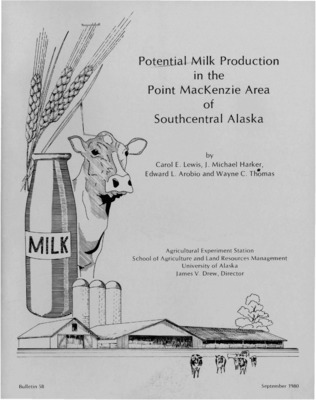
Potential Milk Production in the Point MacKenzie Area of Southcentral Alaska
Wayne C. Thomas and J. Michael Harker
Point MacKenzie is an area northwest of Anchorage directly across the Knik Arm of Cook Inlet (Figure 1 ). This area contains a substantial amount of latent agricultural land and discussion regarding its potential has been going on for some time. The catalyst which activated the recent planning process directed at Point MacKenzie was concern over potential loss of the southcentral Alaska dairy industry expressed on May 4, 1979, in a letter from Jack Flint, General Manager, Matanuska Maid, Inc., to Governor Jay Hammond: "It is my opinion that if we do not take immediate steps to stabilize this important phase of agriculture, [the dairy industry] will pass from the scene. I think that if it should occur, it would be a serious blow to the State of Alaska, economically and socially. I believe we should also realize that if the dairy industry should cease to exist within the state, it is going to be very difficult to re-establish it." Mr. Flint's letter and corresponding action by the Matanuska-Susitna Borough have directed planning processes of the State of Alaska toward Poinr Mac- Kenzie. The Alaska Agricultural Action Council, created by the 1979 state legislature to plan, recommend, and administer agricultural development projects on state lands in Alaska, held a meeting in the Matanuska Valley in September, 1979, and determined that an economic feasibility study, directed toward dairy production, should be undertaken for the Point MacKenzie area. This report is that feasibility study.
-
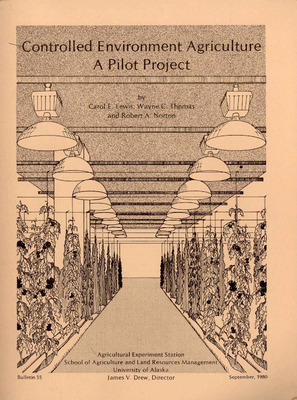
Controlled Environment Agriculture: A Pilot Project
Wayne C. Thomas and Robert A. Norton
The controlled-environment agricultural (CEA) project discussed in this report was first conceived for the Wildwood Air Force Station in Kenai, Alaska, in 1972. The region contained high unemployment and a U.S. Air Force Station that had just closed. The Kenai Native Association, Inc. (KNA), was to take possession of the Air Force Station through land transfers associated with the Alaska Native Claims Settlement Act, and this corporation was interested in expanding business and employment opportunities for local people. The University of Alaska Agricultural Experiment Station (AES) contacted KNA to determine if it had a facility which might be adaptable for use in a research and development program in controlled- 1 environment agriculture. It was determined that such a facility was available. Subsequently, AES and KNA contacted the General Electric Company (GE) in Syracuse, New York, to determine its interest in such a project. GE had extensive background in lighting technology and environmental control systems and the engineering capability to develop a total system for CEA production. It was agreed that GE would provide technological expertise and AES would provide horticultural and economic expertise for the growing and marketing of a variety of salad crops. KNA would manage the project, employ the nontechnical people, and provide the building. The Wildwood site was selected because it contained two buildings which were thought to be well suited for CEA production. One building would provide sufficient inside space for a 1/4-acre pilot production plant, nine small research modules , a laboratory , offices, a training area, and space for preparing the crop for shipping. A second building near the first contained three diesel generators which were to be converted to natural gas to provide power for the production facility.
-
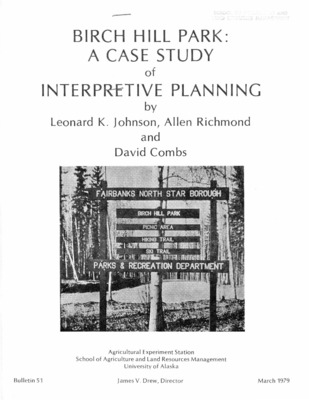
Birch Hill Park: A Case Study of Interpretive Planning
David Combs
The Fairbanks North Star Borough Parks and Recreation Department is responsible for the planning, acquisition, development, improvement, and maintenance of lands and facilities to meet the community's needs for park and open space lands in accordance with established standards. 1 Current department emphasis is on sports facilities and programs. Some small neighborhood parks and the Growden Park and Picnic Area are the only significantly developed areas in which organized sports are not emphasized. Birch Hill Park was acquired to expand the spectrum of recreational resources and opportunities available to borough residents. Cross-country skiing, both competitive and recreational, is an important winter activity, but the area's size and its natural environment provide for a variety of other uses. The park has a summer youth camp, and planned developments will enhance the opportunities for visitors of all ages to picnic, hike, and study nature. This paper presents a direct contribution to the diversification of the borough's recreational program by highlighting the interpretive resources and opportunities of the park and by making specific recommendations for the implementation of an interpretive program. The interpretive plan proposed here can be integrated with the comprehensive development planning for Birch Hill Park now underway at the Parks and Recreation Department. Preliminary research for this study was done as a University of Alaska class project in the spring semester of 1976. The students in LR 493, Interpretive Services, developed basic information on the natural and cultural resources of Birch Hill and its surrounding region. They also identified policy gaps and provided general guidance for interpretation in the park.2 The plan presented here is a fo llow-up to that work. Additional fieldwork and library research have been done to supplement the earlier effort, and the implementation aspects have been made more specific with regard to the trail and visitor center recommendations. The process followed in this study is adapted from Perry J. Brown's Procedures for Developing an Interpretive Master Plan.
-
Lime Requirement Indices of Alaskan Soils
T. E. Loynachan
Perhaps the most significant single measurement of a soil's ability to adequately support plant growth is a pH determination. If soils are too acid, reduced nutrient availability of all the macronutrients will result. Conversely with several of the micronutrients, low soil pH can increase solubilities, even to the point of causing plant toxicity. Aluminum, an element regarded as nonessential for plant growth, has been shown by numerous workers to produce toxic plant effects at low soil pH (1). High soil pH likewise is undesirable for plant growth and can result in reduced availability of several micronutrients such as boron, zinc, iron, and manganese. Phosphate fixation can occur when excessive calcium is present. Therefore, the majority of agronomic plants do best when grown in neutral to slightly acid soils in the 6 to 7 pH range
-
Alaska-Washington Trade Profile: Waterborne Commerce
Wayne C. Thomas and Charles L. Logsdon
The overall purpose of this study was to establish a profile of Alaska-Washington waterborne movements, emphasizing commodity and port components that determine the needs of a physical distribution system. Specific objectives of the report are : 1. To determine Washington's share of the total Alaska-bound, waterborne traffic. 2. To present selected Washington-to-Alaska, waterborne movements by commodity and destination ports. 3. To present selected Alaska-to-Washington, waterborne movements by commodity and origination ports. 4. To determine implications of the trade profile with regard to future transportation and marketing needs. It should be noted that there are sizable noncommodity trade flows between the regions, i.e., labor, capital, and services that are not in this data base. This report contains only data on major commodity grouping and principal ports in Alaska. Additional information is on file at the Agricultural Experiment Station, University of Alaska, and at the Department of Agricultural Economics, Washington State University.
-
Barley Production in the Delta-Clearwater Area of Interior Alaska
Frank J. Wooding
When oil from Prudhoe Bay on the northern coast of Alaska began to flow in the fall of 1977, it marked the beginning of another flow of perhaps equal significance. Eighty per cent of the revenue received by the State of Alaska in the foreseeable future will come from the oil industry. This prompts concern that long-term growth of the Alaskan economy is based on revenue from a single nonrenewable resource. Historically, nonrenewable resources have exhibited a boom-bust development pattern. Diversifying the economy of the state could contribute to economic stability. Of particular interest, when the development of renewable resources is considered, is the potential for agriculture. A half century ago, the Tanana Valley in interior Alaska produced a higher per-capita quantity of agricultural products for Fairbanks consumers than it does today. Now, more than 95 per cent of the food consumed in the area is imported from areas outside the state. Additionally, there is a growing worldwide concern abut increasing populations and the need for increased food production. This has created a new awareness of agriculture in Alaska as well as across the nation.
-
Input-Output Tables for Alaska's Economy: A First Look
Kenneth L. Casavant and Wayne C. Thomas
Geographic isolation, a subarctic climate, large size, and a regionally diverse landscape make Alaska a unique part of the United States. The factors that make Alaska so unique also contribute to her present lack of industrial and agricultural production, which requires shipment into the state of most of the goods necessary for life. In filling the need for such goods, the state of Washington has been, and continues to be, the principal marketing and transportation center for Alaska-associated trade.
-
Creating a Northern Agriculture. IV. Reservation and Preservation of Agricultural Lands in Alaska
Wayne E. Burton
The reservation of agricultural lands is one of the most urgent, and least recognized, problems facing Alaskans today. While more than 17 million acres suitable for agricultural tillage have been identified, fewer than 20,000 acres, in widely scattered locations, are now being tilled and they are increasingly suffering the ravages of suburban, urban, and industrial encroachment. Most lands suitable for agricultural tillage in the future, and all lands suited to domestic livestock grazing, are now in public ownership and control; yet public land use plans do not include agricultural production1 as a consideration for the future in Alaska.
-
Creating a Northern Agriculture. V. An Agroeuthenics Approach to Development in Alaska.
Wayne E. Burton
The growing national concern for a better environment and more rewarding life-style is being reflected in the many proposals regarding Alaska's future. Particular attention has been directed to preserving wilderness, wildlife, and scenic values. Increasing attention is being directed to energy resource development. Continuing attention is being directed to fishery, forestry, and recreation resources. All incorporate concern for certain attributes of a more rewarding life-style. However, little attention is being directed to development concepts, or infrastructures, suited to Alaska's latent agricultural regions, and even less has been directed to the inter-relationships of rural-agricultural and urban-industrial developments.
-
ALASKA FOOD PRICE PATTERNS
Monica E. Thomas
Prices and costs of living in Alaska have been reviewed in earlier works by this author and others (1) ; until now, however, there has not been detailed analyses of trends in food prices, despite the need for this information . Food comprises a large portion of the consumer budget; this is particularly significant in the lower income brackets. Alaska presently imports the majority of its foodstuffs, making Alaska food prices dependent on m any circumstances, some beyond state influence. Concurrently, Alaska's potential for large scale agricultural production is being discussed and recognized (2). This paper has three primary objectives: (1) to discuss the level of retail food prices in Anchorage relative to the U.S. (2) to describe trends in retail food prices, both in Anchorage and the U.S. ( 3) to present retail food price comparisons among selected communities within Alaska.
-
Creating a Northern Agriculture. II. Historical Perspectives in Alaskan Agriculture
Wayne E. Burton
Much can be learned about the present status of agriculture in Alaska from a review of the long and varied history of Alaskan agriculture. At some times, concerted public efforts have been directed to its development; at others, agriculture has suffered long periods of public neglect. At national levels, opinion has vacillated from limited optimism to abject negativism. However, correlations may be found among the public policy attitudes and agricultural development success.
-
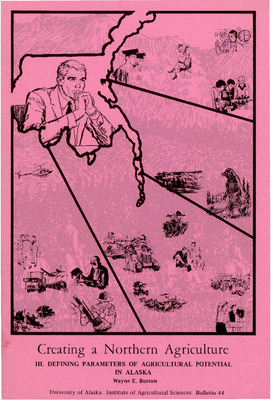
Creating a Northern Agriculture. III. Defining Parameters of Agricultural Potential in Alaska
Wayne E. Burton
Alaska's current land-use planning is characterized by a particular void in providing for future agricultural development. One reason for this void in planning has been a profound lack in identification of production possibilities in most areas of the state. While the report, ALASKA'S AGRICULTURAL POTENTIAL (4), generally identified some 16 million acres suitable for tillage, and millions of acres suitable for livestock grazing, it did not provide other than a cursory review of product types which might be grown in Alaska. Further, it did not identify probable locations where particular crops and livestock would be produced, nor possible scope and magnitude of such industry development.
-
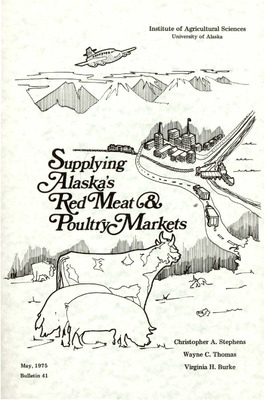
Supplying Alaska's Red Meat & Poultry Markets
Christopher A. Stephens, Wayne C. Thomas, and Viginia H. Burke
Analysis of the red meat and poultry market will be presented on a regional basis. Alaska was divided into three geographic regions: Southcentral, Southeast, and Bush (Figure 1). These regions differed in population, modes of transportation available, and market structure. Southcentral Alaska includes the Kenai Peninsula, Big Delta, Glennallen, Valdez, Cordova, and Chitina, as well as all areas serviced directly by the Alaska Railroad, i.e., Whittier, Anchorage, and Fairbanks.3 It contained 224,000 people in 1972, which was 69 percent of Alaska's population [2]. Most of the meat and other goods shipped into the region came by water transportation through Seattle. The area had the only completely differentiated retail, wholesale and military market sectors in the state. The Southeast region extends from Icy Bay in the north to Ketchikan in the south. This region was third in population size in 1972 with an estimated population of 45,000, 14 percent of the state total. It received most of its meat from Seattle via water. Retail and the hotel, restaurant and institution trade made up almost all of the red meat market. A differentiated wholesale sector was not apparent. The Bush includes all other areas of the state. It also received meat and other goods by air and water, mainly transshipped through Anchorage. No highway or rail transportation was available to this region. The 1972 population, 17 percent of the state total, was approximately 55,000. Twenty-nine percent of this was concentrated on Kodiak Island and the Aleutian Islands. The retail, wholesale and military sectors are primarily extensions of wholesale and military markets of Southcentral Alaska.
-
A Method for Establishing Outdoor Recreation Project Priorities in Alaska
G. K. White and W. C. Thomas
The objectives of this study are to define outdoor recreation benefits to the public and to develop a priority ranking method for proposed outdoor recreation projects. A careful analysis of the benefits which people derive from outdoor recreation provides a frame of reference for evaluating a recreational facility. A project should supply those benefits which are most highly demanded by the public. Fifteen benefits of recreation are defined and discussed. They are divided into two major categories; those which accrue to recreational participants and those which accrue to non-participants.
Printing is not supported at the primary Gallery Thumbnail page. Please first navigate to a specific Image before printing.