-
Aboveground Biomass Equations for the Trees of Interior Alaska
John Yarie, Evan Kane, and Michelle Mack
Calculation of forest biomass requires the use of equations that relate the mass of a tree or it's components to physical measurements that are relatively easy to obtain. In the literature individual tree relationships have been reported that estimate aboveground biomass on individual sites (e.g. Barney and Van Cleve 1973)and over large landscape areas where many data sets are combined (Jenkins et al. 2003). The equations presented in this report represent a compilation of aboveground biomass data collected within interior Alaska over the past 40 years.
-
Visitor Preferences for Interpretation in Kennecott Mill Town, Wrangell-St. Elias National Park
Stephen C. Taylor and Peter J. Fix
This report compiles the results from a study on visitor preferences for interpretation in Kennecott Mill Town within Wrangell-St. Elias National Park (WRST). This study was conducted in cooperation of the University of Alaska Fairbanks and the National Park Service during summer 2004.
-
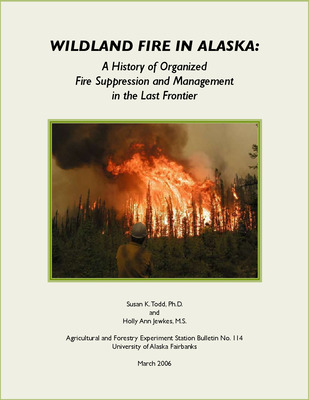
Wildland Fire in Alaska: A History of Organized Fire Suppression and Management in the Last Frontier
Susan K. Todd and Holly Ann Jewkes
When the federal government used the military to fight fires in Yellowstone National Park in 1886, it marked the beginning of wildland fire suppression in the United States (Pyne 1982). Organized fire suppression in the Territory of Alaska began almost 60 years after the emergence of this first federal effort in the contiguous states. The state's first fire control agency, the Alaska Fire Control Service, was established in 1939. It Faced a vast, remote, and largely unknown territory where wildfires burned millions of acres every year.
-
Response of Bluejoint Reedgrass Dominated Stands to Mowing and Nitrogen Fertilization in Central Alaska
S. D. Sparrow and M. T. Panciera
The purpose of this study was to determine treatment year and residual effects of mowing and nitrogen (N) fertilization management on yield and forage quality of bluepoint reedgrass in native stands in central Alaska and of mowing timing and frequency on control of bluepoint reedgrass as a weed.
-
Performance of Agronomic Crop Varieties in Alaska 1978 –2002
Robert M. Van Veldhuizen and Charles W. Knight
There is no such thing as the perfect variety for Alaska. Some varieties are adapted to a wide range of climatic and geographic locations, while others are more specific in their adaptation. The change in elevation of a few hundred feet or a move of a few miles can have a considerable effect on the performance of any variety. Also, cultural practices such as tillage, fertilizer rates, planting date, seeding rate, pest control, and a multitude of other factors can also influence crop yields. This is especially noticeable in northern environments such as Alaska. For example, date-of-planting studies done by F.J. Wooding (1973) and C.W. Knight (1989) found that any date after the middle of May for planting an agronomic crop can result in delayed maturity, low yields, and low quality grain, even for the best adapted varieties for Alaska.
-
No-till Forage Establishment in Alaska
Stephen D. Sparrow, Michael T. Panciera, Darleen T. Masiak, Beth A. Hall, and Raymond G. Gavlak
We assessed the effectiveness of no-till forage establishment at six Alaska locations: Anchor Point, Sterling, Point MacKenzie, Palmer, Delta Junction, and Fairbanks. Directly seeding grass into established grass stands generally did not improve forage yields or quality. Seeding rate had little effect on establishment of newly seeded forages in no-till. Grass yields were depressed when companion crop yields were high, and they typically did not recover in subsequent years. Red clover established well, producing high yields of good quality forage under no-till at Point MacKenzie, but established poorly at Anchor Point and Delta Junction. These results indicated that no-till seeding of most forage crops into declining grass stands is not likely to be successful in Alaska with current available technology.
-
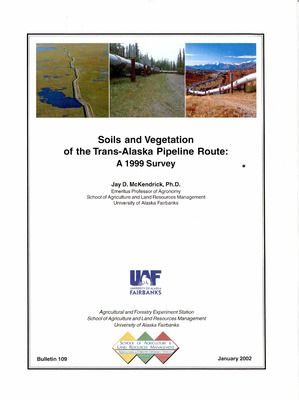
Soils and Vegetation of the Trans-Alaska Pipeline Route: A 1999 Survey
Jay D. McKendrick
This report presents the results of a survey of soil s and vegetation along the Trans Alaska Pipeline System (TAPS) right-o f-way (ROW) from Prudhoe Bay to Valdez, Alaska. This survey, conducted in the summer of 1999, was designed to secure an overall perspective of the soil fertility and general vegetation conditions in the ROW and in the undisturbed habitat immediately adjacent to the ROW. Researchers examined 52 sites along the 800-mile ROW, which crosses three vegetation zones: tundra, alpine, and boreal (includes coastal forest). Soil samples were collected for laboratory analysis of plant nutrients, vascular plant species were inventoried, and photographs were taken at each site. This information can be used to assess the impacts of TAPS on vegetation and the success or failure of revegetation efforts performed during pipeline construction in the 1970s and to make recommendations for revegetation of future disturbed areas in regions similar to the TAPS ROW. The Federal Agreement and Grant of Right-of-Way for the Trans-Alaska Pipeline System requires that seeding and planting of disturbed areas be conducted as soon as practicable and, if necessary, repeated until vegetation was successful. As a res ult , a reasdisturbed during pipe line construction were revegetated by seeding grasses and fertilizing soil s and by planting willow cuttings and transplants from natural sources and greenhouse production. Seeding and fertilizing were the most extensively used applications along the route. Transpl anted trees and shrubs were used where the pipeline crossed public roads, in order to shield the view of the open ROW from the highway. Native and non-native grasses were seeded. As a res ult, some weeds were introduced and grasses were established, some of which have persisted.
-
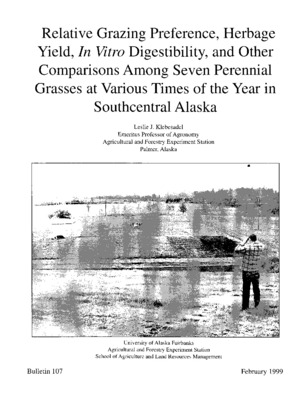
Relative Grazing Preference, Herbage Yield, In Vitro Digestibility, and Other Comparisons Among Seven Perennial Grasses at Various Times of the Year in Southcentral Alaska
Leslie J. Klebesadel
This report summarizes a two-year study of dairy cow grazing preference among seven perennial grasses at various times during the growing season conducted at the University of Alaska's Matanuska Research Farm (6l.6°N) near Palmer in southcentral Alaska. Other factors documented were herbage yields, digestibility (in vitro dry-matter disappearance =IVDMD), winterhardiness, and persistence of grasses. Grasses compared were three named cultivars released by this station: 'Polar' bromegrass (Bromus inermis Leyss. x B. pumpellianus Scribn.), 'Nugget' Kentucky bluegrass (Poa pratensis L.), and 'Arctared' red fescue (Festuca ruhra L.); 'Engmo' timothy (Phleumpratense L.) from northern Norway; 'Garrison' creeping foxtail (Alopecurus arundinaceus Poir.) selected in North Dakota; and two native Alaska grasses, Siberian wildrye (Elymus sihiricus L.) and arctic wheatgrass (Agropyron sericeum Hitchc.).
-
Bromegrass in Alaska. VI. Effects of a Broad Array of Harvest Schedules and Frequencies on Forage Yield and Quality and on Subsequent Winter Survival of Cultivars Manchar and Polar
Leslie J. Klebesadel
Objectives of this study were to compare several schedules and frequencies of forage harvest of smooth bromegrass (Bromus inermis Leyss.): (a) for distribution of forage yields and total productivity in the year of differential harvests, (b) for percent crude protein in herbage in the various cuttings and for yields of crude protein, (c) for determining rates of growth (production of herbage dry matter) during the growing season, and (d) for effects of those different harvest schedules and frequencies on subsequent winter survival and on stand health and vigor the following year as measured by a uniform evaluation harvest in late June or early July. Two bromegrass cultivars, mid–temperate–adapted Manchar and subarctic–adapted Polar, were utilized in four experiments (Manchar in two, Polar in two) conducted at the University of Alaska’s Matanuska Research Farm (61.6°N) near Palmer in the Matanuska Valley in southcentral Alaska.
-
Timothy in Alaska: Characteristics, History, Adaptation, and Management
Leslie J. Klebesadel
This report (a) summarizes the characteristics of timothy (Phleum pratense L.) as a forage species, (b) reviews briefly the history of its use in the U.S., and the history of timothy evaluations and culture in Alaska, (c) compares winterhardiness of alpine timothy (P. alpinum L.) with common timothy, (d) compares physiological and morphological characteristics of timothy cultivars from widely divergent latitudinal origins and relates those characteristics to winter survival, (e) compares planting dates and different seeding–year harvest dates for seeding– year forage production and effects on subsequent winter survival and productivity, and (f) evaluates forage production of established timothy under a broad array of harvest schedules and frequencies, and compares the effects of those harvest treatments on subsequent winter survival and first–cut forage yield the following year. All experiments were conducted at the University of Alaska Agricultural and Forestry Experiment Station’s Matanuska Research Farm (61.6oN) near Palmer in southcentral Alaska.
-
Bromegrass in Alaska. V. Heading and Seed Production as Influence by Time and Rate of Nitrogen Fertilization, Sod Disturbance, and Aftermath Management
Leslie J. Klebesadel
This report summarizes five primarily exploratory experiment conducted at the University of Alaska's Matanuska Research Farm (61.6'N) near Palmer in southcentral Alaska. The problem addresses was the rapid decline in Polar bromegrass seed yields with each year of production.
-
Bromegrass in Alaska. IV. Effects of Various Schedules and Frequencies of Harvest on Forage Yields and Quality and on Subsequent Winter Survival of Several Strains
Leslie J. Klebesadel
Effects of different annual harvest schedules and frequencies on several cultivars and strains of bromegrass (Bromus species) were measured in five field experiments at the University of Alaska’s Matanuska Research Farm (61.6oN) near Palmer in southcentral Alaska. Most cultivars evaluated and compared were smooth bromegrass (B. inermis Leyss.). Native Alaskan pumpelly bromegrass (B. pumpellianus Scribn.) and the predominantly hybrid (B. inermis x B. pumpellianus) cultivar Polar, developed in Alaska, were included also.
-
Comparative Winterhardiness of Cultivated and Native Alaskan Grasses, and Forage Yield and Quality as Influenced by Harvest Schedules and Frequencies, and Rates of Applied Nitrogen
Leslie J. Klebesadel
Objectives of this investigation were to compare certain traditional forage grasses with several native Alaskan grass species for forage yield, forage quality as measured by percent crude protein and digestibility (in vitro dry-matter disappearance or percent IVDMD), and comparative winterhardiness in three separate experiments. Management variables included different harvest frequencies (2, 3, and 4 times per year), and five different rates of applied nitrogen (N). Experiments were conducted at the University of Alaska’s Matanuska Research Farm (61.6oN) near Palmer in southcentral Alaska. All species were tall-growing, cool-season perennials. Traditional forage grasses included ‘Polar’ hybrid bromegrass (predominantly Bromus inermis x B. pumpellianus), ‘Engmo’ timothy (Phleum pratense), ‘Garrison’ creeping foxtail (Alopecurus arundinaceus), and a non-cultivar, commercial meadow foxtail (A. pratensis). Native Alaskan species were Siberian wildrye (Elymus sibiricus), slender wheatgrass (Agropyron trachycaulum), arctic wheatgrass (A. sericeum), bluejoint (Calamagrostis canadensis), and polargrass (Arctagrostis arundinacea).
-
Responses of Biennial Sweetclovers of Diverse Latitudinal Adaptation to Various Management Procedures in Alaska
Leslie J. Klebesadel
This report summarizes eight experiments with sweetclover (Melilotus species). Objectives were (a) determine responses of numerous cultivars and strains, representing a wide range of latitudinal adaptation, to various management procedures, (b) identify management options that contribute to improved winter survival, (c) delineate management procedures for maximizing yields, nutritional value, and usefulness of sweetclover for forage production in Alaska, and (d) identify logical avenues for future management research with sweetclover in this north-latitude area. Species of sweetclover included were biennial yellow (M. officinalis), biennial white (M. alba), and annual white (M. alba var. annua). All experiments except one were conducted at the University of Alaska’s Matanuska Research Farm (61.6oN) near Palmer in southcentral Alaska; one experiment was conducted at the Fairbanks Experiment Farm (64.9oN) in central Alaska’s Tanana Valley.
-
Winterhardiness, Forage Production, and Persistence of Introduced and Native Grasses and Legumes in Southcentral Alaska
Leslie J. Klebesadel
This study consisted of four separate field experiments, each of six years duration, conducted at the University of Alaska’s Matanuska Research Farm (61.6oN) near Palmer in southcentral Alaska. Objectives were to compare winterhardiness, forage productivity, and general persistence of introduced grass and legume species, strains, and cultivars from various world sources with Alaska-developed cultivars and native Alaskan species. Twenty-one species of grasses compared (Tables 1 through 4) included eight native to Alaska, four Alaska cultivars, and numerous introduced cultivars and regional strains (one to seven per species) from North America and northern Europe. Legumes included two species of biennial sweetclover and nine species of perennials, six introduced and three native. Each experiment was harvested once near the end of the seeding year and twice annually for five years thereafter.
-
Rates and Methods of Application of Nitrogen and Phosphorus for Commercial Field Production of Head Lettuce in Southcentral Alaska
James L. Walworth, Donald E. Carling, and Raymond G. Gavlak
Head lettuce (Lactuca sativa L.) is one of the major agricultural crops grown in Alaska. In 1992, its wholesale value was approximately $314,000, second only to potatoes among Alaska’s commercially field grown vegetables (Brown et al., 1992). The quality of head lettuce is as important as yield, as lettuce heads that do not meet minimum size and weight standards are unmarketable. Head size and weight are strongly influenced by management practices, dictating a high level of management for successful commercial production. Among manageable cultural variables, rate of fertilizer application and the method of fertilizer placement are two of the most critical. Despite the value of the head lettuce crop to Alaska vegetable growers and the importance of fertilization as a management practice, little research has been published on rates of application and method of applying nitrogen and phosphorus to commercially grown head lettuce.
-
Bromegrass in Alaska. II. Autumn Food-Reserve Storage, Freeze Tolerance, and Dry-Matter Concentration in Overwintering Tissues as Related to Winter Survival of Latitudinal Ecotypes
Leslie J. Klebesadel
The objective of this study was to acquire improved understanding of factors that influence winter survival of bromegrass (Bromus spp.) at northern latitudes. Four bromegrass strains of diverse latitudinal origins were used: (a) native Alaskan pumpelly bromegrass (B. pumpellianus Scribn.) adapted at 61° to 65°N, (b) the Alaska hybrid cultivar Polar (predominantly B. inermis Leyss. x B. pumpellianus) selected at 61.6°N, and two smooth bromegrass (B. inermis) cultivars, (c) Manchar selected in the U.S. Pacific Northwest (43° to 47°N), and (d) Achenbach originating from Kansas (34° to 42°N).
-
Bromegrass in Alaska. III. Effects of Planting Dates, and Time of Seeding-Year Harvest, on Seeding-Year Forage Yields and Quality, Winter Survival, and Second-Year Spring Forage Yield
Leslie J. Klebesadel
Objectives of this study were to (a) determine yields and quality of forage that could be obtained in the seeding year from smooth bromegrass (Bromus inermis) seeded in spring without a cereal companion crop, and (b) determine whether planting dates and date of the seeding-year harvest influenced subsequent winter survival and forage yield in the following year. Bromegrass plots were harvested for forage yield once during the seeding year on several dates approximately 10 days apart during August, September, and early October; effects of those harvest dates were measured by comparing yields of all plots harvested on the same date in the second year of growth. Five of the six experiments were conducted at the University of Alaska’s Matanuska Research Farm (61.6oN) near Palmer in southcentral Alaska, and the other was at the Research Center in Palmer.
-
Effects of Daily Photoperiod/Nyctoperiod and Temperature on Autumn Development of Crown Buds and Dormanc y, Freeze Tolerance, and Storage of Food Reserves in Latitudinal Ecotypes of Biennial White Sweetclover
Leslie J. Klebesadel
The investigation consisted of both an outdoor experiment and one conducted indoors in controlledenvironment chambers. Objectives were to determine during late-summer/autumn the effects of (a) the changing daily light/dark (photoperiod/nyctoperiod) pattern, and (b) seasonally lowering temperatures on pre-winter behavior of sweetclover. Measurements were made of certain morphological characteristics and various facets of the winter-hardening process. Both experiments were conducted at the University of Alaska’s Palmer Research Center (61.6°N) in southcentral Alaska.
-
Fescue Grasses Differ Greatly in Adaptation, Winter Hardiness, and Therefore Usefulness in Southcentral Alaska
Leslie J. Klebesadel
This report summarizes agronomic research with several species of fescue (Festuca spp.) conducted over recent decades at the Matanuska Research Farm (61.6°N) near Palmer in southcentral Alaska. Cultivars and strains within five species of fescue from Alaska, Canada, the conterminous states, and Europe were evaluated for winter hardiness and for forage production in comparison with two standard, non-fescue forage cultivars. Certain aspects of physiological behavior associated with winter hardiness were compared in red fescue cultivars of diverse latitudinal adaptation.
-
Winterhardiness and Agronomic Performance of Wildryes (Elymus species) Compared With Other Grasses in Alaska, and Responses of Siberian Wildrye to Management Practices
Leslie J. Klebesadel
This report summarizes eight field experiments involving both native and introduced wildrye grasses (Elymus species) conducted over a span of several years at the University of Alaska’s Matanuska Research Farm (61.6oN) near Palmer in southcentral Alaska. Objectives were to (a) evaluate winterhardiness, persistence, forage yield, and other aspects of agronomic performance of numerous strains within several species of wildrye, (b) assess their potential for forage use or conservation plantings in Alaska, and (c) determine the effects on Siberian wildrye (E. sibiricus) of seeding-year management options (time of planting and time of harvest) on seeding-year forage production, subsequent winter survival, and on second-year forage production.
-
Winter Survival of Grasses and Legumes in Subarctic Alaska as Related to Latitudinal Adaptation, Pre-Winter Storage of Food Reserves, and Dry-Matter Concentration in Overwintering Tissues
Leslie J. Klebesadel
similar experiments, were to (a) compare winter hardiness in subarctic Alaska of numerous plant species and ecotypes from various latitudinal sources within most species, and (b) seek a better understanding of certain aspects of pre-winter physiologic changes in plants that are associated with successful or with unsuccessful winter survival in this northern area. Both experiments were conducted at the University of Alaska’s Matanuska Research Farm (61.6°N) near Palmer in southcentral Alaska.
-
Effects of Planting Date and Latitude-of-Adaptation on Seeding- Year Development, Winter Survival, and Subsequent Seed and Forage Production Potentional of Grasses and Legumes in Subarctic Alaska
Leslie J. Klebesadel
Objectives of the present study were to compare effects of several planting dates on seeding year development, winter survival, and second year herbage and seed production potential of cultivars from three diverse latitudinal sources within three grass species and four latitudinal sources within two legume species. Three two-year field experiments were conducted over a four-year period at the University of Alaska’s Matanuska Research Farm (61.6oN) in southcentral Alaska.
Printing is not supported at the primary Gallery Thumbnail page. Please first navigate to a specific Image before printing.