-
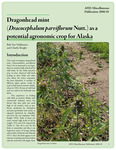
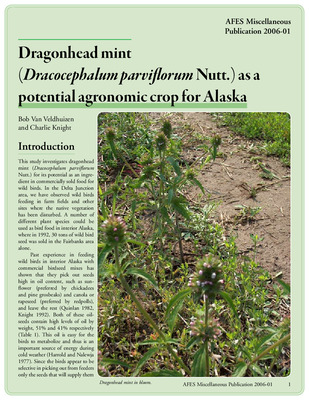
Dragonhead mint (Dracocephalum parviflorum Nutt.) as a potential agronomic crop for Alaska
Bob Van Veldhuizen and Charlie Knight
This study investigates dragonhead mint (Dracocephalum parviflorum Nutt.) for its potential as an ingredient in commercially sold food for wild birds.
-
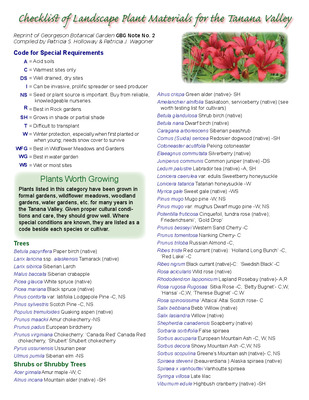
Checklist of Landscape Plant Materials for the Tanana Valley
Patricia S. Holloway and Patricia J. Wagoner
-
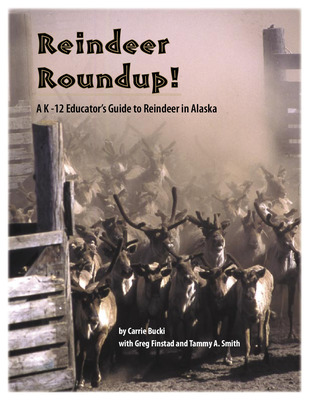
Reindeer Roundup! A K-12 Educator's Guide to Reindeer in Alaska
Carrie Bucki, Greg Finstad, and Tammy A. Smith
Reindeer Roundup! is the response to countless requests received by the RRP to visit classrooms and present information on reindeer in Alaska. It was developed in part using lesson plans written by Nome and Fairbanks teachers who attended our reindeer education workshops.
-
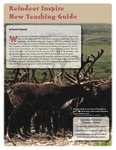
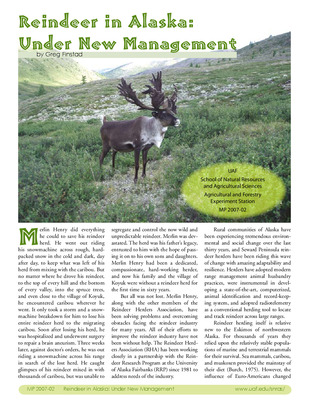
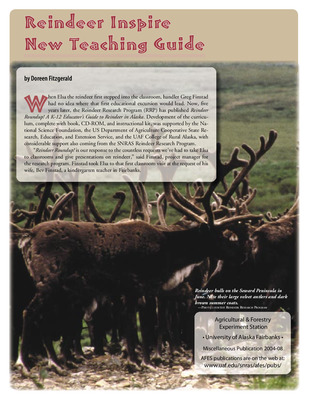
Reindeer Inspire: New Teaching Guide
Doreen Fitzgerald
When Elsa the reindeer first stepped into the classroom, handler Greg Finstad had no idea where that first educational excursion would lead. Now, five years later, the Reindeer Research Program (RRP) has published Reindeer Roundup! A K-12 Educator's Guide to Reindeer in Alaska. Development of the curriculum, complete with book, CD-ROM, and instructional kit, was supported by the National Science Foundation, the US Department of Agriculture Cooperative State Research, Education, and Extension Service, and the UAF College of Rural Alaska, with considerable support also coming from the SNRAS Reindeer Research Program.
-
Shapeshifter carbon - a universal building block
Doreen Fitzgerald
The behavior of carbon in northern ecosystems and effects related to warming are under study at the School of Natural Resources and Agricultural Sciences, University of Alaska Fairbanks.
-
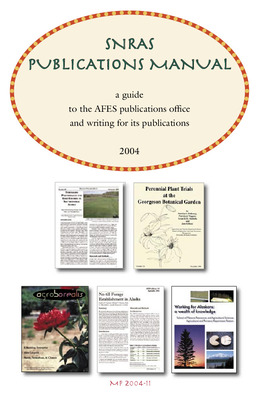
SNRAS Publications Manual: a guide to the AFES publications office and writing for its publications
N/A N/A
The AFES/SNRAS Publications Office provides the editing, publishing, and distribution activities that accompany and support the research of SNRAS. Agricultural and Forestry Experiment Station publications include several categories of technical publications written for a general or a scientific audience: bulletins, circulars, miscellaneous publications, and research progress reports.
-
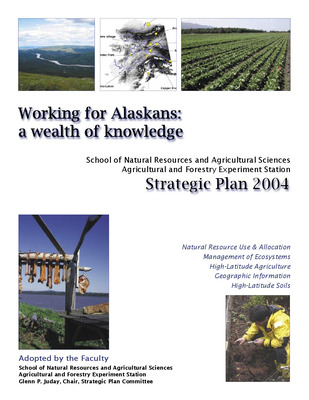
Working for Alaskans: a wealth of knowledge
N/A N/A
2004 Strategic Plan of the School of Natural Resources and Agricultural Sciences (SNRAS) and Agricultural and Forestry Experiment Station (AFES) by Carol E. Lewis.
-
Careers: Natural Resources Management, Agriculture and Horticulture, Environmental Science, Forest Science, Geography
N/A N/A
There’s a strong and growing job market for technicians, managers, scientists, and educators in the natural resource arena. Completing one of the degrees offered by our school will prepare you to work in such fields as natural resource management, agriculture, horticulture, watershed science, geography, fishery and wildlife biology, land use planning, forest biology or management, resource economics, outdoor recreation, tourism, and rangeland science and ecology.
-
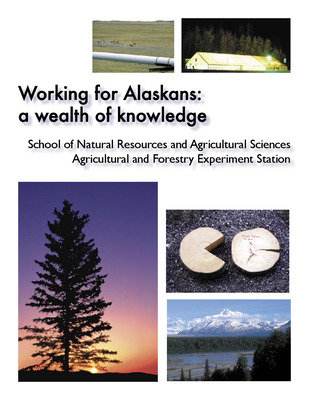
Working for Alaskans: a wealth of knowledge
N/A N/A
This publication highlights some of the research, instruction, and outreach programs of the School of Natural Resources and Agricultural Sciences (SNRAS). If you are acquainted with us, you will notice our name change and the recent addition of the geography department. Our research arm remains the Agricultural and Forestry Experiment Station to assure you of continued research and outreach programs that include traditional agricultural production and forest management.
-
ALASKA HOT DOGS: OUR DOGS ARE TOP DOGS
Carol E. Lewis and Hans Geier
Sausages, one of the oldest forms of processed food, are a means of using and preserving animal trimmings. The hot dog is a specialized sausage. It originated in Germany where it was named “dachshund” sausage because it looked like the popular badger (dachs) hound (hund). The U.S. hot dog originated at the Polo Grounds in New York. Vendors hawked dachshund sausages in buns while a sports cartoonist sketched a barking dachshund nestled warmly in a bun. He labeled the cartoon “hot dog”. Today the hot dog enjoys popularity throughout the world.
-
Alaska Spinach: Savory, Succulent Salad Selection
Carol E. Lewis, Pat Holloway, and Grant Matheke
Spinach salad is a new, exciting choice for the table! There is an increasing use of a variety of greens in salads by U.S. consumers, spinach among them. The fresh quality demanded by Alaska consumers could be met by Alaska producers from June through August if a spinach cultivar that did not bolt early in the season could be identified. For the past 30 years, horticulturists at the Fairbanks Experiment Farm, now a part of the Agricultural and Forestry Experiment Station, University of Alaska Fairbanks, have tested spinach cultivars looking for a cultivar that will not bolt early in the growing season.
-
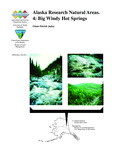
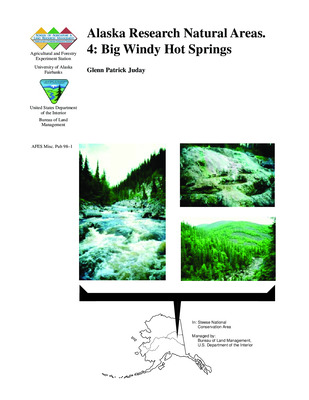
Alaska Research Natural Areas. 4: Big Windy Hot Springs
Glenn Patrick Juday
The 65 ha Big Windy Hot Springs Research Natural Area (RNA) in the Steese National Conservation Area of central Alaska is managed by the Bureau of Land Management. It contains a vent that issues hot water at about 61° C flowing at about 8 liters per minute from the largest of a system of small springs and seeps. Geothermal water seeping over the face of a cliff has intensely weathered the local granitic bedrock into gruss. The fracture of massive boulders from the possibly fault-related cliff is one of the most distinctive features of the RNA. Small boulders from the cliff have fallen into Big Windy Creek where they have been caught in the swirling current of Big Windy Creek and ground potholes into the bed of the high-gradient stream. Big Windy Creek is constricted to a narrow canyon. The main geothermal pools are lined with thermophytic algal and cyanobacteria mats. Undescribed high-temperature aquatic species may be present. geothermal heat in the vicinity of the main vents promotes a lush growth of vegetation including Phalaris arundinacea and Ranunculus cymbalaria, two species that occur here north of their previously reported distribution in Alaska. The RNA contains contrasting north- and south-facing canyon slopes. Diffuse geothermal heating of soil around the vents is associated with a large and productive mature white spruce forest on the south-facing slope. A paper birch forest with a minor white spruce component covers most of the south-facing slope. The north-facing slope is underlain with permafrost; areas of boulder talus are subjected to periglacial weathering processes. Low paper birch forest, black spruce woodland, and dwarf birch tundra provide the main vegetation cover. The lowland east-central Alaska region has experienced a strong climate warming trend since the late 1970s. Radial growth of white spruce at Big Windy Hot Springs is generally negatively related to summer temperature. The Big Windy Hot Spring site is a mineral lick heavily used by a local population of Dall sheep that roam from nearby alpine habitats into the RNA. A collection of the water shrew (Sorex palustris) in the RNA is several hundred km from other known populations and is the new northern limit for the species in North America.
Printing is not supported at the primary Gallery Thumbnail page. Please first navigate to a specific Image before printing.