-
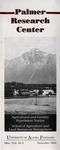
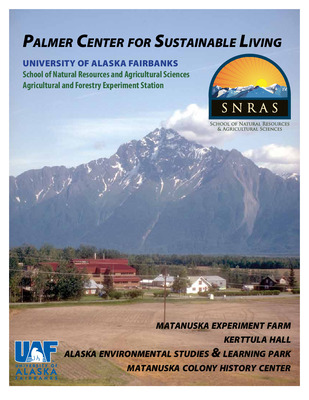
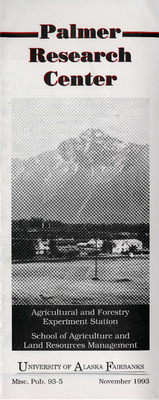
Palmer Research Center
N/A N/A
The Agricultural and Forestry Experiment Station, University of Alaska Fairbanks, operates the Palmer Research Center. Included are offices and laboratory facilities in Palmer and the Matanuska Experiment Farm outside of Palmer. Researchers at these locations solve problems related to agriculture, forestry and the environment. State and federal agencies, private industry and the university sponsor and fund the research.
-
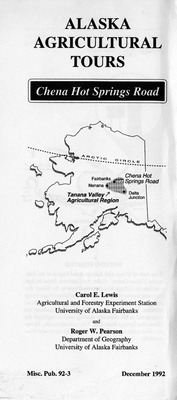
ALASKA AGRICULTURAL TOURS: Chena Hot Springs Road
Carol E. Lewis and Roger W. Pearson
Entrance to the Chena Hot Springs Road is only 5 miles from downtown Fairbanks. The road provides an excellent opportunity to see an example o f the diversity of agricultural production in the Tanana Valley.
-
Soil Survey and Its Use in Alaska
Chien-Lu Ping
Soils have been surveyed in various parts of Alaska to meet resource -development needs since territorial days. These surveys have been conducted and published by the National Cooperative Soil Survey since 1952 and are a joint effort of the United States Department of Agriculture Soil Conservation Service and the Alaska Agricultural Experiment Station. Initially, government agencies were the major users of such soil surveys because land ownership was controlled almost entirely by government agencies. However, the demand for soils and geographic information increased substantially as population increased and urban areas grew following the discovery of oil on the Kenai Peninsula during the 1950s and on the North Slope in the late 1960s. Interest also heightened when the state gained titles to a large portion of land following statehood in 1959. The National Cooperative Soil Survey (NCSS) published many soil surveys for areas of intensive land use or potential land development. These soil surveys often are underutilized or misused. This publication, "Soil Survey and Its Use in Alaska," was developed over three years based on my field reviews of NCSS activities in Alaska as well as on my discussions with users of soil surveys regarding questions and problems arising from using the reports. In this publication, soil surveys and their use in Alaska are reviewed and discussed.
-
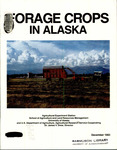
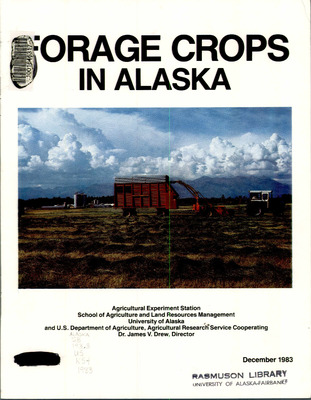
Forage Crops in Alaska
L.J. Klebesadel
Forage crops can be defined as the aboveground growth (stems, leaves, and sometimes seed heads and immature seeds) of plants that are gathered and fed to herbivorous, domestic animals. Similar plant growth that is grazed directly by livestock in rotational or permanent pastures, but on a less extensive basis than rangelands, is also considered in this discussion. For the most part, forage crops are herbaceous (nonwoody) members of two large plant families—grasses and legumes. The grass family world-wide numbers about 5,000 species, but only about three dozen of these are important as forages. The legume family includes more than 12,000 species world-wide, fewer than 20 of which are considered to be important forage crops.
Printing is not supported at the primary Gallery Thumbnail page. Please first navigate to a specific Image before printing.