







-
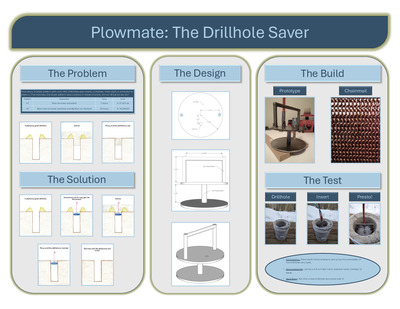
Plowmate: The Drillhole Saver
Hunter Keller and Tathagata Ghosh
Plowmate is a novel solution in mitigating the loss of a drill pattern under snow. When a storm is imminent, Plowmate is installed into each hole. After the storm passes, the drill pattern is quickly plowed. Plowmate is removed with the integrity of each drill hole remaining intact.
-

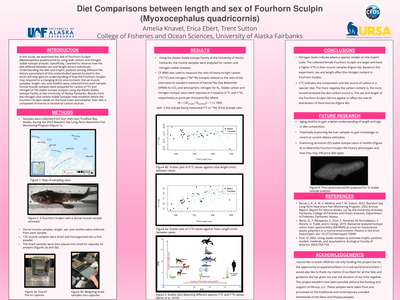
Diet Comparisons between length and sex of Fourhorn Sculpin (Myoxocephalus quadricornis)
Amelia Knavel, Erica Ebert, and Trent Sutton
Samples of Fourhorn Sculpin were collected from the Beaufort Sea. Dorsal muscle samples, length, sex, and otoliths were taken from each sample. The muscle samples were prepared for carbon and nitrogen stable isotope analysis. Otoliths were set in resin, cut, and polished for aging and strontium stable isotope analysis.
-
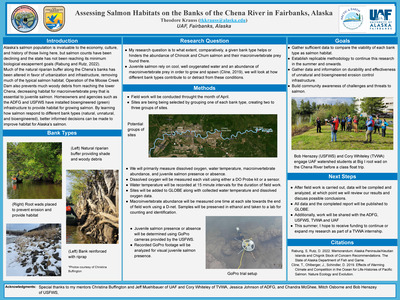
Assessing Salmon Habitats on the Banks of the Chena River in Fairbanks, Alaska
Theodore Krauss, Christina Buffington, and Cory Whiteley
UAF student and Tanana Valley Watershed Association investigate different types of riverbanks including natural, bioengineered, and riprap banks in order to assess the extent to which they contribute to or detract from macroinvertebrate abundance and salmon habitation on the Chena River after river break up.
-
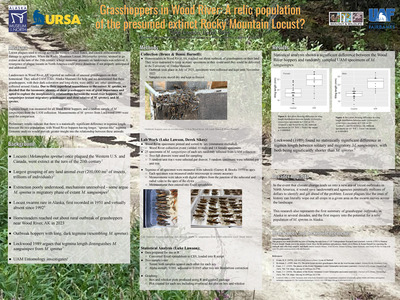
Grasshoppers in Wood River: A relic population of the presumed extinct Rocky Mountain Locust?
Luke Lawson and Derek Sikes
Investigation into the taxonomy of a grasshopper outbreak in rural Alaska.
-

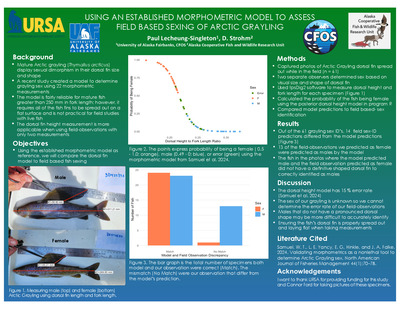
Using an established morphometric model to assess field-based sexing of Arctic grayling
Paul Lecheung-Singleton and Deanna Strohm
Arctic grayling display sexual dimorphism in dorsal fin shape and size. A recent study established a reliable model for fish sex determination using morphometric measurements, but its application is time-consuming. Our objective is to assess the accuracy of field-based fish sexing using the established morphometric model as a reference.
-
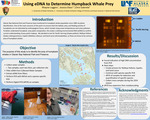
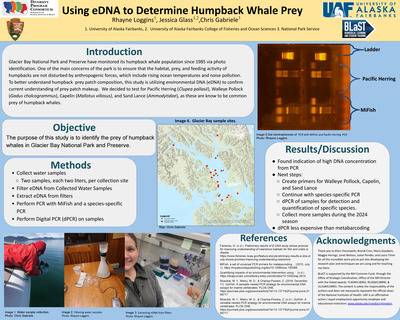
Using eDNA to determine Humpback Whale Prey
Rhayne Loggins, Jessica Glass, and Chris Gabriele
Identify the prey of humpback whales in Glacier Bay National Park and Preserve by preforming digital PCR on eDNA samples collected by feeding whales.
-
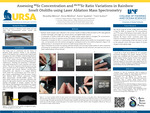
Assessing 88Sr Concentration and 86/87Sr Ratio Variations in Rainbow Smelt Otoliths using Laser Ablation Mass Spectrometry
Nivedita Menon, Anna Medina, Karen Spaleta, and Trent Sutton
This study aims to understand Rainbow Smelt life history traits in Beaufort Sea's nearshore waters. Our objective is to analyze Rainbow Smelt otolith 88Sr concentrations and 86/87Sr ratios in marine and freshwater sites. We hypothesize that there are higher 88Sr concentrations and 86/87Sr ratios in marine otolith edges.
-
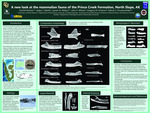
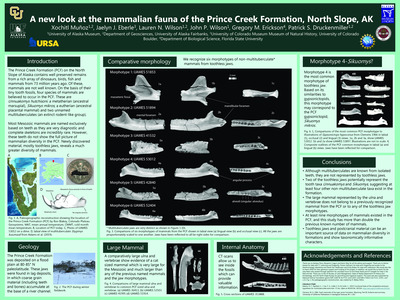
A new look at the mammalian fauna of the Prince Creek Formation, North Slope, AK
Xochitl Muñoz, Lauren Wilson, and Patrick Druckenmiller
The Prince Creek Formation is famous for polar dinosaurs, but it also contains ancient mammals, four species of which were previously known from studying teeth. However, we have found a greater diversity and identified nine morphotypes of mammals from jaws and skeletal material, more than doubling the previous known number.
-
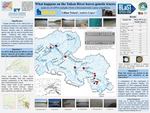
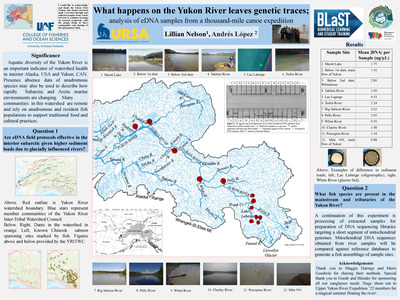
What happens on the Yukon River leaves genetic traces; analysis of eDNA samples from a thousand-mile canoe expedition
Lillian Nelson and J. Andres Lopez
In the summer of 2022, I collected eDNA samples on a six-week self-supported expedition along the upper one thousand miles of the Yukon River. While traveling along the upper half of the river, I was able to take samples in many different ecosystems and from different classifications of tributaries that contribute to the main flow of the Yukon. The Yukon and some of the tributaries are known for having high sediment loads. My first five samples were focused on the headwaters of the main Yukon, and sampling upstream and downstream of the two dams supporting the community of Whitehorse. After this, I sampled at the confluences of major tributaries. The samples were then transported back to Fairbanks following the expedition. The fish DNA was extracted from the eDNA filters, and I have been doing the genetics since. Eventually, the samples will be processed utilizing metabarcoding techniques to determine which fish species were present at the various sample sites.
-

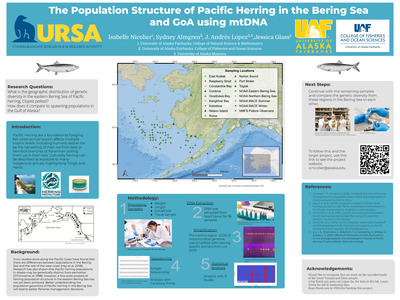
The Population Structure of Pacific Herring in the Bering Sea and Gulf of Alaska using mtDNA
Isabelle Nicolier, Sydney Almgren, and Jessica Glass
To inform sustainable management practices an extensive understanding of population genetic structure and diversity is needed. This project builds on previous work to analyze the population structure and genetic diversity of regional Pacific Herring stocks. By analyzing the control region 1 (COI) gene in the mitochondrial genome and comparing samples throughout Alaska's waters.
-
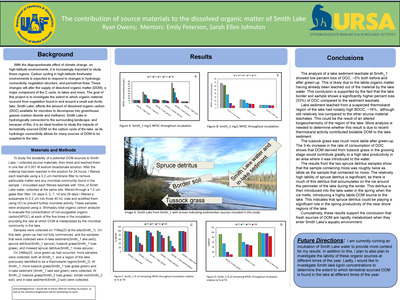
The contribution of source materials to the dissolved organic matter of Smith Lake
Ryan Owens, Sarah Ellen Johnston, and Emily Peterson
Evaluation of the sources of biodegradable dissolved organic matter in Smith Lake in the context of a changing climate and hydrologic cycle.
-

What I Learned From My Mom (お母さんから学んだこと)
Paradise Porter
Japanese Language Speech What I Learned From My Mom (お母さんから学んだこと)
-

Improving Hydrogen Production Efficiency from Electrode Surface Modifications
Nicholas Samuel and Sun Woo Kim
This project explores how surface modifications of the metal electrodes used in electrolysis can improve the efficiency of hydrogen gas production. Water electrolysis is a key player in providing clean energy for a greener future.
-
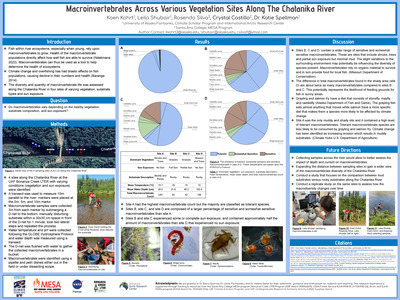
Macroinvertebrates Across Various Vegetation Sites Along the Chatanika River
Leila Shubair, Koen Kohrt, and Katie Spellman
Our project was to look at the salmon fry diet and see what was present in the Chatanika River. We wanted to see if erosion of the rivers would be a problem to the salmon fry diet. To better understand how well the salmon population is doing regarding climate change.
-
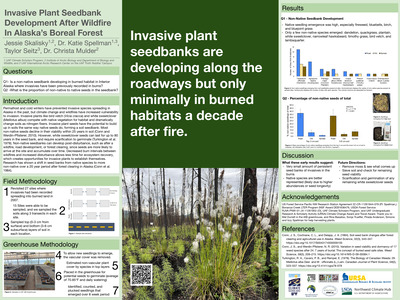
Invasive Plant Seedbank Development After Wildfire in Alaska’s Boreal Forest
Jessie Skalisky and Katie Spellman
Wildfire and invasive species are increasing across Alaska as the climate changes. My study focuses on the development of an invasive species seedbank in soils from burns in Interior Alaska. What species of seeds are there and what does this mean for the vulnerability of Alaska in the future?
-
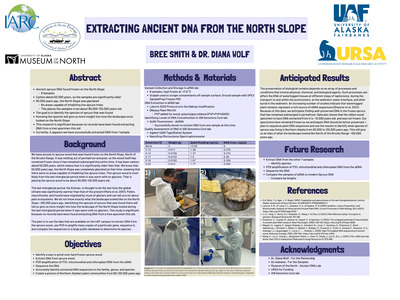
Extracting Ancient DNA From the North Slope
BreAnna Smith and Diana Wolf
Eight samples of ancient spruce DNA were found frozen on the North Slope. The samples are about 80,000-130,000 years old. 50,000 years ago, the North Slope was glaciated. We have successfully extracted DNA from 1 sample. We will conduct future extractions on the remaining samples and identify their species.
-
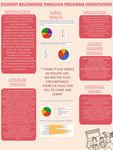
Student Belonging through Program Orientation
Charles Stark and Retchenda George-Bettisworth
Student Belonging and Community in an online asynchronous program through Program Orientation and an online community hub.
-
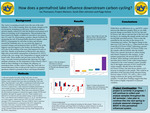
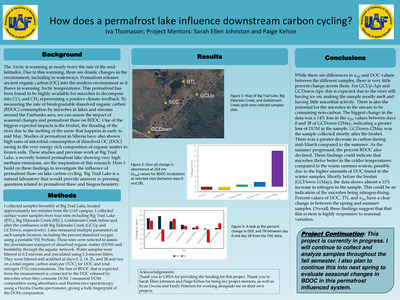
How does a permafrost lake influence downstream carbon cycling?
Iva Thomason, Paige Kehoe, and Sarah Ellen Johnston
The Arctic is warming at nearly twice the rate of the mid-latitudes. Due to this warming, there are drastic changes in the environment, including in waterways. Permafrost releases ancient organic carbon (OC) into the modern environment as it thaws in warming Arctic temperatures. This permafrost has been found to be highly available for microbes to decompose into CO2 and CH4 representing a positive climate feedback. By measuring the rate of biodegradable dissolved organic carbon (BDOC) consumption by microbes in lakes and streams around the Fairbanks area, we can assess the impact of seasonal changes and permafrost thaw on BDOC.
-
Understanding Introductory Geometry Through Music, Movement, and Listening
Beatrice Turley and Sean Dowgray
Turley's project, mentored by Dr. Sean Dowgray, centers around the Alaskan public school standard geometry curriculum and integrates percussion instruments into the lesson plan to strengthen students' fundamental understanding of mathematical concepts
-
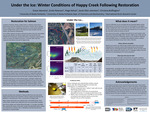
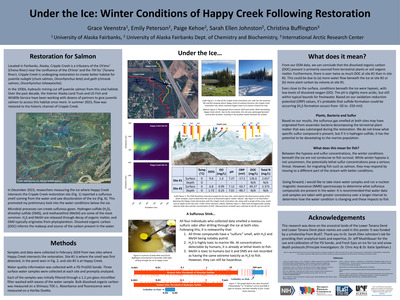
Winter Conditions of Happy Creek following Restoration
Grace Veenstra and Christina Buffington
Following a restoration project of Cripple Creek, we are still learning about the impacts it had on the creek ecosystem. Using water quality and water sample data, this poster offers insight into the current winter conditions of Happy Creek, and what these conditions imply for fish survival under the ice.
-
When Hiragana Turned to Kanji (ひらがなが漢字に変わる時)
Gavi Ximenez
Japanese Language Speech When Hiragana Turned to Kanji (ひらがなが漢字に変わる時)
Printing is not supported at the primary Gallery Thumbnail page. Please first navigate to a specific Image before printing.