-
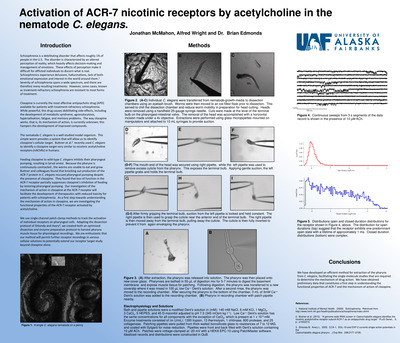
Activation of ACR-7 nicotinic receptors by acetylcholine in the nematode C. elegans.
Jonathan McMahon and Alfred Wright
-
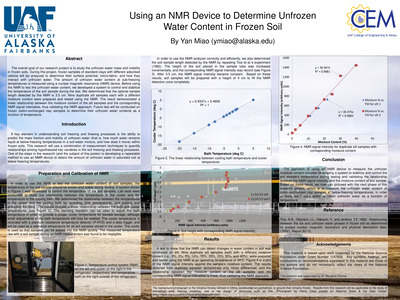
Using an NMR Device to Determine Unfrozen Water Content in Frozen Soil
Yan Miao
The overall goal of our research project is to study the unfrozen water mass and mobility in frozen soils. During this project, frozen samples of standard clays with different adsorbed cations will be analyzed to determine their surface potential, micro-fabric, and how they interact with unfrozen water. The amount of unfrozen water content at sub-freezing temperatures is measured using a nuclear magnetic resonance (NMR) device. Before using the NMR to test the unfrozen water content, we developed a system to control and stabilize the temperature of the soil sample during the test. We determined that the optimal sample length detected by the NMR is 3.5 cm. Nine duplicate silt samples each with a different moisture content were prepared and tested using the NMR. The result demonstrated a linear relationship between the moisture content of the silt samples and the corresponding NMR signal intensities, thus validating the NMR approach. Future test will be conducted on frozen cation-exchanged clay samples to determine their unfrozen water contents as a function of temperature.
-
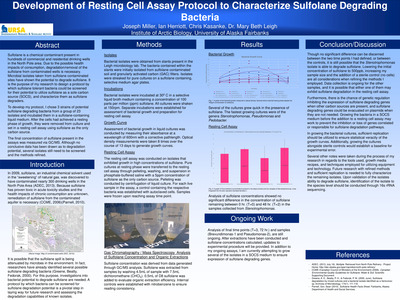
Development of Resting Cell Assay Protocol to Characterize Sulfolane Degrading Bacteria
Joseph Miller, Ian Herriot, and Chris Kasanke
Sulfolane is a chemical contaminant present in hundreds of commercial and residential drinking wells in the North Pole area. Due to the possible health impacts of consumption, degradation/removal of the sulfolane from contaminated wells is necessary. Microbial isolates taken from sulfolane contaminated sites have shown the potential to degrade sulfolane. It is the purpose of my research to design a protocol by which sulfolane tolerant bacteria could be screened or their potential to utilize sulfolane as a sole carbon source (SOCS), and characterize them as sulfolane degraders.
-
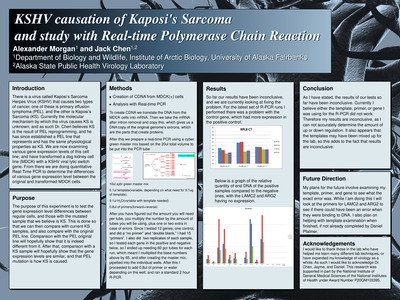
KHSV causation of Kaposi's Sarcoma and study with Real-time Polymerase Chain Reaction
Alexander Morgan and Jack Chen
-
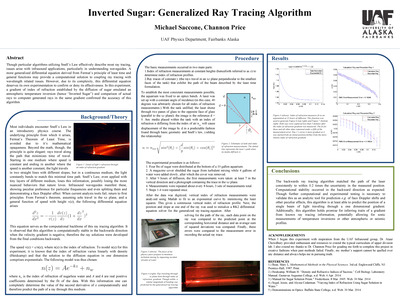
Inverted Sugar: Generalized Ray Tracing Algorithm
Michael Saccone and Channon Price
Though particular algorithms utilizing Snell’s Law effectively describe most ray tracing, issues arise with infrasound applications, particularly in understanding waveguides. A more generalized differential equation derived from Fermat’s principle of least time and general functions may provide a computational solution to coupling ray tracing with wavelength related issues. However, due to its complexity, this differential equation deserves its own experimentation to confirm or deny its effectiveness. In this experiment, a gradient of index of refraction established by the diffusion of sugar emulated an atmospheric temperature inversion (hence “Inverted Sugar”) and comparison of actual rays to computer generated rays in the same gradient confirmed the accuracy of this algorithm.
-
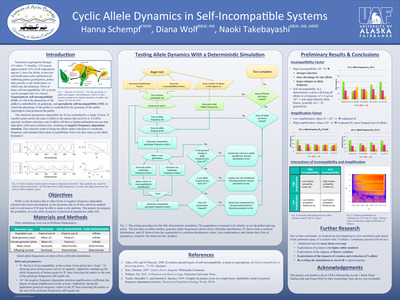
Cyclic Allele Dynamics in Self-Incompatible Systems
Hanna Schempf, Diana Wolf, and Naoki Takebayashi
-
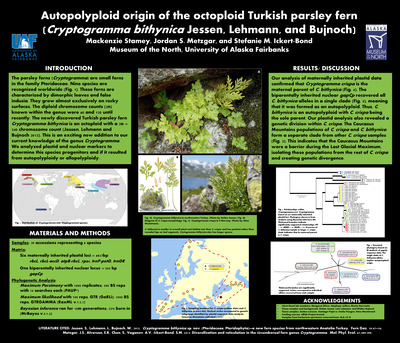
Autopolyploid origin of the octoploid Turkish parsley fern (Cryptogramma bithynica Jessen, Lehmann, and Bujnoch)
Mackenzie Stamey, Jordan S. Metzgar, and Stefanie M. Ickert-Bond
-
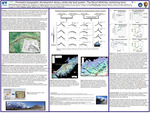
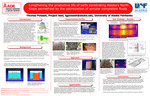
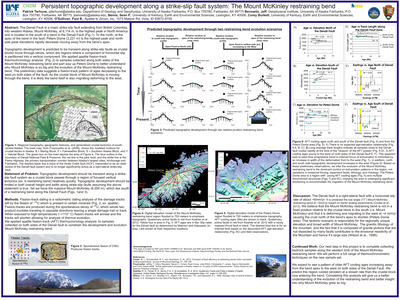
Persistent topographic development along a strike-slip fault system: The Mount McKinley restraining bend
Patrick Terhune, Jeff Benowitz, Sean P. Bemis, Corey Burkett, and Paul B. O'Sullivan
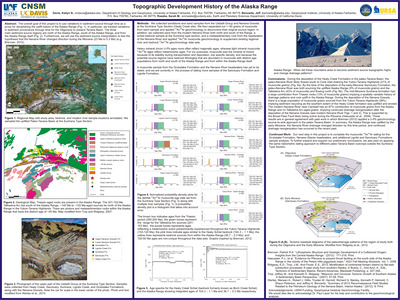
The Denali Fault is a major strike-slip fault extending from British Colombia, into western Alaska. Mount McKinley, at 6,114 m, is the highest peak in North America and is located to the south of a bend in the Denali Fault (Fig.1). To the north, at the apex of the bend in the fault, Peters Dome (3,221 m) is the highest peak and north-side peak elevations rapidly decrease moving away from the bend’s apex.
-
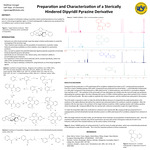
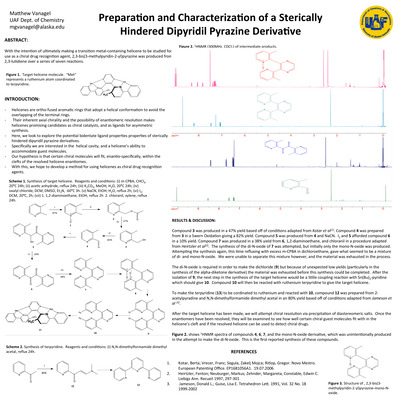
Preparation and Characterization of a Sterically Hindered Dipyridil Pyrazine Derivative
Matthew Vanagel
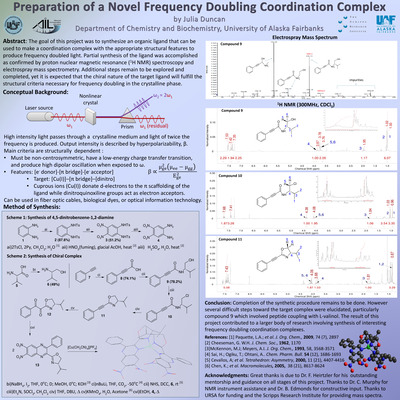
With the intention of ultimately making a transition metal-containing helicene to be studied for use as a chiral drug recognition agent, 2,3-bis(3-methylpyridin-2-yl)pyrazine was produced from 2,3-lutidiene over a series of seven reactions.
-
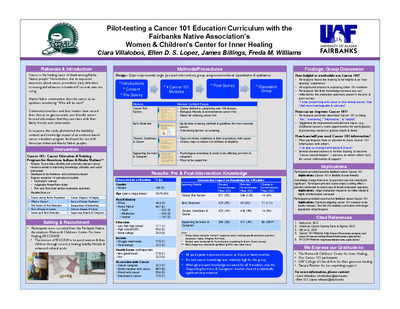
Pilot-testing a Cancer 101 Education Curriculum with the Fairbanks Native Association’s Women & Children’s Center for Inner Healing
Ciara Villalobos, Ellen D. Lopez, James Billings, and Freda M. Williams
Cancer is the leading cause of death among Alaska Native people Nevertheless, due to improved detection awareness about cancer prevention, early screening and advances in treatment survival rates are rising.
-
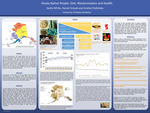
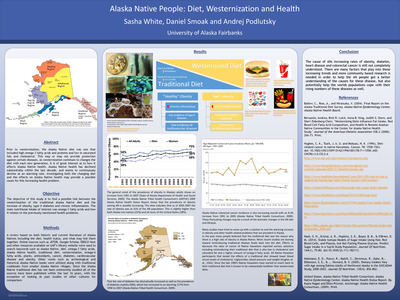
Alaska Native People: Diet, Westernization and Health
Sasha White, Daniel Smoak, and Andrej Podlutsky
Prior to westernization, the Alaska Native diet was one that included high omega-3 fatty acids and proteins and low in saturated fats and cholesterol. This may or may not provide protection against certain diseases. As westernization continues to changes the diet with each new generation, it is of great interest as to how it affects Alaska Native health. Alaska Native health has declined substantially within the last decade, and seems to continuously decline at an alarming rate. Investigating both the changing diet and the effects on Alaska Native health may provide a possible cause for this increasing health problem.
-
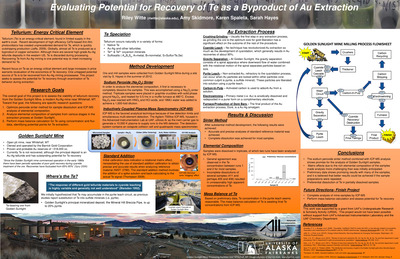
Evaluating Potential for Recovery of Te as a Byproduct of Au Extraction
Riley Witte, Amy Skidmore, Karen Spaleta, and Sarah Hayes
Printing is not supported at the primary Gallery Thumbnail page. Please first navigate to a specific Image before printing.