
Files
Download Full Text (13.8 MB)
Description
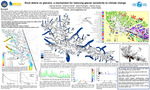
Rock debris covering a glacier surface affects the local melt rate by regulating the amount of solar energy available for melting. Supraglacial debris with a thickness of about 2 cm or more insulates the ice, thereby reducing the heat flux. This reduction of melt rate allows heavily debris-covered glaciers to extend further down-valley than meteorological variables alone would suggest. Here we present a regional study of supraglacial debris cover in the Delta Mountains, a sub-range of the Alaska Range. Using remote sensing and in situ measurements we consider the following questions: -How does glacier and debris-covered area change from 1986 to 2010? -Can we estimate debris thickness remotely? -How does debris affect melt? -Will ice melt cease below two meters of debris? -Is there a correlation between geologic setting and debris cover?
Publication Date
4-17-2012
Keywords
URSA, Research Day
Recommended Citation
Herreid, Samuel, "Rock debris on glaciers: a mechanism for reducing glacier sensitivity to climate change" (2012). 2012 Research Day Posters. 19.
https://ualaska.researchcommons.org/uaf_ursa_2012_posters/19
Handle
http://hdl.handle.net/11122/1517