-
Direct Satellite Communications
Alex Hills
Mobile radio communications in Alaska are not always effective along our highways, marine system, and remote field sites. This ineffective mobile radio communications coverage is due in part to the lack of repeaters in appropriate locations and an excess of users on certain frequencies. Lower frequencies can propogate over hilly areas whereas higher frequencies tend to travel in straight lines and are shielded by hills, ridges, and tall buildings. A new communications system called Mobile Satellite Service (MSS) may be available for use in the State in three or four years. The MSS system utilizes a satellite link between the transmitting station to the receiving station. The system is best suited for areas with few path obstructions therefore use in remote, rural areas where other forms of communication are unavailable or unreliable is very appropriate. This interim report identifies candidate applications in the state and determines coverage which will be provided in Alaska by each of the proposed satellites. The final report will give specific recommendations for feasible applications and include a technical and economical analysis of mobile satellite operations in Alaska, specifying technical requirements and defining potential operating difficulties.
-
Performance Characteristics of a Remote Alaskan Meteor Burst Telemetry System
Otto Johansen and T.D. Roberts
-
Part-Load Economy of Diesel-Electric Generators
James B. Malosh and Ronald Johnson
Diesel-electric generators used to produce power in rural Alaska are often found to be inefficient and suffer from premature mechanical failures. Such failures are commonly caused by hydrocarbon build-up in the engine resulting from long-term operation under light-load conditions. There are several feasible approaches to this problem which use proven technology. The most technologically direct approach is to properly size systems. Another involves the optimum control of engine oil, coolant and intake air temperature with thermostatically-controlled electric heaters. Economic analysis shows that this approach could save as much as $13,000 per year in the cost of electricity for a 100 kw diesel generator operating at 25% load. However, further research is needed to establish that the mechanical problems associated with part-load operation are actually abated with proper control of operating temperatures. Practical experience implies that this should be the case. Acoustically tuned low restriction intake and exhaust systems are also an attractive approach because they provide a definite increase in efficiency under all operating conditions. However, these units must be developed for a specific engine and operating speed range. They are not presently commercially available, but could be developed in a continuing research effort. Parallel operation of small diesel-electric generators was suggested by many vendors and operators as a method of improving part-load performance. Though it has the benefit of redundant reliability, the economic analysis does not show a clear advantage because of higher electrical costs near full-load conditions. At very low loads, single small units may also suffer from the same mechanical problems as the large units. The other methods of improving part-load performance which include the use of improved injectors and microprocessor-controlled injection pumps are not presently feasible. However, the state of diesel engine technology is changing so rapidly that these items could become feasible in less than two years. These developments should be monitored closely.
-
Pilot Plant Studies and Process Design for the Production of Calcim-Magnesium Acetate
R.D. Ostermann and M.J. Economides
Chloride salts are commonly used as deicing chemicals in many northern states. These chemicals are corrosive to automobiles, bridge decks and other public structures, and cause considerable damage to plants found near salted roadways. Calcium Magnesium Acetate (CMA) offers potential as an alternate deicing chemical. CMA is a generic term applied to the reaction product of acetic acid and limestone. It is non-corrosive and has no known potential to cause environmental damage. During 1982-194, over 12,000 gallons of saturated CMA solution were produced by researchers in the Petroleum Engineering Department of the University of Alaska - Fairbanks. The raw materials were acetic acid, hydrated lime and native limestone. The product CMA solution was used in road tests in Fairbanks as well as for environmental studies. The results of these pilot plant studies is presented in this report. A process design for the production of 12,000 GPD of CMA from native limestone based on the results of the pilot plant studies is presented. For a grass-roots operation located in Fairbanks, the total capital cost is estimated at $215,000, including site and structure costs. Using current prices for acetic acid, limestone and hydrated lime, a product price of $413 per ton (dry CMA equivalent) is required for a 15% annual rate of return. It should be noted that raw materials costs amount to over 85% of the annual operating costs with capital cost amortization amounting to only 2% of the product cost. The process economics are thus relatively insensitive to changes in capital costs due to process design changes. Moreover, acetic acid cost alone accounts for 70% of the product price. The key to reducing the price of CMA lies in obtaining inexpensive acetic acid.
-

Corrosion of Steel in Calcium-Magnesium-Acetate (CMA) Deicier
Eswarahalli S. Venkatesh and Stephanie Kutterer
The corrosiveness of a new road deicer, Calcium Magnesium Acetate (CMA), was determined under various conditions of temperature, pH, and concentration. The corrosion rates of steel in CMA solutions were generally found to be of the order of 2 mils per year (mpy). In comparison, for the currently used chloride salt deicers the corrosion rates can range from 25-80 mpy. CMA is generally found to be a non-corrosive medium compared to sodium and calcium chloride. Although this preliminary corrosion research indicates that CMA is less corrosive to steels than salts, further work is necessary to confirm the corrosion characteristics of CMA on other materials. Additional studies should be performed on environmental and aesthetic aspects before widespread application of CMA as a road deicier.
-

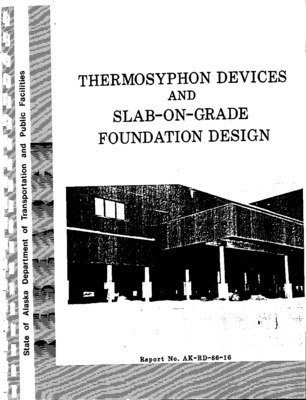
Thermosyphon Devices and Slab-on-Grade Foundation Design
John P. Zarling and F. Donald Haynes
Subgrade cooling methods to prevent thermal degradation of permafrost in cold regions include the use of thermosyphons with inclined evaporator sections. This laboratory study was conducted to determine the thermal performance characteristics of two commercially available thermosyphons. Evaporator inclination angles ranged from 0(degrees) to 12(degrees) from the horizontal, and air speeds ranged from 0 to 13.4 miles per hour over the finned condenser sections. Two standard full size thermosyphons, one charged with CO2, carbon dioxide and the other with NH3, anhydrous ammonia, were tested in CRREL's atmospheric wind tunnel. Empirical expressions are presented for heat removal rates as a function of air speed, ambient air temperature and evaporator inclination angle. An analytical method is also presented to approximate thermal design of foundations using thermosyphons under buildings with a slab-on-grade. We present heat gains from the slab and pad to the thermosyphon as well as the evaporator temperature as functions of time.
-
Determination of Seasonal, Frequency and Durational Aspects of Streamflow with Regard to Fish Passage Through Roadway Drainage Structures
William S. Ashton and Robert F. Carlson
Optimal design of culverts for fish passage for each stream crossing requires the magnitude, duration, frequency and seasonal relationship of the flow and the timing of fish movement. Although previous studies have measured fish swimming abilities and culvert water velocity profiles, there are limited studies in northern regions of the hydrologic relationship among magnitude, duration, frequency and season of discharge for the design of culverts for fish passage. We analyzed streamflow records from 33 gaging stations in southcentral, western, interior, and arctic Alaska (from watersheds with a drainage area less than 100 sq. miles each) to determine the highest consecutive mean discharge with one-, three-, seven and fifteen-day durations, and the lowest consecutive mean discharge with three-, seven-, fourteen- and thirty-day durations. Streamflow during three seasons were analyzed: spring, April 1 to June 30; summer, July 1 to August 31; and fall, Septermber 1 to November 30. The lognormal distribution, using the Blom plotting position formula, was used to estimate flows at recurrence intervals of 1.25, 2, 5, 10 and 20 years. Multiple linear regression equations were developed to predict flows from ungaged watersheds. Significant basin and climatic characteristics for high flows were drainage area, mean annual precipitation and percent of the drainage basin with forest cover. Significant characteristics at low flows were drainage area, mean minimum January temperature, mean annual precipitation and percent of drainage basin covered by forests. This report provides the culvert designer with equations to predict flows, other than the instantaneous peak flow, for use in designing culverts for fish passage. Two example problems are given to show the application of these equations.
-
Rural Alaska Electric Power Quality
J.D. Aspnes
Poor quality electric power has traditionally been blamed for electrical and electronic equipment malfunctions and failures in rural Alaskan communities. This report presents results of a recently completed project in which power system disturbance analyzers provide the first comprehensive power quality data from Alaskan villages. Power systems of four widely separated communities were studied for a total of 1,010 days. These results are important because of the trend in rural Alaska toward more sophisticated equipment that is sensitive to power system disturbances. These data represent a first step in developing appropriate countermeasures to protect electrical systems connected to isolated rural 60 Hz power generator facilities
-
Thermal Properties of Metal Stud Walls
John P. Zarling, W. Alan Braley, James S. Strandberg, and Scott V. Bell
-
Heat Loss Factors for Insulated Building Foundations
J. P. Zarling and W. A. Braley
Steady-state and nonsteady-state finite element analyses of the heat loss occurring from basement and slab-on-grade constructions have been performed. The amount of rigid foam insulation was varied on the perimeter of the walls and slab to determine the effectiveness of various insulation configurations. Annual heat losses per linear foot of wall or slab are reported for weather conditions and soil types of both Anchorage and Fairbanks, Alaska.
-
Product Evaluation: Presto Roadbase Sand Confinement Grid
Nicolaas F. Coetzee
The Alaska Department of Transportation and Public Facilities is continuously looking for methods of using marginal soils for roadway and airport embankments. In areas such as the Western coast of Alaska, where quality materials must be imported and therefore are prohibitively expensive, the use of native soils represents a significant cost savings to the State. The Army Corps of Engineer Experimental Waterways Station has developed a method of stabilizing sand using a plastic grid system. This report analyzes the system for use in Western Alaska using a finite element analysis and the Chev5L computer program. These analysis indicate that the grid system is at least equal to 6 inches of crushed aggregate. The bearing capacity of the sand is greatly enhanced since lateral displacement is eliminated. Although additional work is still required, it is expected that the sand grid system discussed in this report will ultimately result in a significant cost savings in embankment construction in Western Alaska
-
Fuel Cell Power Plants in Rural Alaska
J. B. Malosh
On the basis of fuel efficiency alone, the methanol fueled phosphoric acid fuel cell (PAFC) is a very attractive replacement for the diesel electric generator, especially in the bush regions of Alaska. However, because of the transportation costs for liquid fuel to the bush combined with the lower heating value of methanol, the PAFC looses this advantage and produces electricity that in some instances is more costly than the diesel generator. Although the PAFC is at the highest state of development of all fuel cell power plants, it is still not a commercially mature technology. The present cost of a PAFC power plant is on the order of ten times the price of an equivalent diesel electric generator. There is also no large body of published, long term data on fuel cells of any type larger than 1 kw from which an accurate assessment of reliability, maintenance and operating costs can be made. Considering this and the lack of electrical production cost advantage, the evaluation of the methanol fueled PAFC for buch applications should be suspended until more operational data is made public and units are commercially available.
-
An Analytical Study of Passive Solar Energy and Mass Storage: Observations from a Test Building in Fairbanks, Alaska
Richard D. Seifert and George S. Mueller
-
Solar Assisted Culvert Thawing Device Phase II
John P. Zarling and Douglas H. Murray
A reflective type concentrating solar collector system has been designed, constructed and installed on an ice plugged roadway culvert as a means of melting a channel for water flow. The system consisted of four reflecting collectors, a circulating pump, and a thaw pipe mounted in the culvert. Photovoltaic panels were used as the source of power for the pump. A design analysis and performance characteristics are given for the solar collectors, circulating pump, and photovoltaic panels.
-
A Thermal Performance Design Optimization Study for Small Alaskan Rural Schools
John Zarling and James S. Strandberg
-
Report Supplement: Thermal and Cost Analysis of Thermal Envelopes for a Small Rural School
John Zarling, James S. Strandberg, N/A Maynard and Partch, and Inc. HMS
-
Preliminary Design and Feasibility Study for a Calcium-Magnesium Acetate Unit
M. J. Economides and R. D. Ostermann
The adverse environmental effects and corrosion problems associated with the use of chloride salts as de-icing agents have prompted a search for alternative de-icing compounds. Calcium and Magnesium Acetates (CMA) exhibit excellent de-icing characteristics yet are not corrosive or harmful to the environment. A viable process design for the production of CMA has been developed based on the results of a series of kinetic reaction experiments conducted at the University of Alaska. Acetic acid and native Alaskan limestones were used as the raw materials. An economic evaluation of the process indicates a selling price of less than $600/ton of solid CMA, based on teh production of a saturated, aqueous CMA solution in small scale facilities (10,000 - 50,000 gallons/day). At the upper range of production rates studied (50,000 GPD) and for an acetic acid cost of $1.25/gallon, the calculated CMA price was $290/ton of solid. This represents a minimum price and is attractive when compared with the cost of other de-icing compounds. The results of this cooperative project between the Petroleum Engineering Department at the University of Alaska, Fairbanks and the State D.O.T. are highly encouraging. With the use of native Alaskan limestone and acetic acid, the process economics point toward a high quality, competitively priced product. The environmental advantages of CMA over Chloride salts and reduced secondary costs due to lower corrosion rates for vehicles and bridges indicate that CMA may become the premier de-icing agent.
-

Air-to-Air Heat Recovery Devices for Small Buildings
John P. Zarling
With the escalation of fuel costs, many people are turning to tighter, better insulated buildings as a means of achieving energy conservation. This is especially true in norther climates, where heating seasons are long and severe. Installing efficient well sealed vapor barriers and weather stripping and caulking around doors and windows reduces cold air infiltration but can lead to damaging moisture buildup, as well as unpleasant and even unhealthy accumulations of odors and gases. To provide the necessary ventilation air to maintain air quality in homes while holding down energy costs, air-to-air heat exchangers have been proposed for residential and other simple structures normally not served by an active or forced ventilation system. Four basic types of air-to-air heat exchangers are suited for small scale use: rotary, coil-loop, heat pipe, and plate. The operating principles of each of these units are presented and their individual advantages and disadvantages are discussed. A test program has been initiated to evaluate the performance of a few commercial units as well as several units designed and/or built at the University of Alaska. Preliminary results from several of these tests are presented along with a critique on their design.
Printing is not supported at the primary Gallery Thumbnail page. Please first navigate to a specific Image before printing.