-
Preliminary Study on Snowplow Survivability of Guardrail Terminals
Zhongguo (John) Ma and Steven P. Mattingly
FHWA has asked Alaska Department of Transportation and Public Facilities (DOT&PF) to fix damaged longitudinal and end sections of guardrail throughout Alaska's road system. The proposed research evaluates W-beam guardrail end terminals (GET) which are installed along roads in heavy-snow areas of Alaska. Primarily, it is important for DOT&PF to determine how well GET withstand loads generated during snow plowing and blowing operations. Based on this preliminary study, the following conclusions are made (1) Anecdotal evidence indicates that the newly installed SRT-350s are not very forgiving (because they are designed to be crash-friendly), and relatively minor contact between the snow removal equipment and the terminal may result in terminal failure and at least some damage. (2) There are two types of damage to the newly installed SRT-350s; (a) damage due to contact between the snow removal equipment and the terminal; and (b) damage resulting from the pressure of the snow (snow-only contact). The first type is the most likely damage observed in field visits. The damage due to snow-only contact can occur in heavy snow area. (3) Except in heavy snow area, the average replacement rate for newly installed SRT-350s can be reduced to about the same level as the traditional BCTs if the snowplow operator learn to respect the new terminals more and provide them with a wide berth. To achieve this, it is very important to mark the end of the terminal as well as the beginning of the flare of the terminal. With both locations marked, an operator can carefully avoid the entire length of the terminal. (4) Further research is needed to investigate guardrail end terminals which are more durable or are easily repaired.
-
Parks Highway Load Restriction Study Field Data Analysis
Luffi Raad
The loss of pavement strength during spring thaw could result in excessive road damage under applied traffic loads. Damage assessment associated with the critical thaw period is essential to evaluate current load restriction policies. The Alaska Department of Transportation and Public Facilities (AKDOT&PF) proposed a plan which will provide an engineering analysis fo field conditions with 100% loads on the Parks Highway for 1996. The study was jointly conducted by AKDOT&PF, the Alaskan Trucking Association (ATA), and the University of Alaska Fairbanks Institute of Northern Engineering Transportation Research Center (TRC). Extensive field data were collected and analyzed in an effort to monitor pavement damage during the spring of 1996 and determine the loss of pavement strength. The field data included: 1. Truck traffic data using the Chulitna weigh in motion (WIM) station and the scalehouses at Eagle River and Ester. WIM data were obtained for both northbound and southbound traffic from 199301996. Scalehouse data were obtained for Spring 1996 for comparison with WIM spring data. 2. Pavement temperature data (Spring 1996) for seven ground temperature sites representing typical conditions along the Parks Highway. 3. Profilometer data for pavement roughness and rutting obtained yearly (1993, 1995, and 1996) and also monitored over shorter intervals during Spring 1996. In addition, rut-bar measurements at selected points were also monitored during Spring 1996. 4. Falling Weight Deflectometer (FWD) data for both the northbound and southbound lanes for selected sections in lengths of eight 8 km (5 mile) along the Parks Highway. These data were used in backcalculation of pavement layer moduli, fatigue strength of the asphalt concrete surface, and corresponding damage factors resulting from spring-thaw weakening. Field data were used to analyze the damage effects on the Parks Highways. These included: analysis and comparison of WIM and scalehouse traffic data; determination of overweight axle loads and vehicles; comparison of north- and southbound traffic and its effect on pavement damage; analysis of ground temperature for thaw initiation and propagation; and simulation of the pavement's remaining life, with and without load restrictions, using mechanistic methods. This report presents results of these analyses.
-
Air Convection Embankment Experimental Feature Design
Douglas J. Goering
Prior research work (Goering and Kumar, 1996; and Goering, 1996) has indicated that Air Convection Embankments are a promising technique for limiting the thaw settlement damage that often occurs when roadway embankments are constructed in regions of warm permafrost. These studies lead to the proposal of a full-scale experimental Air Convection Embankment (ACE) to be constructed through the Federal Experimental Features in Construction Program. A work plan for including an ACE in the Parks/Chena Ridge Interchange project (Federal Project No. I-0A4-5(7), State of Alaska Project No. 63538) was forwarded and approved in 1994. This project report discusses the design and construction of the Parks/Chena Ridge ACE expermimental feature which occurred during 1996 and 1997.
-
Rural Facility Electric Power Quality Analysis
J.D. Aspnes, Y. Q. Zhao, B.D. Spell, and R.P. Merrit
This report gives results of a recently completed data collection and analysis project investigating electric power quality of two isolated utility systems in Alaska. This is the second phase of a similar effort reported in 1984 which provided the first comprehensive power quality data from four small Alaskan communities. In this report, second generation instrumentation is described and comprehensive data and data analyses are presented. These data are important because of the increased use throughout Alaska of electrical and electronic equipment that may be damage by power system disturbances.
-
Use of Geogrids for Limiting Longitudinal Cracking in Roads on Permafrost
Bonnie Mae Savage
Longitudinal cracking of road embankments results from lateral movement of the subbase which creates a subsurface void space. The void spaces propogate to the surface causing cracks and voids. This is hazardous to motorists and expensive to repair. This thesis examines the use of geogrids to limit lateral spreading thereby preserving safe and useable road surfaces. A field experiment, a full-scale laboratory experiment, a soil arching experiment, and behavioral and theoretical analyses are presented. Soil arching forces are quantified and developed using an experiment based on work done by Terzaghi and Kienzl. A theoretical analysis for quantifying the shear force redistribution to be used for geosynthetic embankment systems, was derived from the Soil Arching Experiment. Relationships of load, embankment resistance, deflection and geometric factors are presented. A comparison of geogrid performance to a geotextile performance for the given relationship is presented as well.
-

Rural Facility Electric Power Quality Enhancement
M. Wilson, J.D. Aspnes, R.P. Merritt, and B.D. Spell
Electric power disturbances are known to be more prevalent in small, isolated power systems than in larger interconnected grids which service most of the United States. This fact has given rise to a growing concern about the relative merits of different types of power conditioning equipment and their effectiveness in protecting sensitive electronics and essential loads in rural Alaska. A study has been conducted which compares isolation transformers, voltage regulators, power conditioners, uninterruptible power supplies and indoor computer surge suppressors in their ability to suppress the various disturbances which have been measured in several Alaskan communities. These include voltage sags and surges, impulses, blackouts, frequency variations and long-term voltage abnormalities. In addition, the devices were also subjected to fast, high-magnitude impulses such as might be expected in the event of a lightning strike to or near utility distribution equipment. The solutions for power line problems will vary for different load applications and for different rural electrical environments. The information presented in this report should prove to be valuable in making the analysis.
-
BERG2 Micro-Computer Estimation of Freeze and Thaw Depths and Thaw Consolidation
W. Alan Braley and Billy Connor
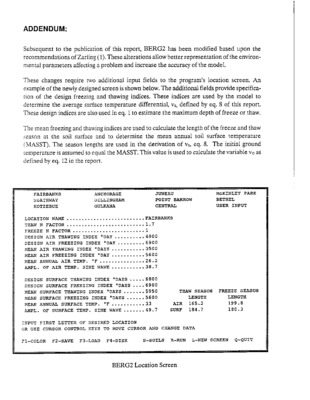
The BERG2 microcomputer program uses a methodology similar to the Modified Berggren method (Aldrich and Paynter, 1953) to estimate the freeze and thaw depths in layered soil systems. The program also provides an estimate of the thaw consolidation in ice rich soils. BERG2 differs from the original Modified Berggren method since it uses the actual frozen and unfrozen material thermal properties instead of average alues. This approach improves the accuracy of the prediction. BERG2 provides an improved user interface over the original BERG program (Braley, 1984). It also requires less input as a result of the ability to compute many of climatic parameters from the more common data. As a result the user required input is significantly reduced. This manual provides the user information concerning the use of BERG2, its strengths and its limitations. It also provides a discussion of the equations used in development of the program for those who wish a better understanding of the analysis process.
-
Cogeneration and Diesel Electric Power Production
Ronald A. Johnson
We have developed a data acquisition system to both monitor the efficiency of a diesel-electric generator set in producing electricity and to evaluate its performance as part of a cogeneration system for producting both heat and electricity. We have used this system to evaluate the performances of a 45 kW system consisting of a Mitsubishi engine coupled to a Stamford generator and an 80 kW Caterpillar system. We find that, even though the efficiency of a generator set in producing electricity decreases appreciably as the electric load decreases, the cogeneration efficiency is relatively insensitive to load. The latter includes both the electric power produced and the rate of heat recovery from the jacket water as benefits. We also found that the engine temperature as measured by jacket water temperature can be maintained at high levels even at low loads if the cooling mechanism is restricted. We accomplished this in a laboratory situation by decreasing the water flow through an externally-mounted heat exchanger used to provide a source of cooling for the engine. We also found that the 80 kW cogeneration system at Coldfoot provided about one-third of the space heat needed by the maintenance shop. The payback period was less than 2 years for this system with about 2200 gallons of fuel oil being saved annually because of heat recovery from the jacket water. Volume I contains the main body of the report; appendices are contained in Volume II.
-
Moisture-Temperature Realtionships in a Sand Due to Outward, Radial Freezing
Erling A. Juel
A "clean" sand is commonly specified as backfill around the evaporator section of thermosyphons designed to maintain the thermal regime of pernnially, frozen, thaw-unstable soils. A series of laboratory tests were performed to determine the magnitude of moisture migration. The test results indicate the moisture migration can result due to outward radial freezing in a nonfrost susceptible sand possessing a low to moderate degree of saturation. Moisture did not migrate when the sand was saturated prior to freezing. The redistribution of moisture changes the thermal properties of the soil system which effects the maximum radius of freezing by desiccating soil at the outermost radius of influence and increasing the degree of saturation around the evaporator. The desiccated soil region will experience an accelerated rate of thaw due to a lower volumetric latent heat of fusion. In addition, the radius of freezing is reduced as moisture migrates towards the evaporator section. These effects warrant additional considerations that must be addressed when designing refrigerated foundations with thermosyphons.
-
Retrofit Design of Drainage Structures for Improved Fish Passage: Literature Review
Vanessa Blevins and Robert F. Carlson
This report reviews existing literature on issues relevant to retrofitting culverts to mitigate fish passage barriers. The analysis of this information will set the stage for future laboratory experimentation on various retrofitting techniques. The topics in this report include a review of fish swimming capabilities, hydrologic factors involved in choosing a design flow, fish passage problems resulting from conventional culvert design, and potential retrofit solutions to these problems.
-
Effect of Radiant Barriers in Wall Construction
Mark Estes and Todd Olson
The performance of radiant cardboard barriers were tested and evaluated using the DOT&PF guarder hot box. Two types of insulation were used in the testing fiberglass bat and blown cellulose. The test procedure consisted of obtaining temperature measurements at designated positions throughout seven types of wall configurations. These tests showed, that the configuration with 5.5 inches of fiberglass bat insulation compressed to 4 inches with a radiant cardboard barrier allowed the least total heat flux through the wall section. An economic analysis indicated that the use of radiant barriers may be feasible in situations where insulation support is needed or an uninsulated gab is required for wiring or utilities.
-
Implementation of CALINE4
R.A. Johnson, M. Anderson, E. Lilly, and C. Hok
To help gauge the environmental impacts of proposed highway projects, computer models are commonly used to predict both CO emissions and the resultant concentrations of CO in the atmosphere. This study has focused on an assessment of MOBILE3 as a mobile source emissions model and CALINE4 as a line source dispersion model in Alaska. We have used limited data obtained in Fairbanks o evaluate CALINE4 here. We have modified MOBILE3 to allow it to predict emissions at ambient temperatures below 0(degrees)F and have incorporated available meteorological data for Fairbanks to evaluate CALINE4. We find the use of these models does allow one to approximate trends over time in CO levels in Fairbanks, but a lack of more detailed data precludes our being able to make global statements about the abilities of the models to predict peaks and detailed spatial trends. However, the results to data indicate that these models have the potential to accurately predict CO levels in Alaska. In particular, results from a 37-hour calibration run made near an intersection indicates that CALINE4, using emissions generated by MOBILE3, can predict peak one-hour and eight-hour values within a factor of two of measured values. Conservative peak value predictions occur when the intersection option is used with the wind blowing from the intersection toward the receptor. However, the nonmodeled CO contributions may be significant if only major roads near a receptor are modeled. For worst case predictions, the limited data analyzed corroborates prior work linking worst case scenarios with cold stable meteorological conditions. In particular, a G stability case and wind speed around 0.5 m/s are appropriate. We also suggest the receptor be located downwind from an intersection. For the input emissions, we suggest the use of MOBILE3 using an average vehicle speed of 20 mph and a temperature around -20(degrees)F for Fairbanks and 10(degrees)F for Anchorage. For ambient CO levels, we suggest the user consult with local environmental agency personnel.
-
Rural Electric Power Quality Analysis Data Base Development
J. Aspnes, R. Merritt, B.D. Spell, K. Woodruff, D. Alden, and G. Mulligan
The actual cost of poor quality electric power is difficult to accurately determine. Such cost information is important in determining the extent to which power quality enhancement techniques should be applied. This report presents data compiled to help determine the quantity and type of electrical and electronic equipment at risk in rural Alaska and the repair frequency of this equipment. Cost attributable to poor electric power quality are identified. Methods of electric power quality improvement and their relative costs are presented.
-
Radon Concentrations in Public Facilities in Alaska
Shelby J. Leonard, Daniel B. Hawkins, and Timothy Tilsworth
Radon levels were measured in forty public facilities throughout Alaska. Test buildings consisted mainly of schools, DOT/PF maintenance garages, and office buildings. The project had two general goals: 1) To determine whether areas of potentially high indoor radon levels can be identified based on knowledge of the bedrock geology in the area, and 2) to determine if there is cause for concern regarding radon levels in public facilities in Alaska. Radon levels measured ranged from 0.0 to 5.2 pCi/l with a mean value of 0.6 pCi/l. No conclusive evidence was found correlating radon concentration with the geology of an area. The data suggest no urgency regarding radon levels in public facilities in Alaska, especially where mechanical ventilation and positive building pressure influence the dispersion of concentrations. However, the small size of the sample and the fact that most of the buildings sampled were mechanically ventilated does not rule out the possibility that higher radon levels may yet be found.
-
Winter Highway Construction
F. Lawrence Bennet
This report focuses on the feasibility of extending the highway construction season further into the winter season than is currently practiced in Alaska. It reviews the literature of research and project experience in accomplishing several elements of succssful highway construction in the winter. It summarizes the cold weather sections of highway construction specification s from 18 states, provinces, and foreign countries. It reports on personal interviews and survey questionnaires with 24 Alaskan contractors who have been engaged in building highway elements in the winter. The report concludes that additional inter highway construction should be permitted in Alaska and urges the Department of Transportation and Public Facilities (DOT&PF) to revise its specifications, on a trial basis, for selected projects in order to permit construction of embankments and asphaltic concrete pavements at below-freezing temperatures. Further research on "cold" concrete, additive materials in embansments and construction productivity is suggested
-
1985 Alaska Field Survey of Part-Loading of Diesel-Electric Generators
Ronald Johnson and John Gray
By conducting a survey by mail, by phone and in person, we obtained information on 356 diesel electric generator sets in Alaska in 1985. User groups surveyed included the Alaska Village Electric Cooperative (AVEC), public school districts, those certified by the Alaska Public Utilities Commission, the Tanana Chiefs, and the Alaska Department of Transportation and Public Facilities. Our survey focused on part-load operation. We found that a lack of detailed site-specific data precludes making a general quantitative statement about part loading. The most detailed data, by far, are those collected by AVEC. Those data plus some other information indicate that many gensets (some for good reasons) are underloaded, especially in the summer. The simple algebraic average July and January loadings for the 44 AVEC systems surveyed are close to 35% and 50%, respectively. Minimum loads as low as 15% occurred in the summer. AVEC recognizes the potential for improvement and has increased its system-wide efficiency by 25% from 1980 to 1985.
-
Air-Flow Dindows - an Evaluation of Their Potential for use in Arctic and Sub-Arctic Environments
Frank L. Lemon
Air-flow windows, developed in Scandinavia, are being considered for application in arctic and sub-arctic environments. Air-flow windows consist of a double or triple-glazed outer sash and a single glazed inner sash. Room air is returned to the building heating, ventilating and air-conditioning system through the window every cavity existing between the inner and outer sashes, thus warming the inner pane of glass. Air-flow windows have the potential of improving room comfort and reducint building heat losses, particularly if the outdoor air requirement is greater than or at least can be matched to the air extracted through the windows. A sample air-flow window was tested in a guarded hot box at various air flow rates at cold side temperatures ranging from -50(degrees)F to +10(degrees)F. Based on the test results, U-values were calculated for winter night time conditions. The economics of this window system are discussed. The energy balance of an air-flow window is established.
-
Effects of Calcium Magnesium Acetate on Small Lentic Environments in Interior Alaska
Caryn L. Rea and Jacqueline D. LaPerriere
-
Highway Right-of-Way Sludge Disposal
T. Tilsworth and D. Manning
This report encompasses a proposal to consider application of wastewater sludge to highway right-of-way. Conventional disposal of this sludge is a complex and expensive process and in some areas is severely restricted by land use and regulations. The report includes a literature review, a national survey of highway organizations and a hypothetical design analysis. Application of sludge to highway ROW can be beneficial by supplying nutrients required for plant growth, subsequent erosion stabilization and ultimate disposal of a waste resource. Disadvantages include negative public reaction, potential for contamination of ground and surface water, aesthetics, and relatively high costs. Preliminary findings of the report indicate the process is marginally feasible and recommends that a small pilot project should be conducted prior to full-scale consideration
Printing is not supported at the primary Gallery Thumbnail page. Please first navigate to a specific Image before printing.