





-

Stem Respiration of Black Spruce (Picea mariana), Interior Alaska
Yongwon Kim and S.-D. Kim
This stem respiration, that is equipped with a control system that consists of data-logger (CR10X), NDIR CO2 analyzer, and pump, a compressor, and seven stem chambers, was conducted in parallel with the flux-measurement of soil respiration in different-sized black spruce of 4.3 cm to 13.5 cm in DBH (diameter at breast height), interior Alaska during the growing season of 2007 to 2009. The average stem respirations were 0.011±0.005 mgCO2/m3/s (range 0.005±0.002 to 0.015±0.008 mgCO2/m3/s, CV 45%) in black spruce forests, which the DBH (Diameter at Breast Height) of black spruce ranges from 4.3 to 13.5 cm. The stem respiration in different-sized black spruce forest soils has temporally varied during the growing season of 2007-9. This suggests that the young black spruce has 3-fold higher metabolism than the old. Temperature is one of critical roles in determining stem respiration rate. Q10 values on air temperature and average stem respiration rates are 2.02 in 2007, 2.00 in 2008, and 2.37 in 2009 during the growing season, respectively. However, during the dormant season, measurement of stem respiration was failed and especially the diaphragm pump was damaged by input of the extremely cold air of 35 °C below the zero. Interestingly, the lagging effect of stem respiration on temperature and PAR (photosynthetically active radiation) was found during the clear sky, indicating lagging time of 1-2 hours on temperature and of 4-5 hours on PAR, respectively. Based on the Q10 equation on air temperature, annual variation of stem respiration rate was estimated, suggesting that the relationship between measured and simulated daily stem respiration was a good linear for the better understanding of interannual variation of stem respiration rates during 2007-9. The contribution of simulated monthly stem respiration to the ecosystem respiration (Re) by the eddy covariance method was 4.2±2.1 % in 2007, 2.5±0.9 % in 2008, and 5.7±4.3 % in 2009, respectively. The suggests that the higher contribution during 2009 may be due to much higher temperature in late winter and early spring.
-
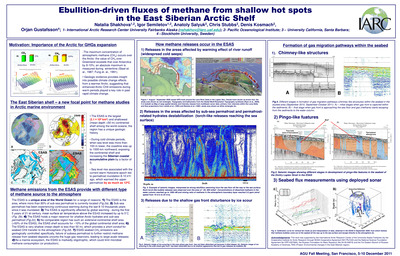
Ebullition-Driven Fluxes of Methane from Shallow Hot Spots in the East Siberian Arctic Shelf
Natalia Shakhova, Igor Semiletov, Anatoly Salyuk, Chris Stubbs, and Denis Kosmach
The maximum concentration of atmospheric methane (CH4) occurs over the Arctic: the value of CH4 over Greenland exceeds that over Antarctica by 8-10%; an absolute maximum is measured during wintertime (Steel et. al., 1987; Fung et. al., 1991). Geologic evidence provides insight into possible climate change effects from a warmer Arctic, suggesting that enhanced Arctic CH4 emissions during warm periods played a key role in past rapid climate change.
Printing is not supported at the primary Gallery Thumbnail page. Please first navigate to a specific Image before printing.