
Description
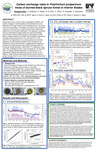
Boreal black spruce forest is highly susceptible to wildfire, and postfire changes in soil temperature and substrates have the potential to shift large areas of such ecosystem from a net sink to a net source of carbon. In this paper, we examine CO2 exchange rates (e.g., NPP and Re) in juniper haircap moss (Polytrichum juniperinum) and microbial respiration in no-vegetation conditions using an automated chamber system at 5-year burned black spruce forest in interior Alaska during the fall season of 2009. Mean microbial respiration and NEP (net ecosystem productivity) of juniper haircap moss were 0.73 ± 0.36 and 0.75 ± 1.04 mgC/m2/min, respectively. CO2 exchange rates and microbial respiration showed temporal variations with fluctuation in air temperature during the fall season, suggesting the temperature sensitivity of juniper haircap moss and soil microbes after fire. During the 45-day fall period, mean NEP of P. juniperinum moss was 0.49 ± 0.28 MgC/ha after 5-year-old forest fire. On the other hand, simulated microbial respiration normalized to a 10 °C temperature might be stimulated by as much as 0.40 ± 0.23 MgC/ha. These findings demonstrate that fire-pioneer species juniper haircap moss is a net C sink in burned black spruce forest of interior Alaska.
Publication Date
1-17-2013
Keywords
Research Subject Categories::NATURAL SCIENCES::Chemistry::Organic chemistry::Physical organic chemistry
Recommended Citation
Kim, Yongwon; Kodama, Y.; Iwata, H.; Kim, S.-D.; Shim, C.; Kushida, K.; and Harazono, Y., "Carbon exchange rates in Polytrichum juniperinum moss of burned black spruce forest in interior Alaska" (2013). Research Posters. 5.
https://ualaska.researchcommons.org/uaf_iarc_posters/5
Handle
http://hdl.handle.net/11122/10976