
-
Canola Quality in Alaska, 2004 and 2005 Harvests
Hans Geier
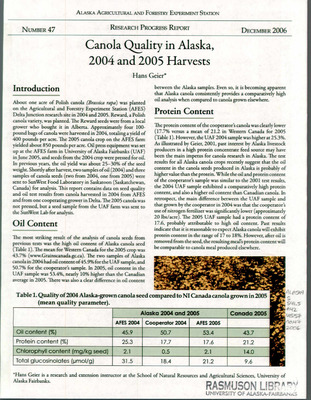
About one acre of Polish canola (Brassica rapa) was planted on the Agricultural and Forestry Experiment Station (AFES) Delta Junction research site in 2004 and 2005. Reward, a Polish canola variety, was planted. The Reward seeds were from a local grower who bought it in Alberta. Approximately four 100-pound bags of canola were harvested in 2004, totaling a yield of 400 pounds per acre. The 2005 canola crop on the AFES farm yielded about 850 pounds per acre. Oil press equipment was set up at the AFES farm in University of Alaska Fairbanks (UAF) in June 2005, and seeds from the 2004 crop were pressed for oil. In previous years, the oil yield was about 25-30% of the seed weight. Shortly after harvest, two samples of oil (2004) and three samples of canola seeds (two from 2004, one from 2005) were sent to SunWest Food Laboratory in Saskatoon (Saskatchewan, Canada) for analysis. This report contains data on seed quality and oil test results from canola harvested in 2004 from AFES and from one cooperating grower in Delta. The 2005 canola was not pressed, but a seed sample from the UAF farm was sent to the SunWest Lab for analysis.
-
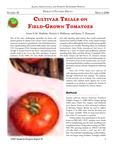
Cultivar Trials on Field-Grown Tomatoes
Grant E.M. Matheke, Patricia S. Holloway, and Janice T. Hanscom
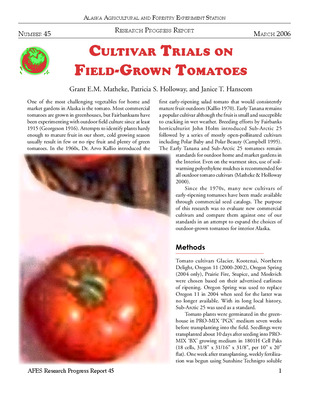
The purpose of this research was to evaluate new commercial cultivars and compare them against one of our standards in an attempt to expand the choices of outdoor-grown tomatoes for interior Alaska.
-
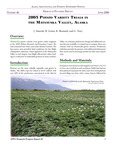
2005 Potato Variety Trials in the Matanuska Valley, Alaska
J. Smeenk, R. Leiner, and G. Terry
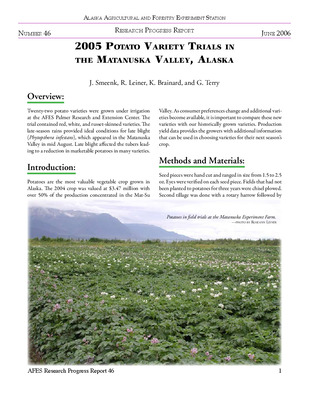
Twenty-two potato varieties were grown under irrigation at the AFES Palmer Research and Extension Center. The trial contained red, white, and russet-skinned varieties. The late-season rains provided ideal conditions for late blight (Phytopthora infestans), which appeared in the Matanuska Valley in mid August. Late blight affected the tubers leading to a reduction in marketable potatoes in many varieties.
-

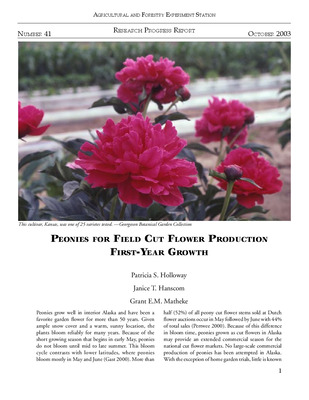
Peonies for field cut flower production
Patricia S. Holloway, Janice T. Hanscom, and Grant E.M. Matheke
-
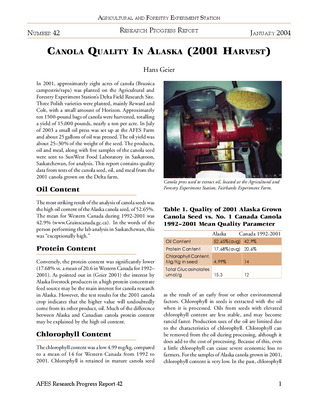
CANOLA QUALITY IN ALASKA (2001 HARVEST)
Hans Geier
In 2001, approximately eight acres of canola (Brassica campestris/rapa) was planted on the Agricultural and Forestry Experiment Station’s Delta Field Research Site. Three Polish varieties were planted, mainly Reward and Colt, with a small amount of Horizon. Approximately ten 1500-pound bags of canola were harvested, totalling a yield of 15,000 pounds, nearly a ton per acre. In July of 2003 a small oil press was set up at the AFES Farm and about 25 gallons of oil was pressed. The oil yield was about 25–30% of the weight of the seed. The products, oil and meal, along with five samples of the canola seed were sent to SunWest Food Laboratory in Saskatoon, Saskatchewan, for analysis. This report contains quality data from tests of the canola seed, oil, and meal from the 2001 canola grown on the Delta farm.
-
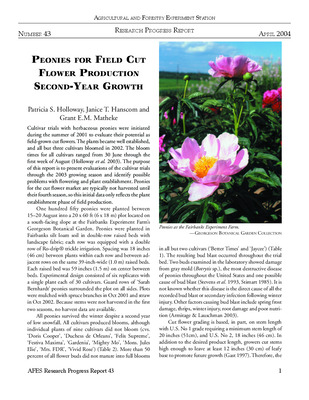
PEONIES FOR FIELD CUT FLOWER PRODUCTION SECOND-YEAR GROWTH
Patricia S. Holloway, Janice T. Hanscom, and Grant E.M. Matheke
Cultivar trials with herbaceous peonies were initiated during the summer of 2001 to evaluate their potential as field-grown cut flowers. The plants became well established, and all but three cultivars bloomed in 2002. The bloom times for all cultivars ranged from 30 June through the first week of August (Holloway et al. 2003). The purpose of this report is to present evaluations of the cultivar trials through the 2003 growing season and identify possible problems with flowering and plant establishment. Peonies for the cut flower market are typically not harvested until their fourth season, so this initial data only reflects the plant establishment phase of field production.
-
Peonies for field cut flower production first-year growth
Patricia S. Holloway, Janice T. Hanscom, and Grant E. Matheke
-
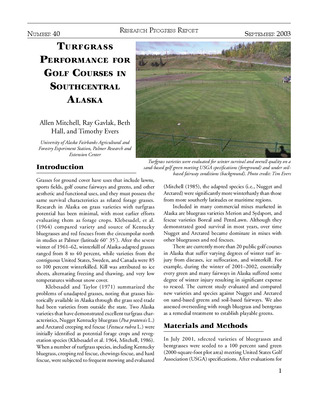
TURFGRASS PERFORMANCE FOR GOLF COURSES IN SOUTHCENTRAL ALASKA
Allen Mitchell, Ray Gavlak, Beth Hall, and Timothy Evers
There are currently more than 20 public golf courses in Alaska that suffer varying degrees of winter turf injury from diseases, ice suffocation, and winterkill. For example, during the winter of 2001–2002, essentially every green and many fairways in Alaska suffered some degree of winter injury resulting in significant expense to reseed. The current study evaluated and compared new varieties and species against Nugget and Arctared on sand-based greens and soil-based fairways. We also assessed overseeding with rough bluegrass and bentgrass as a remedial treatment to establish playable greens.
-
Effect of Reed Canarygrass and Red Clover Mixtures on Forage Yield and Mineral Content in Southcentral Alaska
Raymond G. Gavlak and Beth A. Hall
Early perennial forage performance research was done in Alaska at a number of locations near the turn of the twentieth century, including Copper Center, Kenai, Sitka, and Rampart (Georgeson, 1899; Georgeson, 1901-1904). Resulting yields for native and introduced cool season perennial grasses were fairly positive, however, all sites were rain fed and some seedings were unsuccessful due to dry conditions. Timothy (Phleum pratense L.), smooth bromegrass (Bromus inermis L.), perennial ryegrass (Lolium perenne L.), and orchard grass (Dactyls glomerata L.) dominated the early test plantings.
-
INFLUENCE OF STRAIN OR SOURCE AND GENERATION NUMBER ON PERFORMANCE OF THE POTATO VARIETY RUSSET NORKOTAH 1999
Donald E. Carling
Strains are spontaneously occurring variants within a potato variety that may possess qualitative or quantitative characteristics that are superior to the parent variety. Strain selection is a practice that has been in use with potatoes for many years and examples of successful strain selections include Russet Burbank from Burbank, Dark Red Norland from Norland and Norgold Russet “M” from Norgold Russet. Some strains are discovered based on chance observations of desirable characteristics while others are the products of systematic searches for superior performance. Strain can influence the quality and quantity of tubers produced by a given variety of potato.
-
INFLUENCE OF STRAIN AND GENERATION NUMBER ON PERFORMANCE OF THE POTATO VARIETY RUSSET NORKOTAH
Donald E. Carling
It is well known that strain and generation number can influence the quality and quantity of tubers produced by varieties of potatoes. However, the effect of strain and generation number on yield may be quite different from one variety to another. Strains are spontaneously occurring variants within a variety that may possess qualitative or quantitative characteristics that are superior to the parent variety. Strain selection is a practice that has been in use with potatoes for many years and examples of successful strain selections include Russet Burbank from Burbank, Dark Red Norland from Norland and Norgold Russet M from Norgold Russet. Some strains are discovered based on chance observations of desirable characteristics while others are the products of systematic searches for superior performance.
-
Use of Canola in Dairy Cattle Diets: Year 3
Kirsten Randall, Stephen M. Dofing, and Donald J. Brainard
This report presents results from the third and final trial of a three-year study by the Agricultural and Forestry Experiment Station (AFES) investigating the use of Alaska-grown whole-seed canola in dairy cattle diets.
-
Metam Sodium and Dasomet as Herbicides for Use Vegetable Growers
D.E. Carlin, J.L. Walworth, and J.S. Conn
This study was designed to determine: 1) the effectiveness of surface application followed by “watering in” as a method of applying these two chemicals, 2) the depths to which each chemical is carried into the soil profile by one inch of irrigation water, 3) optimal rates of metam sodium and dasomet required with this method of application to eliminate weed seeds from the plow layer, and 4) phytotoxic effects of metam sodium and dasomet on potatoes and vegetables.
-
Alternative Grain and Oilseed Crops for Interior Alaska
C.W. Knight
Barley is the principal grain crop in Interior Alaska. Oats are second in importance but are often harvested for hay rather than grain. Due to the short growing season (83–100 frost-free days), options for alternative crops are limited and producers have little opportunity to rotate crops for weed and disease control or to switch crops as prices fluctuate. Wheat, triticale, buckwheat, canola, flax, sunflowers, meadowfoam, faba beans, and field peas have all been grown on a small scale in Alaska. However, little information is available on the climatic, nutrient, or cultural requirements, the probability of a successful harvest, the quality of the harvested product, or the potential markets for these crops. This study was initiated in 1993 to evaluate several niche crops for Interior Alaska.
-
Wildflower Seed Mixes for Interior Alaska
Ouina C. Rutledge and Patricia S. Holloway
The objectives of this research were to characterize six native and non-native wildflower seed mixes sold in Alaska in terms of seed germination, flowering dates, winter survival, and public acceptability. In addition, the growth of wildflower seed mixes was evaluated in relation to two management practices: irrigation and seasonal sowing date.
-
Evaluation of Plant Species and Grass Seed Mixes for Mined Land Revegetation Year 3 (1991) Results
D.J. Helm
Careful selection of plant species in a seed mix is important for successful reclamation. The main purpose of grass seed mixes is to establish a living plant cover to stabilize soils at least in the short term. Grasses have a fibrous network of roots which is instrumental in stabilizing soils before outplanted woody species or local colonizers can establish additional roots. Sometimes the grass cover is the end product; other times grass cover is temporary until local species colonize and form a more diverse, natural community. Where moose browse is a desired goal, the grass cover should not compete with the woody plants. At other times, dense grass cover may be needed to suppress undesired native species, such as bluejoint (Calamagrostis canadensis). This same competitiveness may also suppress desired local species and reduce the diversity, thus being a negative factor. The grass species should be able to compete with each other to create a diverse mix. The pH and nutrient levels of soils may also limit the plant species that will grow well. Local species are plant species growing in the area, whether they are native or introduced (possibly by past disturbances in the area or the surrounding region). Native species are indigenous to Alaska but may not grow in the local area. The objectives of this study were to determine: 1. The grass cultivars that would grow on low pH soils (5.2) in the Wishbone Hill area. 2. A ratio of grass species within the seed mix that would improve the diversity of the resultant community. 3. A seeding rate that would allow establishment of local species and outplanted browse without jeopardizing the cover needed to stabilize the soils.
-
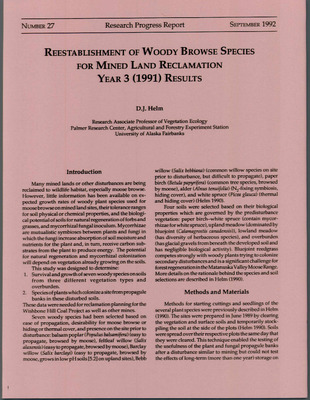
Reestablishment of Woody Browse Species for Mined Land Reclamation Year 3 (1991) Results
D.J. Helm
Many mined lands or other disturbances are being reclaimed to wildlife habitat, especially moose browse. However, little information has been available on expected growth rates of woody plant species used for moose browse on mined land sites, their tolerance ranges for soil physical or chemical properties, and the biological potential of soils for natural regeneration of forbs and grasses, and mycorrhizal fungal inoculum. Mycorrhizae are mutualistic symbioses between plants and fungi in which the fungi increase absorption of soil moisture and nutrients for the plant and, in turn, receive carbon substrates from the plant to produce energy. The potential for natural regeneration and mycorrhizal colonization will depend on vegetation already growing on the soils. This study was designed to determine: 1. Survival and growth of seven woody species on soils from three different vegetation types and overburden. 2. Species of plants which colonize a site from propagule banks in these disturbed soils. These data were needed for reclamation planning for the Wishbone Hill Coal Project as well as other mines.
-
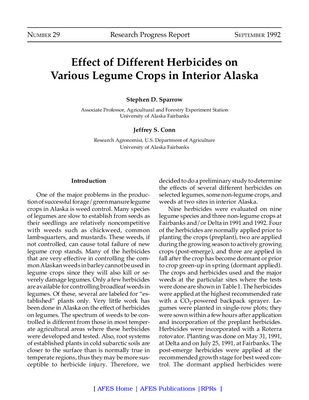
Effect of Different Herbicides on Various Legume Crops in Interior Alaska
Stephen D. Sparrow and Jeffrey S. Conn
One of the major problems in the production of successful forage/green manure legume crops in Alaska is weed control. Many species of legumes are slow to establish from seeds as their seedlings are relatively noncompetitive with weeds such as chickweed, common lambsquarters, and mustards. These weeds, if not controlled, can cause total failure of new legume crop stands. Many of the herbicides that are very effective in controlling the common Alaskan weeds in barley cannot be used in legume crops since they will also kill or severely damage legumes. Only a few herbicides are available for controlling broadleaf weeds in legumes. Of these, several are labeled for “established” plants only. Very little work has been done in Alaska on the effect of herbicides on legumes. The spectrum of weeds to be controlled is different from those in most temperate agricultural areas where these herbicides were developed and tested. Also, root systems of established plants in cold subarctic soils are closer to the surface than is normally true in temperate regions, thus they may be more susceptible to herbicide injury. Therefore, we decided to do a preliminary study to determine the effects of several different herbicides on selected legumes, some non-legume crops, and weeds at two sites in interior Alaska.
-
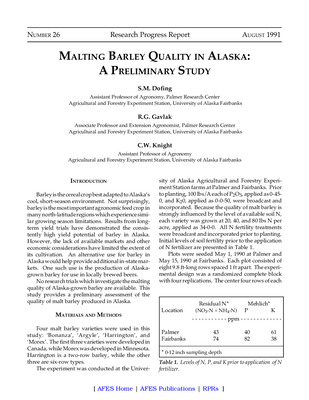
MALTING BARLEY QUALITY IN ALASKA: A PRELIMINARY STUDY
S.M. Dofing, R.G. Gavlak, and C.W. Knight
Barley is the cereal crop best adapted to Alaska’s cool, short-season environment. Not surprisingly, barley is the most important agronomic feed crop in many north-latitude regions which experience similar growing season limitations. Results from longterm yield trials have demonstrated the consistently high yield potential of barley in Alaska. However, the lack of available markets and other economic considerations have limited the extent of its cultivation. An alternative use for barley in Alaska would help provide additional in-state markets. One such use is the production of Alaskagrown barley for use in locally brewed beers. No research trials which investigate the malting quality of Alaska-grown barley are available. This study provides a preliminary assessment of the quality of malt barley produced in Alaska.
-
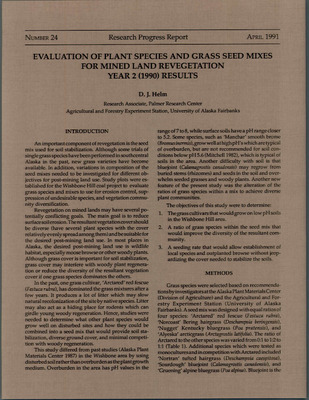
EVALUATION OF PLANT SPECIES AND GRASS SEED MIXES FOR MINED LAND REVEGETATION YEAR 2 (1990) RESULTS
D.J. Helm
An important component of revegetation is the seed mix used for soil stabilization. Although some trials of single grass species have been performed in southcentral Alaska in the past, new grass varieties have become available. In addition, variations in composition of the seed mixes needed to be investigated for different objectives for post-mining land use. Study plots were established for the Wishbone Hill coal project to evaluate grass species and mixes to use for erosion control, suppression of undesirable species, and vegetation community diversification.
-
Reestablishment of Woody Browse Species for Mined Land Reclamation Year 2 (1990) Results
D.J. Helm
Revegetation of coal-mined land with plant species suitable for the desired post-mining land use is required by state and federal regulations. The most common postmining land use in Alaska is wildlife habitat, especially browse production for moose. However, few data are available on growth of woody browse plants on reclaimed sites or effects of different soils on plant species. Another unknown is how much bluejoint reedgrass (Calamagrostis canadensis) suppresses the desired woody browse species. Bluejoint reestablishes from seeds and rhizomes (underground stems in the soil) and is a major problem in establishing moose browse on the Matanuska Valley Moose Range near Palmer. Study plots have been established for the Wishbone Hill coal project to investigate plant species and soil relationships for establishing moose browse in this area. Seven woody species were selected based on ease of propagation, desirability for browse or hiding or thermal cover for moose, and presence on the site prior to disturbance: balsam poplar (Populus balsamifem), feltleaf willow (Salix alaxensis), barclay willow (Salix barclayi), Bebb willow {Salix bebbiana), paper birch (Betula papyrifera), alder (Alnus tenuifolia), and white spruce (Picea glauca) (Helm 1990). Four soils were selected based on their biological properties which are governed by the pre-disturbance vegetation: paper birch-white spruce (contained m ycorrhizae for white spruce), upland meadow (dominated by bluejoint), lowland meadow (has diversity of herbaceous species), and overburden (had gravels from beneath the developed soil and had negligible biological activity). Hereafter birch-spruce soils or plots will be used to refer to those plots and soils from the paper birch-white spruce vegetation type. Similarly the upland meadow and lowland meadow soils refer to those soils disturbed within those vegetation types. The most important biological properties examined were the propagule bank (seeds, rhizomes, roots) from which native species could regenerate and the mycorrhizal fungal propagules which are needed to establish mycorrhizae on the roots of plants. Mycorrhizae are symbioses between plants and fungi in which the fungi increase soil moisture and nutrient absorption for the plant and, in turn, receive carbon (energy) from the plant. Most plant species have mycorrhizae when growing under field conditions. This relationship is essential for some species such as the coniferous trees, including white spruce. More details on the rationale behind the species and soil selections are included in Helm (1990). This study was designed to determine: 1. Survival and growth of woody species on soils from three different vegetation types and overburden. 2. Species of plants which colonize a site from propagule banks in these disturbed soils.
-
IRT-76® POLYETHYLENE MULCH FILM AND GROWTH OF SWEET CORN IN FAIRBANKS, ALASKA
Grant E.M. Matheke, Patricia S. Holloway, and Patricia J. Wagner
Cold soils during the short growing season in interior Alaska often limit growth and prevent the maturing of many field-grown warm season crops such as tomatoes, peppers, cucumbers, pumpkins and sweet corn. Clear polyethylene mulch has been recommended for many years as a method of warming soil to promote crop maturity and improve marketable yields (Dinkel, 1966). One significant problem with the use of clear polyethylene mulch is enhanced weed growth beneath the mulch. Weeds compete with the crop for nutrients and water in addition to reducing the soil-warming effects of the mulch. Consequently, herbicides must be used in conjunction with the clear mulch to obtain optimum plant growth. An alternative to clear polyethylene is black polyethylene mulch which suppresses weed growth but does not have the soil-warming and yield-improvement capabilities of clear polyethylene (Matheke et al., l989).
-
Effects of Seeding Rate on Dry Matter Yield of Two Forage Rape Varieties
Michael T. Panciera and Raymond G. Gavlak
Husby and Krieg (1987) reported that average Alaskan forages were deficient in energy for beef cattle and protein levels were marginal for growing animals. Both the energy and protein of Alaskan forages are low for lactating dairy cows (Brundage and Herlugson, 1984). Energy and protein concentrates are imported to Alaska from elsewhere in the U.S. High transportation costs make these imported feedstuffs expensive for Alaskan livestock producers. Brassica crops, such as rape (Brassica riapus L.) and turnips (B. rapa L.) have been widely studied as forage crops because they have the potential to produce high yields of excellent quality forage. Jung et al. (1986) demonstrated this potential when they reported that Brassica spp. yielded 4-7 tons DM/A and the forage was highly digestible (80-90% in vitro dry matter digestibility). Crude protein was relatively low for turnip roots (8-12%), but top growth was high (up to 27%). Lambert et al. (1987) found that the quality of Brassica spp. was too high for optimum performance of growing lambs. They reported that it was necessary to include some coarse feed, such as grass hay, to increase the fiber content in the diets of these animals. The potential of Brassica crops has been investigated in Alaska (Mitchell and Krieg, 1985; Panciera et al., 1990). The yield and quality of these crops in Alaska were similar to the levels observed in the Lower 48 states. Basic agronomic information is needed in order to develop management recommendations for Brassicas in Alaska. Research is underway to define the nitrogen and phosphorus fertilizer requirements (Panciera etal., 1990). This report summarizes the results of a two year study concerning the effects of seeding rates on dry matter yields of two Brassica hybrids.
-
Growth Performance of Holstein Dairy Calves Supplemented with a Probiotic
Paul M. Windschitl, Kirsten M. Randall, and Donald J. Brainard
Administration of antibiotics in both therapeutic and sub-therapeutic doses has been the standard practice for dealing with pathogenic bacteria problems in farm animals since the 1940s. Several types of antibiotics are currently used to promote weight gain and feed efficiency in domestic livestock. There is growing concern that the use of antibiotics as growth promoters may result in the development of resistant populations of pathogenic bacteria and, in turn, influence the therapeutic use of antibiotics. The indiscriminate and improper use of antibiotics in food-producing animals could result in the presence of residues in milk, meat, and other animal food products consumed by humans. One possible alternative to antibiotics is the use of probiotics. Probiotics can be defined as “live microbial feed supplements which beneficially affect the host animal by improving its intestinal microbial balance” (Fuller, 1989). Probiotics introduce beneficial microorganisms into the gut which act to maintain optimal conditions within the gastrointestinal tract and inhibit the growth of pathogenic or other undesirable bacteria.
-
Effects of Residual Soil Nitrogen and Applied Nitrogen on Yields of Head Lettuce
D.E. Carling, G.J. Michaelson, C.L. Ping, and J.L. Walworth
Field studies previously conducted in the Matanuska Valley have determined that head lettuce production can be optimized by applying approximately 100 lbs per acre of nitrogen (N) as a fertilizer supplement when residual soil N levels are low (Carling et al., 1987 and 1988). However, conditions in grower's fields often are such that significant quantities of residual N fertilizer may remain in the soil from one growing season to the next. Maximizing the utilization of residual N makes sense both economically as this N has substantial value as a plant nutrient, and ecologically as N may contribute to groundwater contamination if permitted to leach from the soil profile. A field study was conducted during the 1988 growing season to examine the effects of residual soil N in combination with various levels of spring-applied N fertilizer on head lettuce yields. Residual soil N is defined as N present in the soil and detected by a soil test prior to the application of fertilizer in the spring. This study had two primary objectives: to promote maximum utilization of N through accurate interpretation of soil test results and to evaluate interactions between residual and spring-applied N. The results of the first year of this study were reported by Michaelson etal. (1989). The experiment was repeated during the 1989 growing season and the results of that study are contained in this report.
Printing is not supported at the primary Gallery Thumbnail page. Please first navigate to a specific Image before printing.