
-
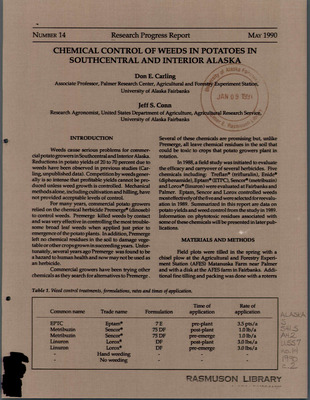
Chemical Control of Weeds in Potatoes in Southcentral and Interior Alaska
Don E. Carling and Jeff S. Conn
Weeds cause serious problems for commercial potato growers in Southcentral and Interior Alaska. Reductions in potato yields of 20 to 70 percent due to weeds have been observed in previous studies (Carling, unpublished data). Competition by weeds generally is so intense that profitable yields cannot be produced unless weed growth is controlled. Mechanical methods alone, including cultivation and hilling, have not provided acceptable levels of control. For many years, commercial potato growers relied on the chemical herbicide Premerge® (dinoseb) to control weeds. Premerge killed weeds by contact and was very effective in controlling the most troublesome broad leaf weeds when applied just prior to emergence of the potato plants. In addition, Premerge left no chemical residues in the soil to damage vegetable or other crops grown in succeeding years. Unfortunately, several years ago Premerge was found to be a hazard to human health and now may not be used as an herbicide. Commercial growers have been trying other chemicals as they search for alternatives to Premerge. Several of these chemicals are promising but, unlike Premerge, all leave chemical residues in the soil that could be toxic to crops that potato growers plant in rotation. In 1988, a field study was initiated to evaluate the efficacy and carryover of several herbicides. Five chemicals including: Treflan® (trifluralin), Enide® (diphenamide), Eptam® (ETPC), Sencor® (metribuzin) and Lorox® (linuron) were evaluated at Fairbanks and Palmer. Eptam, Sencor and Lorox controlled weeds most effectively of the five and were selected for reevaluation in 1989. Summarized in this report are data on potato yields and weed control from the study in 1989. Information on phytotoxic residues associated with some of these chemicals will be presented in later publications.
-
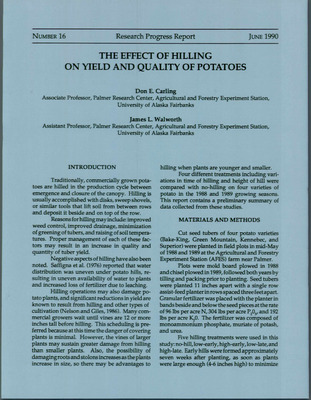
The Effect of Hilling on Yield and Quality of Potatoes
Don E. Carling and James L. Walworth
Traditionally, commercially grown potatoes are hilled in the production cycle between emergence and closure of the canopy. Hilling is usually accomplished with disks, sweep shovels, or similar tools that lift soil from between rows and deposit it beside and on top of the row. Reasons for hilling may include: improved weed control, improved drainage, minimization of greening of tubers, and raising of soil temperatures. Proper management of each of these factors may result in an increase in quality and quantity of tuber yield. Negative aspects of hilling have also been noted. Saffigna et al. (1976) reported that water distribution was uneven under potato hills, resulting in uneven availability of water to plants and increased loss of fertilizer due to leaching. Hilling operations may also damage potato plants, and significant reductions in yield are known to result from hilling and other types of cultivation (Nelson and Giles, 1986). Many commercial growers wait until vines are 12 or more inches tall before hilling. This scheduling is preferred because at this time the danger of covering plants is minimal. However, the vines of larger plants may sustain greater damage from hilling than smaller plants. Also, the possibility of damaging roots and stolons increases as the plants increase in size, so there may be advantages to hilling when plants are younger and smaller. Four different treatments including variations in time of hilling and height of hill were compared with no-hilling on four varieties of potato in the 1988 and 1989 growing seasons. This report contains a preliminary summary of data collected from these studies.
-
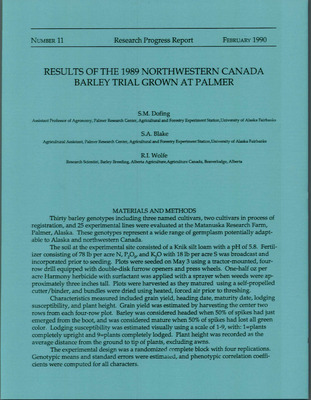
Results of the 1989 Northwestern Canada Barley Trial Grown at Palmer
S.M. Dofing, S.A. Blake, and R.I. Wolfe
Favorable climatic conditions for barley production in 1989 at the Matanuska Research Farm resulted in exceptionally high grain yields. Mean grain yield for cultivars in this test was 92.5 bushels per acre (Table 1). A total of 908 growing degree-days (41 degree F base) were accumulated between May 1 and Aug. 31. 'Otal' required 98 days or 700 growing degree-days to reach maturity. A high temperature of 80 degrees F was recorded on July 19. Soil moisture was generally adequate throughout the growing season.
-
Results of the 1990 Northwestern Canada Barley Trial Grown at Palmer
S.M. Dofing, S.A. Blake, and R.I. Wolfe
-
Reestablishment of Woody Browse Species for Mined Land Reclamation Year 1 (1989) Results
Dorothy J. Helm
Long-term goals of revegetation include the reestablishment of diverse, self-reproducing plant communities suitable for desired post-mining land uses. In Alaska, these uses include habitat for moose and other wildlife. Current state and federal revegetation regulations affect only coal-mined lands, but some mine operators have been revegetating their lands voluntarily. Regulations requiring revegetation may affect other types of mines in the near future. Revegetation of mined lands or other disturbed lands helps control soil erosion, which traditionally has been controlled by grass cover. However, vigorous grass growth may interfere with woody plant regeneration needed by wildlife for thermal cover, browse, and hiding cover. Growth of plant species varies in different soils because of the biological, physical, and chemical properties of the individual soils. Biological components of soils are often overlooked even when the physical and chemical properties of soils are considered. The potential advantages and disadvantages of planting certain species in certain types of soils are examined in this study.
-
Fall Seeding: Will it Work in Interior Alaska?
Darleen Masiak and Stephen Sparrow
Short growing seasons in interior Alaska, averaging 90 days in Fairbanks, are a major factor affecting crop production. In the past, volunteer germination of seed from previous years crops has been observed in the field. These volunteer plants tend to get a head start on spring seeded plants, indicating that the use of fall planting could have potential advantages. Spring planting is often delayed due to soil wetness following snow-melt. This problem could be avoided with fall seeding. Seedbed preparation causes rapid drying of the surface of silt loam soils, which are common in interior Alaska. This, combined with low rainfall during spring, often results in moisture levels which are too low for good germination and early growth of shallow planted seeds. Since the soil would not be disturbed in the spring, seeding in fall might allow crops to take advantage of moisture available from snow-melt. Also, fall seeding has the potential of reducing the workload during the short spring planting period.
-
Evaluation of Forage Legume Potential at Fairbanks, Point Mackenzie, and Soldotna
Michael T. Panciera, Stephen D. Sparrow, Raymond G. Gavlak, and Warren E. Larson
Forage legumes have a high crude protein content and some residual nitrogen from these crops can be utilized by other species that follow legumes in crop rotations. Irwin (1945) compiled the results of early research covering a wide range of legumes, both annual and perennial, at several locations within Alaska, but neither the yields nor the persistence of these crops were comparable to native and introduced grasses. Recommended legumes included field peas and vetches in combination with cereal grains and either alsike or sweetclover in combination with bromegrass for silage (Sweetman et al., 1950). Perennial legume yields (0.5 to 1.9 tons per acre) were low when compared to perennial grasses at the Matanuska Research Farm in southcentral Alaska (Klebesadel, 1980,1983). These low yields were attributed to poor winterhardiness and consequent winterkill of most of the legumes. Formation of ice sheets, direct exposure to lethal temperatures (due to lack of snow cover), and desiccation reduce the ability of perennial legumes to survive winters in southcentral Alaska (Klebesadel, 1974). Yield potentials for perennial grasses may exceed 4.5 tons per acre (Mitchell, 1982), while forage legumes may produce from 0.5 to 2.4 tons per acre in research studies and demonstrations (Klebesadel, 1980; Mitchell, 1986). Husby and Krieg (1987) reported average crude protein contents for Alaska hays to be in the range of 8.3 to 11.8%. Changes in the production potential of Alaskan dairy cattle have effectively redefined the quality of forage that must be produced for the dairy industry. Current milk production potential for Alaska dairy cattle (14,800 lb/yr) requires high concentrations (>16%) of crude protein in the ration (Brown et al., 1989; NRC, 1988). On a dry matter yield basis legumes do not compare well with grasses, but high crude protein content and the cost of protein supplements in Alaska justify further research with both annual and perennial leguminous forage crops. Experiments were conducted to evaluate forage legumes for yield, quality, and persistence potential at three locations in Alaska. Preliminary results from these experiments are presented.
-
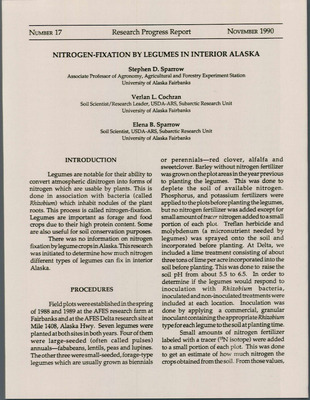
Nitrogen-Fixation by Legumes in Interior Alaska
Stephen D. Sparrow, Verlan L. Cochran, and Elena B. Sparrow
Legumes are notable for their ability to convert atmospheric dinitrogen into forms of nitrogen which are usable by plants. This is done in association with bacteria (called Rhizobium) which inhabit nodules of the plant roots. This process is called nitrogen-fixation. Legumes are important as forage and food crops due to their high protein content. Some are also useful for soil conservation purposes. There was no information on nitrogen fixation by legume crops in Alaska. This research was initiated to determine how much nitrogen different types of legumes can fix in interior Alaska.
-
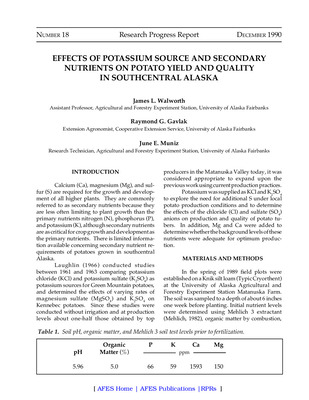
Effects of Potassium Source and Secondary Nutrients on Potato Yield and Quality in Southcentral Alaska.
James L. Walworth, Raymond G. Gavlak, and June E. Muniz
Calcium (Ca), magnesium (Mg), and sulfur (S) are required for the growth and development of all higher plants. They are commonly referred to as secondary nutrients because they are less often limiting to plant growth than the primary nutrients nitrogen (N), phosphorus (P), and potassium (K), although secondary nutrients are as critical for crop growth and development as the primary nutrients. There is limited information available concerning secondary nutrient requirements of potatoes grown in southcentral Alaska. Laughlin (1966) conducted studies between 1961 and 1963 comparing potassium chloride (KCl) and potassium sulfate (K2SO4) as potassium sources for Green Mountain potatoes, and determined the effects of varying rates of magnesium sulfate (MgSO4) and K2SO4 on Kennebec potatoes. Since these studies were conducted without irrigation and at production levels about one-half those obtained by top producers in the Matanuska Valley today, it was considered appropriate to expand upon the previous work using current production practices. Potassium was supplied as KCl and K2 SO4 to explore the need for additional S under local potato production conditions and to determine the effects of the chloride (Cl) and sulfate (SO4) anions on production and quality of potato tubers. In addition, Mg and Ca were added to determine whether the background levels of these nutrients were adequate for optimum production.
-
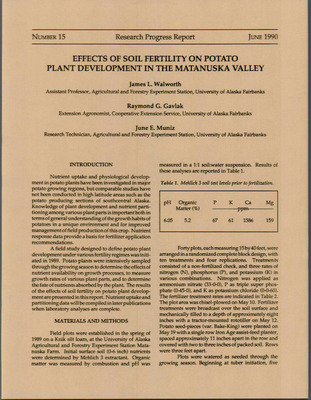
Effects of Soil Fertility on Potato Plant Development in the Matanuska Valley
James L. Walworth, Raymond G. Gavlak, and June E. Muniz
Nutrient uptake and physiological development in potato plants have been investigated in major potato growing regions, but comparable studies have not been conducted in high latitude areas such as the potato producing sections of southcentral Alaska. Knowledge of plant development and nutrient partitioning among various plant parts is important both in terms of general understanding of the growth habits of potatoes in a unique environment and for improved management of field production of this crop. Nutrient response data provide a basis for fertilizer application recommendations. A field study designed to define potato plant development under various fertility regimes was initiated in 1989. Potato plants were intensively sampled through the growing season to determine the effects of nutrient availability on growth processes, to measure growth rates of various plant parts, and to determine the fate of nutrients absorbed by the plant. The results of the effects of soil fertility on potato plant development are presented in this report. Nutrient uptake and partitioning data will be compiled in later publications when laboratory analyses are complete.
-
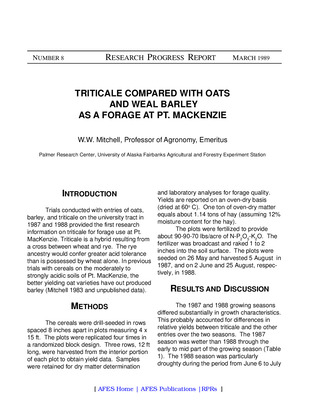
TRITICALE COMPARED WITH OATS AND WEAL BARLEY AS A FORAGE AT PT. MACKENZIE
W.W. Mitchell
Trials conducted with entries of oats, barley, and triticale on the university tract in 1987 and 1988 provided the first research information on triticale for forage use at Pt. MacKenzie. Triticale is a hybrid resulting from a cross between wheat and rye. The rye ancestry would confer greater acid tolerance than is possessed by wheat alone. In previous trials with cereals on the moderately to strongly acidic soils of Pt. MacKenzie, the better yielding oat varieties have out produced barley (Mitchell 1983 and unpublished data).
-
Alaska's Dairy Industry: The Relationship Of History and Statistics
Carol E. Lewis and Roger W. Pearson
The Alaska Crop and Livestock Reporting Service of the United States Department of Agriculture has provided an annual publication detailing the quantity and value of agricultural products in Alaska since 1960. Although the statistics are an excellent source of information, they do not provide a historical insight into events which might have effected rises and falls in product quantities and values. To quote: What statistics cannot always show us is why such trends have occurred (and) what factors have influenced their progress. These are a matter o f interpretation. (Weaver, Alaska Crop and Livestock Reporting Service 1987a). Indeed, one of the challenges of agricultural statistical interpretation is to reflect economic, political, and social events locally, nationally, and internationally.
-
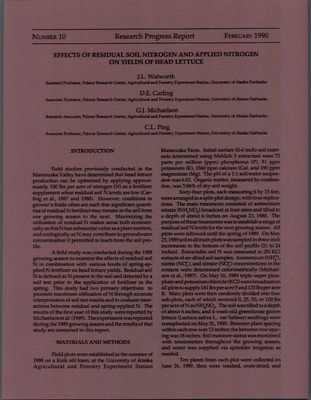
The Effect of Nitrogen Fertilization Rates on Head Lettuce Yields: A Preliminary Report
D.E. Carling, G.J. Michaelson, and C.L. Ping
Quantities of nitrogen (N) traditionally applied to lettuce fields by commercial growers range from lows of 80 to 120 lbs N/A (commonly 800 to 1200 lbs of 8-32-16 or 10-20-20) to rates as high as 250 lbs N/A. The higher rates are attained by supplementing the principal application of N-P-K with ammonium nitrate. Fertilization response research conducted elsewhere suggests that the higher rates are well beyond quantities of N required for maximum yields; however grower experience indicates that the additional N indeed does increase head size and yields, especially in late season plantings when cooler soil temperatures may reduce N uptake. Optimal rates of N to be applied can differ depending upon application rate during the previous year and carryover of N in the soil. Questions remain as to what soil N concentration is required for optimal yield under Alaskan conditions. The field experiment reported here was conducted to assess the effects of increasing rates of N fertilization on lettuce yields and soil N concentrations. Although preliminary, these data may be helpful to growers deciding N application rates.
-
The Effects of Banding and Broadcasting The Complete Nutrient Requirement for Barley
C.E. Lewis, C.W. Knight, B.J. Pierson, and R.F. Cullum
The fertilizer application method used for producing small grains in interior Alaska is not always a matter of choice but of necessity. Farmers must fertilize, till, and seed a large acreage in a short time to complete the seeding operation no later than the last week in May. In most years, this allows time for the crop to mature before being damaged by autumn frosts. A typical fertilizer application for barley is 380 pounds per acre dry, blended material consisting of 100 pounds urea as the primary nitrogen (N) source, 100 pounds monoammonium phosphate, 100 pounds ammonium sulfate, and 80 pounds potassium chloride. This combination provides an application ratio of 77-51-48-24 pounds per acre N, P20 5, K20 , and sulfur (S). This means a farmer planting 1000 acres of barley must handle 190 tons of fertilizer material. The most expedient method is to use a 10- to 20-ton capacity, trailer-type, broadcast spreader which minimizes refilling time. If fields are tilled after fertilization, the material is mixed into the soil; otherwise the fertilizer remains on the soil surface. There are several reasons to investigate other methods of fertilizer application even though this system has worked reasonably well. Most barley produced in interior Alaska is seeded on lands which have been cleared of native vegetation in the last ten years (Lewis and Thomas 1982). Soils are naturally infertile and are cool throughout the growing season (Siddoway et al. 1984), and most have been cropped for only three or four years. Delucchi (1983) reported higher yield response when phosphorus (P) was banded with the seed than when equal applications were broadcast. This is not atypical for P-deficient soils (Cooke 1982). Some farmers in Alaska’s interior have begun to band a starter or “ pop-up” fertilizer in the row with the seed at the time of planting. Monoammonium phosphate (11 pounds N and 51 pounds P20 5 per acre) is typically used. Starter fertilizers banded with the seed render nutrients readily available to the seedlings and may boost plant growth early in the season helping seedlings overcome stress due to cold soil temperatures at planting and during early growth (Veseth 1986, Paul 1987). Yields could potentially be increased and/or fertilizer requirements reduced. A general rule has been to band no more than 140 pounds per acre total fertilizer containing no more than 15 to 20 pounds N per acre with the seed (Loynachan et al. 1979). Particular caution is urged when urea is used as an N source (Cooke 1982, Robertson 1982). There is a possibility of seedling injury from excessive salts or the release of toxic quantities of ammonia near the seed. Several farmers in the interior of Alaska have banded the total nutrient requirement for barley with the seed using urea as the major N source. Good yield results have been reported for several years with no evidence of crop injury at rates of up to 450 pounds of total material per acre. Delucchi (1983) speculated that in wetter soils, typical of newly cleared lands, salts may tend to dissolve and diffuse away from the seed thereby lessening the potential for seedling damage. Banding the full nutrient requirement for barley with the seed may increase yields over those found when the equal amount is broadcast, thus increasing returns. Elimination of the broadcast operation will reduce costs slightly. Urea is available locally at a lesser cost than other N sources which must be shipped into the state and may be more cost effective than other formulations.
-
Perennial Grass and Soil Responses to Four Phosphorus Rates at Point MacKenzie
Wm. W. Mitchell, G. Allen Mitchell, and D. Helm
Three perennial grasses were established on Kashwitna silt loam at Pt. MacKenzie in 1985 to test their responses to different rates o f phosphorus (P) fertilization. Laboratory studies with a number o f Alaskan soils have indicated strong P-fixation properties for the Pt. MacKenzie soils (Ping and Michaelson 1986, Michaelson and Ping 1986). Earlier work with cereal forages showed responses for barley up to 90 lbs/acre and for oats up to 60 lbs P205/acre (Michaelson et al. 1984). All three perennial grasses [‘Engmo’ timothy (Phleum pratense), ‘Manchar’ bromegrass (Bromus inermis), and reed canarygrass (Phalaris arundinacea)] responsed to P2O5 up to 120 lbs/acre in their establishment year in 1985 (Mitchell and Mitchell 1986). Reed canarygrass significantly outproduced in 1985, yielding over two tons dry matter/acre at the higher fertilizer levels. Bromegrass was the least productive in the establishment year. This report concerns the results obtained in 1986, which constituted the first full harvest year.
-
Phosphorus Rate Effects on Establishment of Perennial Grasses And on Soil Values at Point MacKenzie
Wm. W. Mitchell and G. Allen Mitchell
This trial concentrates on the effects of varying rates of P with N and K supplied in amounts judged to be ample for establishment of perennial grasses. The results indicated that, by seeding sufficiently early and supplying 90-120 lb P20 5/acre, harvestable amounts of forage could be obtained in the year o f seeding. Reed canarygrass would provide the most forage in the first year; how ever, in previous trials timothy has been more durable and higher yielding over a series of years (Mitchell, in press). Laboratory measurements of crude protein and digestible dry matter indicated the quality of the forage would be good to excellent. The high-yielding reed canarygrass was the lowest in quality but still afforded about 13 per cent crude protein and 60 percent digestible dry matter. The trial is to be continued to determine the cumulative effects of annual fertilizer applications at the same rates on yields and soil test values. A question of immediate concern is the possible effect of promoting high production in the year of establishment on the overwintering characteristics of the grasses.
Printing is not supported at the primary Gallery Thumbnail page. Please first navigate to a specific Image before printing.