


-

FY 1997 Juvenile Justice and Delinquency Prevention Act Compliance Monitoring Report
Curtis W. N/A and N. E. Schafer
The Juvenile Justice and Delinquency Prevention Act (JJDPA) mandates removal of status offenders and nonoffenders from secure detention and correctional facilities, sight and sound separation of juveniles and adults, and removal of juveniles from adult jails and lockups. In Alaska, 1 instance of a status offender held in secure detention was recorded in FY 1997, compared with 485 violations in the baseline year of CY 1976. 2 separation violations were recorded in FY 1997, representing a 99.8% reduction from the CY 1976 baseline of 824 violations. 68 jail removal violations were projected (52 actual), representing an 92% reduction from the CY 1980 baseline. Originally completed December 1997; revised July 1999.
-

Race and Record: A Study of Juvenile Referrals in Alaska
N. E. Schafer
The disproportionate representation of minorities in the justice system of the U.S. has been viewed with growing alarm by both researchers and policymakers. Studies of the problem tend to focus on African Americans and on the end points of the process — sentencing disparities and, especially, sentences to death at the adult level and on court outcomes and detention decisions at the juvenile level. The research presented here explores the relationship between race and prior record using juvenile referral data from Alaska. White, Alaska Native, and African American youth are compared using four years of statewide data. The research includes an in-depth examination of the files of a sample of the juveniles referred to the Alaska juvenile justice system in order to better assess the relationship between race and record.
-

Disproportionate Representation of Minorities in the Alaska Juvenile Justice System: Phase I Report
N. E. Schafer, Richard Curtis, and Cassie Atwell
The disproportionate processing of minorities in the justice system has been noted with growing concern nationally as well as at the state level. In Alaska, as in other states, the primary basis for concern is that minorities are overrepresented among the adult prison population. The realization that this disproportionality appears in other justice system venues has led nationally to a number of research initiatives with a focus on the overrepresentation of juveniles. This report analyzes referral data from the Alaska Division of Family and Youth Services (DFYS) for 1992-1995 to provide a statistical overview of disproportionate minority contact in the Alaska juvenile justice system, providing comparative data for referrals of Alaska Native, African American, and white youth.
-

FY 1995 Juvenile Justice and Delinquency Prevention Act Compliance Monitoring Report
Curtis W. N/A, Cassie Atwell, and N. E. Schafer
The Juvenile Justice and Delinquency Prevention Act (JJDPA) mandates removal of status offenders and nonoffenders from secure detention and correctional facilities, sight and sound separation of juveniles and adults, and removal of juveniles from adult jails and lockups. In Alaska, 13 instances of a status offender held in secure detention were recorded in FY 1995, compared with 485 violations in the baseline year of CY 1976. 11 separation violations were recorded and 23 projected in FY 1995, representing a 97.3% reduction from the CY 1976 baseline of 824 violations. 143 jail removal violations were projected, representing an 83% reduction from the CY 1980 baseline. Originally completed Feb 1996; revised June 1996.
-

FY 1996 Juvenile Justice and Delinquency Prevention Act Compliance Monitoring Report
Curtis W. N/A, Cassie Atwell, and N. E. Schafer
The Juvenile Justice and Delinquency Prevention Act (JJDPA) mandates removal of status offenders and nonoffenders from secure detention and correctional facilities, sight and sound separation of juveniles and adults, and removal of juveniles from adult jails and lockups. In Alaska, 4 instances of a status offender held in secure detention were recorded in FY 1996, compared with 485 violations in the baseline year of CY 1976. 3 separation violations were recorded in FY 1997, representing a 99.6% reduction from the CY 1976 baseline of 824 violations. 44 jail removal violations were projected, representing an 95% reduction from the CY 1980 baseline.
-

FY 1994 Juvenile Justice and Delinquency Prevention Act Compliance Monitoring Report
Curtis W. N/A, Cassie Atwell, and N. E. Schafer
This report marks Alaska's transition from calendar year to fiscal year reporting of compliance with the Juvenile Justice and Delinquency Prevention Act (JJDPA). JJDPA mandates removal of status offenders and nonoffenders from secure detention and correctional facilities, sight and sound separation of juveniles and adults, and removal of juveniles from adult jails and lockups. No instances of a status offender held in secure detention was recorded in FY94, as compared with 485 violations in the baseline year of 1976. 17 separation violations were recorded in FY94, representing a 98% reduction from the 1976 baseline of 824 violations. 53 jail removal violations were projected, representing a 94% reduction from the 1980 baseline and an 10% decrease from calendar year 1993.
-

Policies and Procedures for Juvenile Justice and Delinquency Prevention Act Compliance Monitoring, Revised
N. E. Schafer
Pursuant to Section 223(1)(15) of the Juvenile Justice and Delinquency Prevention Act of 1974 and 28 CFR Part 31.303(f), states are required to describe their plans and procedures for annually monitoring compliance with the Act. This revision of Alaska's monitoring procedures revises the procedures manual originally developed by the Justice Center of the University of Alaska Anchorage in 1988 under contract with the Alaska Division of Family and Youth Services (DFYS).
-

Alaska Public Safety Statewide Survey: Component Two of Alaska Public Safety Project
University of Alaska Anchorage Justice Center
Results of a statewide public opinion survey indicate that, contrary to the commonly portrayed perspective, anxiety about crime in Alaska is not particularly high. Moreover, many residents feel that crime levels in their communities have stayed the same or are actually decreasing. Over 600 Alaska residents in five regions throughout the state (Anchorage, Fairbanks, Southeast, Valdez/Kenai/Mat-Su, and rural Alaska) were surveyed by telephone for this study.
-

Public Safety and Policing in Alaska Native Villages: Component Three of Alaska Public Safety Project
University of Alaska Anchorage Justice Center
One hundred and seventy-five residents in 28 predominately Alaska Native communities throughout the state were interviewed on-site to obtain information for assessing and improving public safety operations and services in rural villages of Alaska. Throughout the communities surveyed, state justice system personnel were viewed as being unconcerned about local governance arrangements, practices, and problems, and insensitive to values, feelings, and priorities of village residents and officials. Many villages surveyed were found to have established, without support from the Alaska justice system, their own policies and methods for dealing with crime and social control problems. Despite the importance of these extralegal local practices to villages, in general they seem to be unrecognized or ignored by justice system employees serving in the communities.
-

Sex Offender Treatment Project: Literature Review
Allan R. Barnes, Melanie Baca, Melody Dix, Shelly Flahr, Cathy Gaal, Max Whitaker, Samantha Moeglein, and Nicol Morgheim
A comprehensive literature review on recidivism by and the treatment of sex offenders.
-

1993 Juvenile Justice and Delinquency Prevention Act Compliance Monitoring Report
Curtis W. N/A, Cassie Atwell, and N. E. Schafer
The Juvenile Justice and Delinquency Prevention Act (JJDPA) mandates removal of status offenders and nonoffenders from secure detention and correctional facilities, sight and sound separation of juveniles and adults, and removal of juveniles from adult jails and lockups. In Alaska, no instances of a status offender held in secure detention was recorded in 1993, as compared with 485 violations in the baseline year of 1976. 16 separation violations were recorded in 1992, representing a 98% reduction from the 1976 baseline of 824 violations. 59 jail removal violations were projected, representing a 94% reduction from the 1980 baseline and an 25% increase from 1992.
-

Alaska's System for Monitoring Compliance with the Juvenile Justice and Delinquency Prevention Act (Revised)
Schafer E. N/A
Pursuant to Section 223(1)(15) of the Juvenile Justice and Delinquency Prevention Act of 1974 and 28 CFR Part 31.303(f), states are required to describe their plans and procedures for annually monitoring compliance with the Act. This revision of Alaska's monitoring plan revises the plan originally developed by the Justice Center of the University of Alaska Anchorage in 1988 under contract with the Alaska Division of Family and Youth Services (DFYS).
-

Notice and Intervention in ICWA CINA Cases 1992
Lisa Rieger
This study is a preliminary investigation of the relationship between the notice requirement and intervention in a sample of Indian Child Welfare Act (ICWA) Child in Need of Aid (CINA) cases in Alaska in 1992. A randomized sample by geographic district of all active Alaska Native children cases drawn from the "Prober" computerized database of the Alaska Division of Family and Youth Services (DFYS) constituted the study population. Data collection occurred through review of social workers' case files in Juneau, Fairbanks, Bethel, and Anchorage.
-

North Slope Department of Public Safety Community Survey
University of Alaska Anchorage Justice Center
This report presents the results of a public opinion survey of North Slope Borough residents conducted in summer 1993 regarding crime and public safety issues and attitudes toward and satisfaction with the North Slope Borough Department of Public Safety. The survey comprised a fifty-seven item questionnaire which was administered to 165 residents of the North Slope communities of Point Hope, Point Lay, Kaktovik, Anaktuvuk Pass, Wainwright, Nuiqsut, Atqasuk, and Barrow. Some conclusions can be drawn from the data; however, because the overall number of responses is low, individual figures should be viewed with caution.
-

1992 Juvenile Justice and Delinquency Prevention Act Compliance Monitoring Report
Curtis W. N/A, N. E. Schafer, and Cassie Atwell
The Juvenile Justice and Delinquency Prevention Act (JJDPA) mandates removal of status offenders and nonoffenders from secure detention and correctional facilities, sight and sound separation of juveniles and adults, and removal of juveniles from adult jails and lockups. In Alaska, one instance of a status offender held in secure detention was recorded in 1992, as compared with 485 violations in the baseline year of 1976. 11 separation violations were recorded in 1992, representing a 99% reduction from the 1976 baseline and 83% from 1992. 44 jail removal violations occurred, representing a 95% reduction from the 1980 baseline and an 46% reduction from 1992.
-

Employee Comments Concerning PSO Assignment Length and Rotation Policies and Procedures
UAA Justice Center
At the request of the North Slope Borough Department of Public Safety (NSBDPS), the Justice Center conducted a survey of NSBDPS employees which elicted employee opinions about their jobs, the public, and the NSBDPS's role. Both sworn and nonsworn employees were surveyed. This brief report extracts comments made by employees to specific questions from the survey concerning Public Safety Officer (PSO) assignment lengths in rural villages and rotation policies. For each question included, the text of the question is presented, followed by employee comments. Aggregated results of the survey were reported in a conference paper presented in Reno, Nevada in 1993 (https://scholarworks.alaska.edu/handle/11122/10005).
-

1991 Juvenile Justice and Delinquency Prevention Act Compliance Monitoring Report
Curtis W. N/A and N. E. Schafer
The Juvenile Justice and Delinquency Prevention Act (JJDPA) mandates removal of status offenders and nonoffenders from secure detention and correctional facilities, sight and sound separation of juveniles and adults, and removal of juveniles from adult jails and lockups. In Alaska, one instance of a status offender held in secure detention was recorded in 1991, as compared with 485 violations in the baseline year of 1976. 65 separation violations were recorded in 1991, representing a 92% reduction from the 1976 baseline and 48% from 1990. 81 jail removal violations occurred, representing a 90% reduction from the 1980 baseline and an 18% reduction from 1990.
-

1990 Juvenile Justice and Delinquency Prevention Act Compliance Monitoring Report
Read E. N/A and N. E. Schafer
The Juvenile Justice and Delinquency Prevention Act (JJDPA) mandates removal of status offenders and nonoffenders from secure detention and correctional facilities, sight and sound separation of juveniles and adults, and removal of juveniles from adult jails and lockups. In Alaska, no instances of a status offender held in secure detention were recorded in 1990, as compared with 485 violations in the baseline year of 1976. 135 separation violations were recorded in 1990, representing an 84% reduction from the 1976 baseline and 60% from 1989. 99 jail removal violations occurred, representing a 89% reduction from the 1980 baseline and an 60% reduction from 1989.
-

Felony Definition: A White Paper
Lisa Rieger
As part of a larger project to improve the quality and timeliness of Alaska criminal history records, the Alaska Department of Public Safety intends to upgrade the Alaska Public Safety Information Network (APSIN) to provide an indicator to show whether a conviction is for a felony or a misdemeanor. This white paper presents an operational definition of felony which accommodates the limits of APSIN by referring to data fields currently available and makes recommendations to alleviate ambiguity about the category of offense for convictions which can be either felony or misdemeanor.
-

Alaska Criminal History Record Information: A White Paper
Lawrence C. Trostle
In their Statutory Recommendations submitted in 1989 to the Alaska Department of Public Safety, SEARCH Group, Inc. recommended that the Alaska Public Safety Information Network (APSIN) be expanded to capture and report 18 additional events to improve Alaska criminal history record information (CHRI). This paper examines the viability of including the proposed 18 events in Alaska CHRI, and suggests a distributed data tracking system using the Arrest Tracking Number (ATN) to interface between APSIN and other Alaska justice system databases as the best and most economical means of improving Alaska CHRI. Appendices include the SEARCH report and other information bearing on CHRI standards.
-

APSIN Felony Indicator
Lawrence C. Trostle
As part of a larger project to improve the quality of Alaska criminal history records, the Alaska Department of Public Safety in 1991 upgraded the Alaska Public Safety Information Network (APSIN) to provide a felony indicator to indicate whether a criminal conviction was for a felony or misdemeanor. This report, intended for APSIN users, reviews how the felony indicator was established in APSIN, discusses record accuracy, and provides sample APSIN screens to familiarize users with the display location of the felony indicator. An appendix presents an overview of the criteria used in establishing the APSIN felony indicator, which were based on Felony Conviction: A White Paper (Rieger 1991) and approved by the Alaska Department of Law.
-

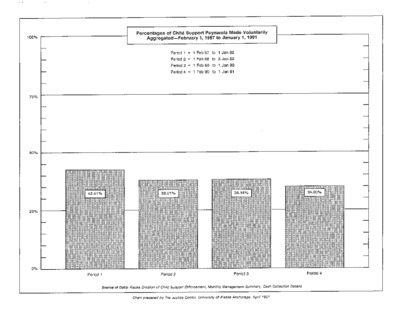
Voluntary and Involuntary Child Support Payments in Alaska, February 1, 1987 to January 1, 1991 — Charts
University of Alaska Anchorage Justice Center
This document presents four figures with tables containing underlying data prepared from data from the Alaska Child Support Enforcement Division, comparing voluntary and involuntary child support payments in Alaska, February 1, 1987 to January 1, 1991.
-

1988 Juvenile Justice and Delinquency Prevention Act Compliance Monitoring Report
Parry L. N/A
The Juvenile Justice and Delinquency Prevention Act (JJDPA) mandates removal of status offenders and nonoffenders from secure detention and correctional facilities, sight and sound separation of juveniles and adults, and removal of juveniles from adult jails and lockups. In Alaska, 7 instances of a status offender held in secure detention were recorded in 1988; by comparison, there were 485 violations in the baseline year of 1976. (An addittional two status offenders held in secure detention satisfied the "valid court order" exception, and were not counted as violations.) 564 separation violations were recorded in 1988, representing a 32% reduction from the 1976 baseline and 30% since the Alaska Division of Family and Youth Services implemented its revised Jail Removal Plan in December 1987. 409 jail removal violations occurred, representing a 53% reduction from the 1980 baseline.
-

JJDP Monitoring Data — 1988: JJDP Violations and Juvenile Detention Counts for Lockups, Jails, Adult Correctional Facilities and Juvenile Detention Centers
Parry L. N/A
This data supplement to the 1988 Juvenile Justice and Delinquency Prevention Act Compliance Monitoring Report (Mar 1990) presents data on 1988 violations in Alaska of the Juvenile Justice and Delinquency Prevention Act (JJDPA), which mandates removal of status offenders and nonoffenders from secure detention and correctional facilities, sight and sound separation of juveniles and adults, and removal of juveniles from adult jails and lockups.
-

Policies and Procedures for Juvenile Justice and Delinquency Prevention Act Compliance Monitoring
Parry L. N/A
Pursuant to Section 223(1)(15) of the Juvenile Justice and Delinquency Prevention Act (JJDPA) of 1974 and 28 CFR Part 31.303(f), states are required to describe their plans and procedures for annually monitoring compliance with JJDPA. This document presents Alaska's monitoring procedures developed by the Justice Center of the University of Alaska Anchorage under contract with the Alaska Division of Family and Youth Services (DFYS).
Printing is not supported at the primary Gallery Thumbnail page. Please first navigate to a specific Image before printing.