



-

Northeast Community Survey: Final Report
Brad A. Myrstol
East Anchorage is currently the only site in Alaska under the nationwide Weed & Seed initiative, which is intended to “weed out” criminals who undermine quality of life for community residents in high-crime neighborhoods and to “seed in” positive practices, programs and institutions that contribute to a better quality of life for neighborhoods. The East Anchorage Weed & Seed site, located in a racially and ethnically diverse neighborhood in the northeast part of Anchorage, had an estimated population in 2001 of more than 20,000 people living in nearly 7,600 households. On behalf of East Anchorage Weed & Seed, the Justice Center conducted a community survey designed to evaluate Northeast community residents’ level of satisfaction with their neighborhood as a place to live, specifically with regards to residents' feelings about neighborhood safety, neighborhood crime levels, criminal victimization, police activity in the neighborhood, and the availability of social services. This report present results of the survey, to which a total of 275 respondents in the Northeast community responded.
-

Officer Drug- and Alcohol-Related Workload Daily Activity Log: User's Guide
Brad A. Myrstol
This guide provides instructions to officers of the Anchorage Police Department for recording daily log forms as part of a study of the extent to which Anchorage patrol officer activities are the result of, or are in some way associated with, drugs and/or alcohol. Data collection was conducted over a seven-day period in August 2002.
-

Alaska Native Technical Assistance and Resource Center: Final Report
Lisa Rieger, Darryl S. Wood, and Michael Jennings
Too often, federal and state justice programs directed at rural, predominately Alaska Native villages do not sufficiently coordinate planning and funding, and are not tailored to fit local cultures and needs. The language and institutional contexts of granting agencies and requests for proposals for grants frame justice problems and their solutions in ways that may or may not relate to the experiences of Alaska Native villages. The Alaska Native Technical Resource Center (ANTARC) was designed as a three-year project to improve village capacity to identify problems and educate the university and granting agencies about the nature of their justice problems and the resources needed to implement solutions. The initial group involved the Justice Center and four rural communities — Gulkana, Kotlik, Wainwright, and Yakutat — with representatives from the communities chosen by village leaders. This report examines ANTARC's evolution, considers its implementation, evaluates the results, and presents recommendations for promoting effective change in Alaska Native villages.
-

Mapping Sex Offender Addresses: The Utility of the Alaska Sex Offender Registry as a Research Data Base
Richard W. Curtis, Maurice Godwin, Robert H. Langworthy, and N. E. Schafer
The registration of sex offenders was part of a national effort to enhance public safety by permitting law enforcement officials to track the location of convicted sex offenders after their release. All fifty states have enacted legislation requiring persons convicted of various sex-related offenses to register with law enforcement agencies; many states also grant public access to all or a portion of their registries. This document reports on the Alaska Statistical Analysis Center's efforts to improve data accuracy in the Alaska Sex Offender Registry, maintained by the Alaska State Troopers, and to assess the registry's utility as a research tool.
-

FY 2000 Juvenile Justice and Delinquency Prevention Act Compliance Monitoring Report
Atwell N/A, N. E. Schafer, Brian Lepine, and Richard W. Curtis
The Juvenile Justice and Delinquency Prevention Act (JJDPA) mandates removal of status offenders and nonoffenders from secure detention and correctional facilities, sight and sound separation of juveniles and adults, and removal of juveniles from adult jails and lockups. In Alaska, 2 instances of status offenders held in secure detention were recorded in FY 2000, compared with 485 violations in the baseline year of CY 1976. In Alaska, 17 separation violations were recorded in FY 2000 (45 projected), representing a 98% reduction from the CY 1976 baseline of 824 violations. 82 jail removal violations were projected (50 actual), representing an substantial reduction from the CY 1980 baseline.
-

The Changing Legal Environment and ICWA in Alaska: A Regional Study
Lisa Rieger and Caroline Brown
By 1974, according to the Association of American Indian Affairs, approximately 25 to 35 percent of all Indian children were separated from their families and placed in foster homes, adoptive homes, or institutions.The Indian Child Welfare Act (ICWA) was passed in 1978 in response to this overwhelming evidence that Native children were being adopted out of tribes at alarming rates. ICWA mandates that tribes and Alaska Native villages have jurisdiction over their child welfare cases, and mandates certain rules when Native children's cases are heard in state courts, including permitting the tribe to intervene in the state case at any time, higher levels of proof, and special evidentiary requirements. This report describes the current implementation status of ICWA in Interior and Southcentral Alaska, with an analysis of the changing legal environment and its significance for Alaska Native villages. In Alaska, recent changes in state law and state court acceptance of the tribal role in ICWA proceedings has legally eliminated state resistance to tribes transferring cases from state court to their own forums, and may lead to a change in the numbers of cases heard in tribal courts in Alaska.
-

Local and Non-Local Jail Use: An Examination of a Sample of Alaska Community Jail Detainees
N. E. Schafer
Data collected for the Alaska Community Jails Statewide Research Consortium included neither race nor place of residence. Because of their interest in both racial distribution and the use of the jail by nonresidents, the fifteen member jails provided this information for a random sample of detainees. The sample consisted of 1,687 detainees, more than a third of whom were not from the communities in which they were held. There was considerable variation by facility and much of the variance appears to be related to the nature of the community and its relationship to surrounding villages and to its geographic location in the state.
-

Evaluation of a JAIBG-Funded Project: Emmonak Elders' Group
N. E. Schafer and Corey Knox
Since 1999, the Emmonak Elders' Group Project has handled certain non-felony juvenile cases in the village of Emmonak, a predominately Yup'ik community on the Yukon Delta of western Alaska. The project permits youth to remain within the community while their offenses are adjudicated through the body of elders – thus avoiding formal justice system processing which usually entails removal from the village. Youths are held accountable within the context of the local community and its traditions. This article describes the results of an initial evaluation of the program in early 2001, after the court had been in operation for approximately a year and a half. The evaluation comprised a review of program files, direct observations of meetings, discussions with community residents and interviews with parents and juveniles. It primarily focused on project implementation: how the court was established, its procedures, and the working relationships among institutions and individual participants.
-

Evaluation of a JAIBG-Funded Project: Voice and Location Telephone Monitoring of Juveniles
N. E. Schafer and Pamela Martin
Direct supervision of juvenile probationers is seldom possible in many communities in Alaska due to their remoteness, so alternative supervision strategies are desirable. Electronic monitoring or voice recognition systems can substitute for institutionalization or face-to-face supervision by a probation officer. This report describes and evaluates the use of a voice and location telephone monitoring system for the supervision of juvenile probationers throught the Mat-Su Youth Corrections Office in Palmer. In practice, VALUE — Voice And Location Update Evaluation — was used primarily as a transitional tool for clients "stepping down" from traditional electronic monitoring to release from supervision.
-

Walking the Talk: A Guide to Assessment Using the CAPRA Community Problem Solving Model
Darryl S. Wood and Lisa Rieger
CAPRA is a community problem-solving model with five stages: C = Clients, A = Analysis, P = Partnership, R = Response, and A = Assessment. CAPRA was the problem-solving method used by the Alaska Native and Technical Resource Center (ANTARC). This guide describes the final stage of the CAPRA model—assessment—including the reasons for conducing an assessment, the documentation needed and why it is needed, and methods for evaluation. Discussion is with a particular focus on assessment methods for community problem-solvers in rural Alaska Native villages. Some background about CAPRA is assumed.
-

Evaluation of the Anchorage Coordinated Agency Network (CANS) Program
Matthew Giblin
In spring 1999, the Anchorage Police Department and the Alaska Division of Juvenile Justice formed a partnership to enhance the supervision and services provided to juvenile probationers in Anchorage. Modeled after a successful program in San Diego, California, the Anchorage Coordinated Agency Network (CANS) project extended the supervision arm of the youth probation office by having Anchorage police officers make random visits to juvenile probationers. This evaluation examines the CANS program during its pilot phase, June through December 1999. The evaluation assesses whether juveniles participating in the CANS program differed from a control group of non-CANS participants with respect to new probation violations and new offenses. An effort is also made to determine the most important factors predicting program outcomes.
-

FY 1999 Juvenile Justice and Delinquency Prevention Act Compliance Monitoring Report
Atwell N/A, N. E. Schafer, and Jason Werre
The Juvenile Justice and Delinquency Prevention Act (JJDPA) mandates removal of status offenders and nonoffenders from secure detention and correctional facilities, sight and sound separation of juveniles and adults, and removal of juveniles from adult jails and lockups. In Alaska, 12 instances of status offenders held in secure detention were recorded in FY 1999, compared with 485 violations in the baseline year of CY 1976. No separation violations were recorded in FY 1999, representing a 100% reduction from the CY 1976 baseline of 824 violations. 69 jail removal violations were projected (56 actual), representing an substantial reduction from the CY 1980 baseline. Originally completed March 2000; revised April 2000.
-

Alaska Community Jails: Jail Profiles
N. E. Schafer
Highly detailed information derived from billing sheets from 1993–1999 on fifteen community jails (Barrow, Cordova, Craig, Dillingham, Haines, Homer, Bristol Bay Borough, Kodiak, Kotzebue, Petersburg, Seward, Sitka, Unalaska, Valdez and Wrangell). Each jail profile shows the number of admissions by month, time of day and day of the week; the charge category for admission; the gender breakdown for admissions and bedspace utilization; and the duration of detention by specific charges. The overall analysis revealed that while there is regional variation, public order charges, including drug and alcohol-related charges and protective custody holds, were, overall, the most frequent cause for admission.
-

Protective Custody Holds in Alaska's Community Jails
N. E. Schafer
A presentation of data from fifteen Alaska community jails (Barrow, Cordova, Craig, Dillingham, Haines, Homer, Bristol Bay Borough, Kodiak, Kotzebue, Petersburg, Seward, Sitka, Unalaska, Valdez and Wrangell) regarding protective custody holds — essentially detention of public inebriates. The report describes the jails and the procedures for such holds under state statute and presents figures on protective custody holds: number per jail, number by season, number by time of day, ages of those held, duration of hold.
-
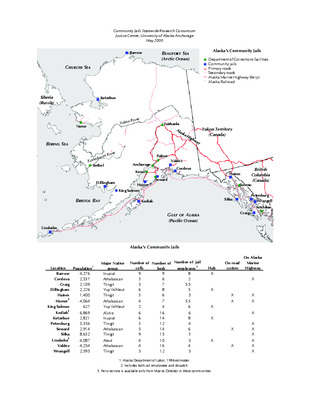
![Alaska's Community Jails [map and table] by University of Alaska Anchorage Justice Center](https://ualaska.researchcommons.org/uaa_justice_reports/1070/thumbnail.jpg "Alaska's Community Jails [map and table] by University of Alaska Anchorage Justice Center")
Alaska's Community Jails [map and table]
University of Alaska Anchorage Justice Center
A map of Alaska's fifteen community jails — Barrow, Cordova, Craig, Dillingham, Haines, Homer, King Salmon, Kodiak, Kotzebue, Petersburg, Seward, Sitka, Unalaska, Valdez, and Wrangell — with a table showing basic facts about the jails including local population (1996 estimates), major Alaska Native group, number of cells, number of beds, and number of jail employees.
-

Turnover Among Alaska Village Public Safety Officers: An Examination of the Factors Associated with Attrition
Darryl S. Wood
Since its inception in 1980, Alaska's Village Public Safety Officer (VPSO) program has provided policing and other public safety services (including fire fighting, search and rescue, water safety, and emergency medical services) to rural Alaska Native villages. The VPSO program was developed in response to public safety needs of the villages and to economies of scale, since individual villages could not generate resources for separate agencies to handle specific programs. Since 1983, the first year for which adequate records are available, turnover in the VPSO program has averaged 36 percent per year; that is, for every 100 VSPOs serving in a given year, 36 have quit or been fired. This turnover rate is far higher than in any other sector of the public safety labor force. This report, based on surveys of current and former VPSOs, examines the extent of and reasons for VPSO turnover, and considers the ramifications of these findings as they pertain to the overall objectives of the VPSO program, the problems of rural police departments, and the feasibility of community-oriented policing in sparsely populated areas. Marriage, service in a home village, connectedness to Alaska Native culture and the presence of other police officers all are factors associated with officers remaining with the VPSO program.
-

Dispositions of DWI Arrestees: Anchorage, 1996
Robert H. Langworthy and Peter Crum
This study explores the dispositions of subjects arrested in Anchorage, Alaska during 1996 for driving while intoxicated (DWI). The project was designed to describe the Anchorage criminal justice system’s processing of DWI offenders and to isolate legal and extralegal variables that predict various offender dispositions. This report presents a literature review of studies relating to legal and extra-legal factors affecting court processing of offenders; discusses methodologies of the present study; presents flow charts of DWI arrestee processing in Anchorage; and presents the multivariate analysis that isolates significant correlates of DWI arrest disposition.
-

FY 1998 Juvenile Justice and Delinquency Prevention Act Compliance Monitoring Report
Atwell N/A, N. E. Schafer, and Kelley Connor
The Juvenile Justice and Delinquency Prevention Act (JJDPA) mandates removal of status offenders and nonoffenders from secure detention and correctional facilities, sight and sound separation of juveniles and adults, and removal of juveniles from adult jails and lockups. In Alaska, 3 instances of status offenders held in secure detention were recorded in FY 1998, compared with 485 violations in the baseline year of CY 1976. 2 separation violations were recorded in FY 1998, representing a 99.8% reduction from the CY 1976 baseline of 824 violations. 57 jail removal violations were projected (52 (actual), representing an 93% reduction from the CY 1980 baseline.
-

Child Welfare and Alaska Native Tribal Governance: A Pilot Project in Kake, Alaska — Report of Findings
Lisa Rieger and Randy Kandel
This report details research on child welfare decision-making in Kake in the context of a proposed ordinance for the establishment of an organized tribal court in the village. The tribal court did not, in fact, come into being at that time, but the researchers were able to follow the development of a different local decision-making approach — circle sentencing. The research revealed that welfare issues and problems were handled through a variety of informal and formal methods that reflected Tlingit cultural emphases. Ideas arising from outside, such as circle sentencing, were selectively adapted.
-

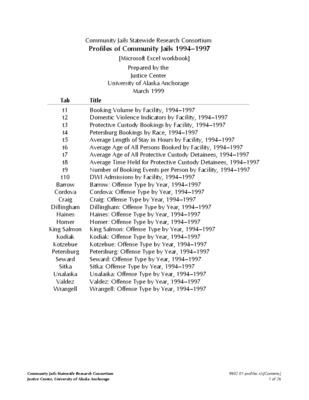
Profiles of Community Jails 1994–1997
University of Alaska Anchorage Justice Center
PDF of a Microsoft Excel workbook containing tables and charts of data derived from billing sheets for 1994–1997 from fifteen Alaska community jails — Barrow, Cordova, Craig, Dillingham, Haines, Homer, Bristol Bay Borough, Kodiak, Kotzebue, Petersburg, Seward, Sitka, Unalaska, Valdez and Wrangell. The facilities are compared on several variables, including booking volume, domestic violence indicators, protective custody bookings, average length of stay, age, bookings per person, DWI admissions, and offense type by year.
-

Preliminary Results From the Long-Term Inmate Survey: Focus on Child Abuse Histories
Robert H. Langworthy, Allan R. Barnes, and Richard Curtis
This preliminary report of long-term inmates in Alaska correctional facilities finds that over 80 percent of long-term inmates report having been physically abused as children, over 65 percent report having suffered neglect. Other findings related to the child abuse histories of long-term inmates are also reported.
-

Results From the Long-Term Inmate Survey: Focus on Child Abuse Histories
Robert H. Langworthy, Allan R. Barnes, and Richard Curtis
This report of long-term inmates in Alaska correctional facilities attempts to describe the childhood experiences of a sample of long-term inmates, address the "cycle of abuse" issue; and present the correlates of abuse which may impact the pattern of offending or inmate functioning. Over 80 percent of long-term inmates report having been physically abused as children; over 65 percent report having suffered neglect.
-

Comparison by Race of Juvenile Referrals in Alaska: Phase II Report
N. E. Schafer
Phase I of this study analyzed data on over 28,000 referrals to the Alaska Division of Family and Youth Services (DFYS) for 1992–1995 to provide comparative information on referrals of Alaska Native, African American, and white youth to the Alaska juvenile justice system. In Phase II, a stratified sample of 112 individual files was examined in an attempt to identify factors, such as race, residence in rural or urban locations, alcohol involvement, age at first referral, family and living situations, and local priorities which might be associated with the decision to refer a child to DFYS. This examination supported the previous finding that minority youth, including Alaska Natives, were more likely than white youth to accumulate referrals. Native youth were also more likely to accumulate alcohol-related referrals, particularly at the village level, Alaska Native juveniles may be receiving referrals in rural areas for behaviors that would be ignored or dealt with more informally by urban police. Furhter, youth who had multiple referrals tended to have more unstable home lives than those with fewer referrals, regardless of racial or ethnic identities.
-

Bridging Justice Communities: A Professional Workshop Curriculum for Alaska Natives
University of Alaska Anchorage Justice Center
Despite the complicated legal and justice questions which present themselves regularly in the life of the Alaska Native community, Native employment in justice system positions — in the bureaucracies and agencies which administer the state and federal justice systems — is low. The program outlined in this document presents a twelve-day to two-week educational workshop for Alaska Native participants focusing on opportunities for careers in the justice system.
-

Literature Review: Diverting Mentally Ill Offenders from Jail
Robert H. Langworthy and Peter Crum
This literature review describes literature available on the topic of diverting mentally ill offenders from jail; outlines major themes found in the literature; analyzed programs described in the literature by type; and highlights recommendations from the literature.
Printing is not supported at the primary Gallery Thumbnail page. Please first navigate to a specific Image before printing.