
-
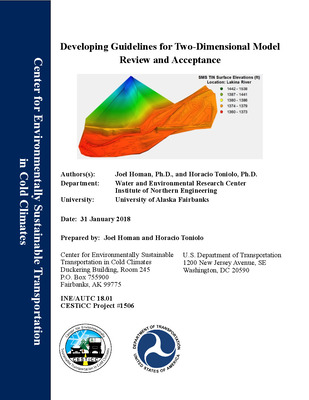
Developing Guidelines for Two-Dimensional Model Review and Acceptance
Horacio Toniolo and Joel Homan
Two independent modelers ran two hydraulic models, SRH-2D and HEC-RAS 2D. The models were applied to the Lakina River (MP 44 McCarthy Road) and to Quartz Creek (MP 0.7 Quartz Creek Road), which approximately represent straight and bend flow conditions, respectively. We compared the results, including water depth, depth averaged velocity, and bed shear stress, from the two models for both modelers. We found that the extent and density of survey data were insufficient for Quartz Creek. Neither model was calibrated due to the lack of basic field data (i.e., discharge, water surface elevation, and sediment characteristics). Consequently, we were unable to draw any conclusion about the accuracy of the models. Concerning the time step and the equations used (simplified or full) to solve the momentum equation in the HEC-RAS 2D model, we found that the minimum time step allowed by the model must be used if the diffusion wave equation is used in the simulations. A greater time step can be used if the full momentum equation is used in the simulations. We developed a set of guidelines for reviewing model results, and developed and provided a two-day training workshop on the two models for ADOT&PF hydraulic engineers.
-
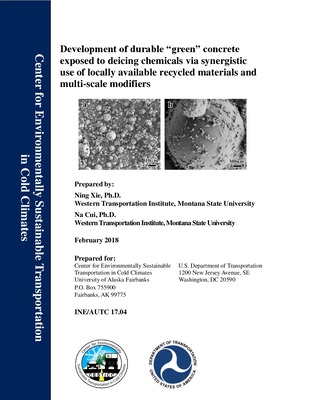
Development of durable “green” concrete exposed to deicing chemicals via synergistic use of locally available recycled materials and multi-scale modifiers
Ning Xie and Na Cui
From the economic and social perspectives, the use of waste materials would not be attractive until their costs and quality can satisfy the construction requirements. In this study, a pure fly ash paste (PFAP) was developed in place of ordinary Portland cement paste (OPCP). This PFAP was prepared at room temperature and without direct alkali activation. The samples were prepared using only the as-received class C coal fly ash, water, and a very small amount of borax (Na2B4O7). On average, the PFAP featured 28-d compressive strength of about 36 MPa, and micro-nano hardness and elastic modulus 29% and 5%, higher than the OPCP, respectively. These mechanical and other properties of the PFAP make it a viable “green” construction binder suitable for a host of structural and non-structural applications. Advanced characterization of the raw material and PFAP pastes was employed to elucidate the hydration mechanisms of this “green” binder. The obtained knowledge sheds light on the role of class C CFA in the hydration process and may benefit the expanded use of various CFAs in cementitious materials.
-
Environmentally Friendly Pervious Concrete for Treating Deicer-Laden Stormwater: Phase II
Gang Xu and Xianming Shi
In Phase I of this project, graphene oxide (GO)-modified pervious concrete was developed using coal fly ash as the sole binder. The primary objectives of Phase II of this project were (1) to evaluate the stormwater infiltration capacity of GO-modified fly ash pervious concrete; (2) to evaluate the durability performance of GO-modified fly ash pervious concrete using freeze/thaw and salt resistance testing methods; and (3) to use advanced analytical tools to fully characterize the GO-modified fly ash binder. Test results indicate different degrees of reduction in concentrations of possible pollutants in stormwater—copper, zinc, sulphate, chloride, ammonia, nitrate, and total phosphate. The incorporation of GO significantly improved the resistance of pervious concrete to freeze/thaw cycles and ambient-temperature salt attack. The specimens were examined using X-ray diffraction, which revealed that the mineralogy and the chemical composition of fly ash pastes differ considerably from those of cement pastes. Nuclear magnetic resonance was used to study the chemical structure and ordering of different hydrates, and provided enhanced understanding of the freeze/thaw and salt scaling resistance of fly ash pervious concrete and the role of GO.
-
Evaluation of Effectiveness and Cost-Benefits of Woolen Roadside Reclamation Products
Rob Ament, Eli Cuelho, Monica Pokorny, and Stuart Jennings
This research project developed three types of products for study: woolen erosion control blankets (ECBs), wool incorporated into wood fiber compost at a 40:1 ratio (compost to wool, by weight), and wool incorporated into silt fence. The project, supported by Montana Department of Transportation (MDT) and the Center for Environmentally Sustainable Transportation in Cold Climates, compared the wool products’ performance to roadside reclamation products commonly used for revegetating cut slopes: straw/coconut (coir) ECB, wood fiber compost and woven plastic silt fence. Three versions of wool silt fence were developed by the project, yet, even more versions are needed to arrive at a commercially viable product. Wool silt fence was the least promising of the three types of reclamation materials. The primary measure for success for ECBs and wool additive to the compost was the amount of seeded or desired vegetation they established after two growing seasons. The research team evaluated the performance of the woolen and standard products by measuring the percentage of canopy cover of each plant species present in each treatment plot. Canopy cover measures the percentage of ground that is covered by a vertical projection of a plant’s foliage. To conduct the comparative analysis, researchers calculated an average percent canopy cover for each functional group: seeded native grasses, desired non-seeded (volunteer) grasses and forbs, and weeds. There was no statistical difference in the mean canopy cover of seeded grass species of the compost treatment (control) compared to the cut wool with compost treatment, 6.4% and 10.2%, respectively. Thus, the project could not determine that cut wool pieces provided a benefit to plant establishment and growth when it is added to compost material. Further experimentation to determine the ideal ratio of wool pieces to add to compost is warranted. The two best performing treatments (i.e. greatest seeded grass establishment) were the rolled wool/straw ECBs. The 100% wool ECB and 50% wool/50% straw ECB had the greatest mean seeded grass canopy cover after two years. Both of these wool ECBs had more seeded grass canopy cover than the standard 70% straw/30% coir ECB demonstrating their potential as a commercially viable product for roadside revegetation applications. Laboratory tests of the wool/straw ECB demonstrated it was comparable to the specifications of a short-term (Type II B or C) standard ECB used along MDT roadways. Future product development of the wool/straw ECB should focus on improving the shear strength at high flows so it meets all required Type III specifications.
-
Guidelines for the Use of Synthetic Fluid Dust Control Palliatives on Unpaved Roads
David Barnes and Billy Connor
The amount of small soil particles, dust, lost from typical unpaved roads to fugitive dust is staggering. A 1 km stretch of unpaved road can contribute over 2400 kg of dust to the atmosphere (4.2 ton/mile) in a typical 3-month summer season. Road managers typically manage dust from unpaved roads with various dust-control palliatives, which are effective for up to 1 year. Synthetic fluids are a relatively new category of dust-control palliatives. Unlike the more commonly used dust-control palliatives, such as salts, engineering guidelines do not exist for the application and maintenance of synthetic fluids on unpaved roads. To fill this void, we present through this document guidelines for road design and maintenance, palliative selection, application, and care of synthetic fluid-treated roadways.
-
Prediction of Thermal Behavior of Pervious Concrete Pavements in Winter
Zhao Chen, Benjamin Nantasai, Somayeh Nassiri, and Liv Haselbach
Because application of pervious concrete pavement (PCPs) has extended to cold-climate regions of the United States, the safety and mobility of PCP installations during the winter season need to be maintained. Timely application of salt, anti-icing, and deicing agents for ice/snow control is most effective in providing sufficient surface friction when done at a suitable pavement surface temperature. The aim of this project was to determine the thermal properties of PCP during the winter season, and to develop a theoretical model to predict PCP surface temperature. The project included a laboratory and a field component. In the laboratory, thermal conductivity of pervious concrete was determined. A linear relationship was established between thermal conductivity and porosity for pervious concrete specimens. In the field, the pavement temperature in a PCP sidewalk installation at Washington State University was monitored via in-pavement instrumentation. Based on the field data, the Enhanced Integrated Climatic Model (EICM) was developed and validated for the site, using PCP thermal properties and local climatic data. The EICM-predicted PCP surface temperature during the winter season agreed well with the field temperature. Overall, the predicted number of days that the pavement surface fell below 32°F agreed well with the number based on field data for 85% of the days. Therefore, the developed model is useful in identifying those days to apply deicer agents. Finally, a regression model using climatic indices was developed for PCP surface temperature prediction in the absence of a more advanced temperature model.
-
Modeling Impacts of Cold Climates on Vehicle Emissions
Serena Chung
This project relates to the research thrust area of ‘environmental impact assessment,' specifically the impact of cold climates on vehicle exhaust emissions. Motor vehicles emit pollutants that are harmful to human. Emissions are thought to be elevated during engine cold starts. During winter, low-lying temperature inversion can trap vehicle emissions near the surface, leading to significantly elevated pollutant concentrations. Despite the importance, vehicle emissions data for cold climates are sparse and the accuracy of vehicle emissions model parameterizations for cold climates is not known. The goal of this project is to improve ability of EPA's Motor Vehicle Emission Simulator (MOVES) model to simulate cold start emissions in cold climates
-
Stormwater-Pavement Interface in Cold Climates
Liv Haselbach and Somayeh Nassiri
This project relates to “managing stormwater runoff in cold climates” and addresses the feasibility of low-impact development at a regional demonstration site in eastern Washington. The studies relate to seven large permeable pavement systems. The findings for similar climates and soils are as follows: The draindown times for retention in Palouse or similar clay soils may handle many typical storms. On average, every square foot of a permeable pavement system installed also receives run-on from another square foot of impermeable pavement, doubling its impact on both stormwater quantity reduction and stormwater quality improvement. Most of the clogged sections on various applications were downslope of other areas. Permeable pavements installed in areas targeted for additional stormwater quantity control and quality improvement may be feasible. On average, the cleaning for installations is less frequent than annually. Power washing plus vacuuming appears to be an effective method for pervious concrete. Surface distress was usually where vehicles turned, or from placement activities. Preliminary studies on various surface treatments on pervious concrete show promise for added safety benefits under wintry conditions. Both detention-type and retention-type permeable pavement systems appear to have little negative impact on neighboring soils in the winter under the study conditions. However, further research is needed for different designs of retention-type systems to ensure that water volumes in the aggregate storage bed do not allow for sufficient water flow into neighboring soils that might result in ice lens formation or other negative impacts.
-
The Reliability and Effectiveness of a Radar-Based Animal Detection System
Marcel P. Huijser, Elizabeth R. Fairbank, and Fernanda D. Abra
This document contains data on the reliability and effectiveness of an animal detection system along U.S. Hwy 95 near Bonners Ferry, Idaho. The system uses a Doppler radar to detect large mammals (e.g., deer and elk) when they approach the highway. The system met most of the suggested minimum norms for reliability. The total time the warning signs were activated was at most 90 seconds per hour, and likely substantially less. Animal detection systems are designed to detect an approaching animal. After an animal has been detected, warning signs are activated which allow drivers to respond. Results showed that 58.1–67.9% of deer were detected sufficiently early for northbound drivers, and 70.4–85% of deer were detected sufficiently early for southbound drivers. The effect of the activated warning signs on vehicle speed was greatest when road conditions were challenging (e.g., freezing temperatures and snow- and ice-covered road surface) and when visibility was low (night). In summer, there was no measurable benefit of activated warning signs, at least not as far as vehicle speed is concerned. Depending on the conditions in autumn and winter, the activated warning signs resulted in a speed reduction of 0.69 to 4.43 miles per hour. The report includes practical recommendations for operation and maintenance of the system and suggestions for potential future research.
-
Performance of TenCate Paving Interlayers in Asphalt Concrete Pavements
Jenny Liu, Sheng Zhao, and Lin Li
As a continued effort of a previously completed project entitled “Performance of TenCate Mirafi PGM-G4 Interlayer-Reinforced Asphalt Pavements in Alaska,” this project evaluated two newly modified paving interlayers (TruPave and Mirapave) through overlay, dynamic modulus tests and low-temperature performance tests. A field survey was conducted to further evaluate the performance of three paving interlayers (G4, G50/50, and G100/100) applied to field sections constructed in May 2013 at Milepost 148–156 Richardson Highway in Alaska. Overlay test results indicate that asphalt concrete (AC) with paving interlayers (TruPave and Mirapave) shows lower reduction in peak load, suggesting better cracking resistance. The dynamic modulus measurement of AC with paving interlayers reveals more rational results from the IDT mode test than the AMPT method due to similar stress conditions in the paving interlayer. With paving interlayers, the temperature sensitivity and cracking potential of AC material were reduced according to the results from the IDT creep test. Field survey results confirm that all sections reinforced with paving interlayers (G4, G50/50, and G100/100) had better cracking resistance than the control section.
-
Continued Field Evaluation of Precutting for Maintaining Asphalt Concrete Pavements with Thermal Cracking
Jenny Liu, Sheng Zhao, and Robert McHattie
In continuation of a previously completed project entitled Evaluate Presawn Transverse Thermal Cracks for Asphalt Concrete Pavement, this project was a further effort to understand important variables in the thermal cracking process through continued field monitoring of three precutting test sites in Interior Alaska. The test sites included (1) Phillips Field Road, precut in 1984 (≈ west ¼ mile of this road), (2) Richardson Highway precut in 2012 (≈ MP 343–344), and (3) Parks Highway precut in 2014 (≈ MP 245–252). Preliminary results at relatively short periods (up to 4 years) indicate that precutting is an economically promising way to control natural thermal cracks. Even short-term economic benefits appear to range between about 2% and 21%. The degree to which precutting works for an AC pavement appears to be a function of the thickness and general structural robustness of new construction. Shorter precut spacing, along with stronger and/or thicker pavement structures, looks promising with respect to crack control. Continuing evaluation and monitoring of test sections are needed to recommend an effective design methodology and construction practice for Alaska and cold areas of other northern states.
-
Freeze-Thaw Durability and Long-Term Performance Evaluation of Shotcrete in Cold Regions
Pizhong Qiao and Zhidong Zhou
This study’s aim was to evaluate the freeze-thaw durability of shotcrete in cold regions and predict its long-term performance. One benchmark mix design from the WSDOT was chosen to prepare samples for performance evaluation. Shotcrete specimens were conditioned in accordance with ASTM C666. The long-term freeze-thaw performance after certain cycles was evaluated using the dynamic modulus of elasticity test (ASTM C215), fracture energy test (RILEM 50-FMC), and X-ray CT microstructure imaging analysis. Probabilistic damage analysis was conducted to establish the relation between the durability life and the damage parameter for different probabilities of reliability using the three-parameter Weibull distribution model. The fracture energy test was found to be a more sensitive test method than the dynamic modulus of elasticity for screening material deterioration over time and for capturing accumulative material damage caused by rapid freeze-thaw action, because of smaller durability factors (degradation ratios) obtained from the fracture energy test. X-ray CT imaging analysis is capable of detecting microcracks that form and pore evolution in the aggregate and interface transition zone of conditioned samples. Moreover, the continuum damage mechanic-based model shows potential in predicting long-term material degradation and the service life of shotcrete.
-
Recycled Glass Fiber Reinforced Polymer Composites Incorporated in Mortar for Improved Mechanical Performance
Harry Rodin, Somayeh Nassiri, Karl Englund, Osama Fakron, and Hui Li
Glass fiber reinforced polymer (GFRP) recycled from retired wind turbines was implemented in mortar as a volumetric replacement of sand during the two phases of this study. In Phase I, the mechanically refined GFRP particle sizes were sieved for four size groups to find the optimum size. In Phase II, the select GFRP size group was incorporated at three different volumetric replacements of sand to identify the optimum replacement content. The mixtures were tested for compressive strength, flexural strength, toughness, and the potential for alkali-silicate reaction. Incorporation of GFRP in mortar proves promising in improving flexural strength and toughness in fiber-like shapes and 1–3% volumetric fractions.
-
Recent Advances in Sustainable Winter Road Operations – A Book Proposal
Xianming Shi
Investing in winter transportation operations is essential and beneficial to the public and the economy. The U.S. economy cannot afford the cost of shutting down highways, airports, etc., during winter weather. In the northern U.S. and other cold-climate areas, winter maintenance operations are essential to ensure the safety, mobility, and productivity of transportation systems. Agencies are continually challenged to provide a high level of service and improve safety and mobility in a fiscally and environmentally responsible manner. To this end, it is desirable to use the most recent advances in the application of materials, practices, equipment, and other technologies. Such best practices are expected to improve the effectiveness and efficiency of winter operations, to optimize material usage, and to reduce associated annual spending, corrosion, and environmental impacts. Currently, no professional societies, scientific journals, or textbooks are dedicated solely to sustainable winter road operations, and key information is scattered across a variety of disciplines. The objective of the proposed book is to summarize the best practices and recent advances in sustainable winter road operations for the purposes of education and workforce development. This book is now in press and can be cited as follows: Shi, X., Fu, L. (2017). Sustainable Winter Road Operations (Eds.). ISBN: 978-1-119-18506-2. Wiley-Blackwell.
-
Monitoring Winter Flow Conditions on the Ivishak River, Alaska
Horacio Toniolo, D. Vas, J. Keech, and J. Bailey
The Sagavanirktok River, a braided river on the Alaska North Slope, flows adjacent to the trans-Alaska pipeline for approximately 100 miles south of Prudhoe Bay. During an unprecedented flooding event in mid-May 2015, the pipeline was exposed in an area located approximately 20 miles south of Prudhoe Bay. The Ivishak River is a main tributary of the Sagavanirktok River, but little is known about its water flow characteristics and contribution to the Sagavanirktok River, especially in winter and during spring breakup. To gather this information, we installed water level sensors on two main tributaries of the Ivishak River (Upper Ivishak and Saviukviayak rivers), early in winter season 2016–2017, in open-water channels that showed promise as locations for long-term gauging stations. Our ultimate goal was to find a location for permanent deployment of water level sensors. By February, the first sites chosen were ice covered, so two additional sensors, one on each river, were deployed in different locations. Some of the sensors were lost (i.e., carried away by the current or buried under a thick layer of sediments). Water level data gathered from the sensors showed a maximum change of 1.07 m. Winter discharge measurements indicate a 44% reduction between February and April 2017. A summer discharge measurement shows a 430% increase from winter to summer.
-
A Framework for Life Cycle Sustainability Assessment of Road Salt Used in Winter Maintenance Operations
Na Cui, Ning Xie, and Xianming Shi
It is important to assess from a holistic perspective the sustainability of road salt widely used in winter road maintenance (WRM) operations. The importance becomes increasingly apparent in light of competing priorities faced by roadway agencies, the need for collaborative decision-making, and growing concerns over the risks that road salt poses for motor vehicles, transportation infrastructure, and the natural environment. This project introduces the concept of Life Cycle Sustainability Assessment (LCSA), which combines Life Cycle Costing, Environmental Life Cycle Assessment, and Social Life Cycle Assessment. The combination captures the features of three pillars in sustainability: economic development, environmental preservation, and social progress. With this framework, it is possible to enable more informed and balanced decisions by considering the entire life cycle of road salt and accounting for the indirect impacts of applying road salt for snow and ice control. This project proposes a LCSA framework of road salt, which examines the three branches of LCSA, their relationships in the integrated framework, and the complexities and caveats in the LCSA. While this framework is a first step in the right direction, we envision that it will be improved and enriched by continued research and may serve as a template for the LCSA of other WRM products, technologies, and practices.
-
Impact of Cold Climates on Vehicle Emissions: The Cold Start Air Toxics Pulse
Tom Jobson and Yibo Huangfu
This project measured cold start emissions from four vehicles in winter using fast response instrumentation to accurately measure the time variation of the cold start emission pulse. Seventeen successful tests were conducted over a temperature range of -4°C to 10°C in winter 2015 at the Washington State University campus. Vehicle cold starts are thought to be a significant source of air toxic compounds in cold winter environments due to the rapid increase in mass emission rates with decreasing temperature. We used a proton transfer reaction mass spectrometer for high time resolution measurement of the emissions the air toxic compounds benzene, formaldehyde, acetaldehyde, in addition to toluene and C2-alkylbenzenes. Measured molar emission ratios relative to toluene in the cold start pulse were compared with cold start emission profiles for E10 fueled vehicles used in the EPA MOVES2014 model. We found that the measured acetaldehyde-to-toluene emission ratio was about a factor of 8 greater than the emission ratio used in MOVES2014. Measured formaldehyde-to-toluene emission ratios were a factor of 5 greater. Our study suggests that emission of the air toxics acetaldehyde and, likely, formaldehyde is significantly underestimated in wintertime by the MOVES2014 model.
-
A Bio-Wicking System to Mitigate Capillary Water in Base Course
Chuang Lin and Xiong Zhang
Water within pavement layers is the major cause of pavement deteriorations. High water content results in significant reduction in soil’s resilient behavior and increase in permanent deformation. Conventional drainage systems can only drain gravity water but not capillary water. Both preliminary lab and field tests have proven the drainage efficiency of a newly developed H2Ri geotextile with wicking fabrics. This bio-wicking system aims at resolving the potential issues that the original design may encounter: (1) H2Ri ultraviolet degradation, (2) H2Ri mechanical failure, (3) loss of drainage function under high suction, and (4) clogging and salt concentration. Both elemental level and full-scale test results indicated that the bio-wicking system is more effective in draining capillary water within the base courses compared with original design, in which the geotextile is directly exposed to the open air. However, a good drainage condition is required for the bio-wicking system to maintain its drainage efficiency. Accumulation of excess water will result in water re-entering the road embankment. Moreover, grass root and geotextile share the same working mechanism in transporting water. In the proposed bio-wicking system, the relatively smaller channels in the grass roots further ensures water moving from H2Ri geotextile, transporting through the stems of grass, and eventually evapo-transpiring into the air at the leaf-air interfaces. In sum, the bio-wicking system seemed to successfully address the concerns in the preliminary design and is a more efficient system to dehydrate the road embankment under unsaturated conditions.
-
Characterization of Alaskan Hot-Mix Asphalt containing Reclaimed Asphalt Pavement Material
Jenny Liu, Sheng Zhao, and Lin Li
In order to properly characterize Alaskan HMA materials containing RAP, this study evaluated properties of 3 asphalt binders typically used in Alaska, PG 52-28, PG 52-40, and PG 58-34, and 11 HMA mixtures containing up to 35% RAP that were either produced in the lab or collected from existing paving projects in Alaska. Various binder and mixture engineering properties were determined, including true high binder grades, complex modulus (|G*|), and phase angle (δ) at high performance temperatures, MSCR recovery rate and compliance, BBR stiffness and m-value, DTT failure stress and strain for binders, and dynamic modulus, flow number, IDT creep stiffness and strength for mixtures. Binder cracking temperatures were determined through Thermal Stress Analysis Routine (TSAR) software along with BBR and DTT data. Mixture cracking temperatures were determined with IDT creep stiffness and strength data. It was found that rutting may not be a concern with Alaskan RAP mix, while low-temperature cracking concerns may still exist in RAP mix in Alaska. A savings of $13.3/ton was estimated for a 25% RAP mix, with consideration of Alaskan situations. Many recommendations for future RAP practice and research are recommended based on testing results and cost analysis.
-
Bio-based Renewable Additives for Anti-icing Applications (Phase I)
Mehdi Honarvar Nazari, Eden Adele Havens, Xianming Shi, and Anburaj Muthumani
The performance and impacts of several bio-based anti-icers along with a traditional chloride-based anti-icer (salt brine) were evaluated. A statistical design of experiments (uniform design) was employed for developing anti-icing liquids consisting of cost-competitive chemicals such as bio-based compounds (e.g., sugar beet extract and dandelion extract), rock salt, sodium metasilicate, and sodium formate. The following experimentally obtained parameters were examined as a function of the formulation design: ice-melting capacity and ice penetration at 25°F (−3.9°C) and 15°F (−9.4°C), compressive strength of Portland cement mortar samples after 10 freezethaw/deicer cycles, corrosion rate of C1010 carbon steel after 24-hour immersion, and impact on asphalt binder’s stiffness. One viable formula (“best performer”) was tested for freezing point depression phase diagram (ASTM D1177-88) and the friction coefficient of asphalt pavement treated by this anti-icing formulation (vs. 23 wt.% NaCl) at a certain temperature near 25°F or 30°F after being applied at 30 gallons per lane mile (1 hour after simulated trafficking and plowing). Laboratory data shed light on the selection and formulation of innovative bio-based snow and ice control chemicals that can significantly reduce the costs of winter maintenance operations. This exploratory investigation contributes to more systematic study of optimizing “greener” anti-icers using renewable resources.
-
Durability and Smart Condition Assessment of Ultra-High Performance Concrete in Cold Climates
Pizhong Qiao, Zhidong Zhou, and Srinivas Allena
The goals of this study were to develop ecological ultra-high performance concrete (UHPC) with local materials and supplementary cementitious materials and to evaluate the long-term performance of UHPC in cold climates using effective mechanical test methods, such as “smart aggregate” technology and microstructure imaging analysis. The optimal UHPC mixture approximately exhibited compressive strength of 15 ksi, elastic modulus of 5,000 ksi, direct tensile strength of 1.27 ksi, and shrinkage of 630 at 28 days, which are characteristics comparable to those of commercial products and other studies. The tensile strength and modulus of elasticity in tension, dynamic modulus, and wave modulus show slight increases from the original values after 300 freeze-thaw (F-T) cycles, indicating that UHPC has excellent frost resistance in cold climates. Although porosity deterioration was observed in the F-T cyclic conditioning process, no internal damage (cracks or fractures) was found during imaging analysis up to 300 cycles. Since structures for which UHPC would be used are expected to have a longer service life, more F-T cycles are recommended to condition UHPC and investigate its mechanical performance over time. Moreover, continuum damage mechanic-based models have the potential to evaluate damage accumulation in UHPC and its failure mechanism under frost attack and to predict long-term material deterioration and service life.
-
An Empirical Model for Optimal Highway Durability in Cold Regions
Jia Yan
We develop an empirical tool to estimate optimal highway durability in cold regions. To test the model, we assemble a data set containing all highway construction and maintenance projects in Arizona and Washington State from 1990 to 2014. The data set includes information on location, time, type (resurfacing, construction, or lane widening), pavement material and thickness, and total expenditure for these projects. Using the data, we first estimate how highway maintenance costs and highway duration depend on pavement thickness and traffic loading. We then calibrate the effects of different deicers on highway durability and thus on highway maintenance costs. Finally, we demonstrate how the estimated and calibrated model can be used by planners to make optimal decisions for highway pavement and winter operations in cold regions.
-
Transportation Life Cycle Assessment Synthesis: Life Cycle Assessment Learning Module Series
Liv Haselbach and Quinn Langfitt
The Life Cycle Assessment Learning Module Series is a set of narrated, self-advancing slideshows on various topics related to environmental life cycle assessment (LCA). This research project produced the first 27 of such modules, which are freely available for download on the CESTiCC website http://cem.uaf.edu/cesticc/publications/lca.aspx. Each module is roughly 15- 20 minutes in length and is intended for various uses such as course components, as the main lecture material in a dedicated LCA course, or for independent learning in support of research projects. The series is organized into four overall topical areas, each of which contain a group of overview modules and a group of detailed modules. The A and α groups cover the international standards that define LCA. The B and β groups focus on environmental impact categories. The G and γ groups identify software tools for LCA and provide some tutorials for their use. The T and τ groups introduce topics of interest in the field of transportation LCA. This includes overviews of how LCA is frequently applied in that sector, literature reviews, specific considerations, and software tutorials. Future modules in this category will feature methodological developments and case studies specific to the transportation sector.
-
Sustainable Construction in Remote Cold Regions
Robert Perkins
The goal of this project was to identify sustainable construction techniques appropriate for remote and cold regions, some of which apply to operations and maintenance as well. The vast body of literature regarding green construction in warm regions was reviewed, and information that might be applicable to cold and remote regions was ascertained. A hierarchal taxonomy was developed to categorize the information and reduce it to a form useful for presentation to engineering and construction managers. Twenty-two engineers and construction managers, all familiar with cold regions and remote projects, were interviewed, and the information and taxonomy were reviewed with them. This process resulted in a set of preliminary guidelines, which were then presented at two different meetings: one at AGC and one at the DOT, Central Region, where the preliminary guidelines were revised slightly. The final set of guidelines, approximately 160 suggestions and notes, was used to develop a module for UAF construction management classes, although it is suitable for other learning venues. The module, the Guidelines, as well as a preliminary paper are available on the CESTiCC website.
-
Environmentally Friendly Pervious Concrete for Treating Deicer-Laden Stormwater: Phase I
Gang Xu and Xianming Shi
A graphene oxide-modified pervious concrete was developed by using low-reactivity, high-calcium fly ash as sole binder and chemical activators and other admixtures. The density, void ratio, mechanical strength, infiltration rate, Young’s modulus, freeze-deicer salt scaling, and degradation resistance of this pervious concrete were measured against three control groups. The test results indicate that graphene oxide modified fly ash pervious concrete is comparable to Portland cement pervious concrete. While the addition of 0.03% graphene oxide (by weight of fly ash) noticeably increased the compressive strength, split tensile strength, Young’s modulus, freeze-deicer salt scaling, and degradation resistance of fly ash pervious concrete, it reduced the void ratio and infiltration rate. The fly ash pervious concrete also showed unfavorable high initial loss during the freeze-deicer salt scaling test, which may be attributed to the low hydration degree of fly ash at early age. It is recommended that durability tests for fly ash concrete be performed at a later age.
Printing is not supported at the primary Gallery Thumbnail page. Please first navigate to a specific Image before printing.