-
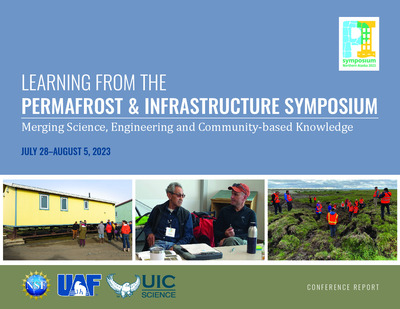
Learning from the Permafrost & Infrastructure Symposium: merging science, engineering, and community-based knowledge
J.L. Peirce
The 2023 Permafrost & Infrastructure Symposium brought over 30 Arctic scientists, engineers, planners, and policymakers to Northern Alaska to see the impacts of permafrost thaw on roads and community infrastructure firsthand and to learn from those who live and work in the Arctic. For the symposium’s first half (July 28–August 1), participants gathered at the Barrow Arctic Research Center in Utqiaġvik for presentations, field trips and discussions focused on critical climate-related issues prioritized by local governments on the North Slope. They were joined in Utqiaġvik by key personnel from the North Slope Borough (NSB), regional housing authority, local utility cooperative, and the Alaska Native villages of Point Lay and Wainwright. Twenty participants flew to Deadhorse, Alaska, for the start of the second half of the symposium (August 1–5), which focused on transportation infrastructure and permafrost landscapes in Prudhoe Bay and south along the 416-mile Dalton Highway towards Fairbanks. A closing half-day session at the University of Alaska Fairbanks (UAF) Usibelli Engineering Learning and Innovation Building explored climate adaptation planning strategies with talks by the Commissioner of Alaska DOT&PF and the U.S. Department of Transportation’s Office of the Secretary. The symposium produced recommendations for the future.
-
Risk Evaluation for Permafrost-Related Threats:Methods of Risk Estimation and Sources of Information
Mikhail Kanevskiy, Billy Connor, Bill Schnabel, Yuri Shur, Kevin Bjella, Erin Trochim, Kelsey Dean, and Ariel Ellison
In our evaluation of permafrost-related threats that affect Alaska communities, we have focused on threats associated with permafrost degradation and thawing ground ice, which can result in significant thaw settlement and cause unacceptable damage to engineered structures. Our evaluation system for permafrost-related threats includes risks of general permafrost degradation and thaw settlement (general and differential). We have evaluated permafrost-related threats for 187 Alaska villages based on available information including scientific publications, maps, satellite imagery and aerial photographs, geotechnical reports, personal communication, community plans and reports, and other sources. Evaluation was based on five criteria: permafrost (PF) occurrence; PF temperature; thaw susceptibility of frozen soils (expected thaw settlement in case of permafrost degradation); massive ice occurrence; and existing PF-related problems. For each of these categories, four risk levels (ranks) were considered. The total (cumulative) risk level was based on the rating score (sum of individual ranks for all five categories). Based on the rating score, each village was assigned one of four risk levels: 0 – no permafrost; 5–8 – low risk level; 9–11 – medium risk level; 12–15 – high risk level. A vulnerability score was developed for each community allowing the identification of communities with the highest risk of damage due to thawing permafrost. Most of communities with the high-risk level (22 villages of 34) are underlain by continuous permafrost, while the low risk level is typical mainly of communities underlain by predominantly unfrozen soils/bedrocks (33 villages of 46), and no high risk levels were detected for this group of villages. Medium risk level is typical mainly of communities underlain by discontinuous and sporadic permafrost (35 villages of 47); some villages of this group are characterized by high and low risk levels (12 and 9, correspondingly). Occurrence of massive-ice bodies (mostly ice wedges) is typical exclusively of communities underlain by continuous and discontinuous permafrost (23 and 20 villages, correspondingly). We presume that at least 20 communities may have extremely ice-rich yedoma deposits with large ice wedges either within villages or in their vicinity. Permafrost conditions in Alaskan communities are very diverse, and in many cases they are extremely variable even within the same community. Detailed studies are required for more precise evaluation of potential permafrost-related threats associated with permafrost degradation and/or thawing of ground ice.
Printing is not supported at the primary Gallery Thumbnail page. Please first navigate to a specific Image before printing.