-
AN EXAMINATION OF A DEVELOPMENT RIGHTS PURCHASE PROGRAM FOR ALASKA AGRICULTURAL LANDS
William G. Workman, Edward L. Arobio, and Anthony F. Gasbarro
Many Alaskans are concerned about the conversion of highly productive agricultural lands to nonagricultural uses now occurring in the state. Land on the urban fringes of Anchorage and Fairbanks that once produced vegetables and grains or supported dairy farms appears most vulnerable to this conversion. As major population centers grow, residential, shopping center and industrial land uses displace agriculture because they render greater returns. This displacement is viewed by some as not being in society's best interest. Those concerned about the loss of agricultural lands argue that these lands are some of the best agricultural lands in the state and are vital to maintaining the agricultural economy of the state. In addition, it is suggested that their preservation will help to maintain a much desired way of life and to provide needed open space. The state and municipal governments in Alaska have made attempts to intervene in the land market to slow down or stop agricultural land conversion. Methods employed to date include tax incentives and the sale of only the agricultural rights on state or municipal lands. This report discusses the feasibility of an alternative means of preserving agricultural lands, namely, the public purchase of development rights from private landowners. Under this voluntary arrangement, private agricultural landowners would be compensated for giving up their option to develop their land for nonagricultural purposes.
-
Guidelines for the Production of Rapeseed in the Delta-Clearwater Area of Alaska
N/A N/A
Experience with the production of rapeseed in Alaska is limited. The material presented in this report is for preliminary planning only. It was prepared on the basis of published Canadian research, and studies of variety trials and planting dates during 1977 in interior Alaska. These guidelines will be revised when the results of additional research and experience with rapeseed production in Alaska becomes available.
-
An examination of a development rights purchase program for Alaska Agricultural lands: Final Report
William G. Workman, Edward L. Arobio, and Anthony F. Gasbarro
Many Alaskans are concerned about the conversion of highly productive agricultural lands to nonagricultural uses now occurring in the state. Land on the urban fringes of Anchorage and Fairbanks that once produced vegetables and grains or supported dairy farms appear is the most vulnerable to this conversion. As major population centers grow, residential, shopping center and industrial land uses displace agriculture because they render greater returns. This displacement is viewed by some as not being in society's best interest. Those concerned about the loss of agricultural lands argue that these lands are some of the best agricultural lands in the state and are vital to maintaining the agricultural economy of the state. In addition, it is suggested that their preservation will help to maintain a much desired way of life and to provide needed open space. The state and municipal governments in Alaska have made attempts to intervene in the land market to slow down or stop agricultural land conversion. Methods employed to date include tax incentives and the sale only of the agricultural rights on state or municipal lands. This report discusses the feasibility of an alternative means of preserving agricultural lands, namely, the public purchase of development rights from private landowners. Under this voluntary arrangement, private agricultural landowners would be compensated for giving up their option to develop their land for nonagricultural purposes.
-
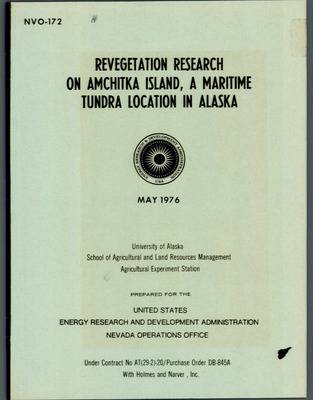
REVEGETATION RESEARCH ON AMCHITKA ISLAND, A MARITIME TUNDRA LOCATION IN ALASKA: Final Report
Wm. W. Mitchell
Revegetation studies commenced by the Alaskan Agricultural Experiment Station in 1970 on Amchitka Island culminated in 1973 with the seeding of disturbed areas associated with the nuclear testing program. Cool temperatures coupled with strong winds and a high incidence of fog and cloud cover impose a tundra aspect on Amchitka, one of Alaska's most southerly land areas. Natural revegetation is undependable for the near term. Twenty-two perennial grasses, two clovers, and four annual grasses were tested on different soil types at low to medium-high (480 ft) elevation sites. At higher elevations severe winds and frost action maintain a barren-ground aspect. Relatively humic, acidic sites were the least favorable, a test site gravel pad the most favorable. Cultivars of red fescue--Boreal, Pennlawn, and Highlight chewings— and an experimental entry of Bering hairgrass, taxa conspecific with species found on the island, and Engmo timothy performed the best. Kentucky bluegrasses and reed canarygrass grew moderately well. Wheatgrasses, wildrye, bromegrass, creeping foxtail, grandis alkaligrass, redtop bentgrass, and white and alsike clover performed unsatisfactorily at some or all of the sites. The revegetation seeding mix included Boreal red fescue, Highlight chewings fescue, Bering hairgrass, and annual ryegrass. Fertilization was necessary to establish plants on most sites. Plants responded erratically to added N on relatively humic, acidic soils, but more normally on gravelly and subsoil sites. Raising the P ration improved fertilizer response. Fertilization greatly enhanced growth on a disturbed site undergoing natural revegetation.
-
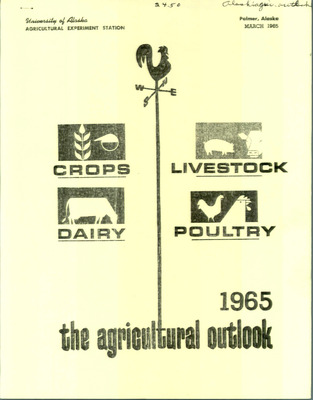
The Agricultural Outlook: 1965
C.F. Marsh, W.E. Burton, and A.D. Saunders
The general economic picture for 1965 indicates another better-than average year for the nation as a whole. Strong advances in economic activity now underway will likely continue at least through the first half of the year. Current trends reveal no serious imbalances in the economy. Forces expected to shape demand expansion for business, consumers and the government in coming months are (1) continued uptrend in business investments, (2) favorable inventory-sales ratios, (3) further improvement in the goods and services export-import trade balance, (4) more favorable factors affecting demand for housing, schools, and facilities, (5) expanded consumer purchases of goods and services, (6) another big sales year for autos, (7) larger consumer expenditures for food, and (8) increased government purchases of goods and services.
-

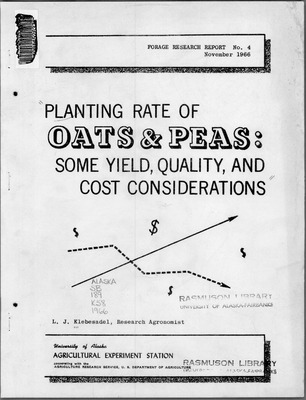
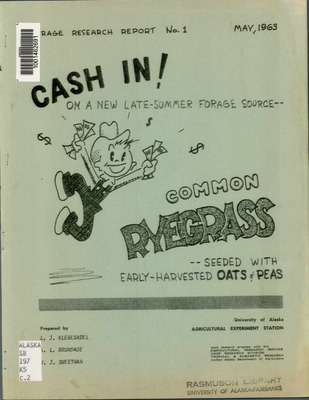
CASH IN! On a New Late-Summer Forage Source -- Common Ryegrass -- Seeded with Early-Harvested Oats & Peas
L.J. Klebesadel, A.L. Brundage, and W.J. Sweetman
-
The Challenge of Circumpolar Biological Research: a report to the Rockefeller Foundation
Charles E. Logsdon
To foster closer working relationships between Alaska and countries of northern Europe through exchange of personnel to work on problems of mutual concern. This report deals only with this first objective of the project and is based on observations and conclusions of Dr. Charles E. Logsdon, Alaska Agricultural Experiment Station Research Plant Pathologist, during his tour of duty at Vollebekk, Norway, from September, 1961, to August, 1962. The other project objectives will be covered in subsequent reports.
-
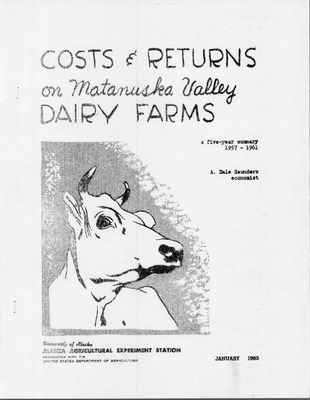
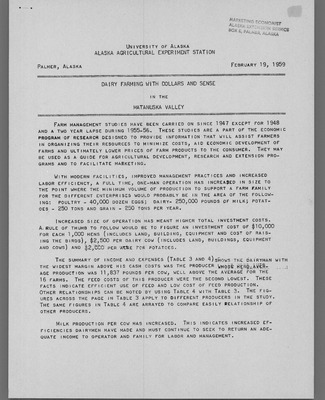
Costs and Returns on Matanuska Valley Dairy Farms
A. Dale Saunders
This study is based on 15 dairy farms in the Matanuska Valley during the period of 1957 through 1961, While all of the farms are owner-operated 80 per cent of them also utilize additional rented crop land. Eleven of the dairies have cooperated for the entire five years. Replacements were necessary in four cases because of changes in business organization or ownership. These dairies, varying in size from 10 to over 50 cows, make up a fairly representative sample of approximately 25 per cent of the dairy farms in the area. They accounted for 26 per cent of the total cow population in the Valley in 1961.
-
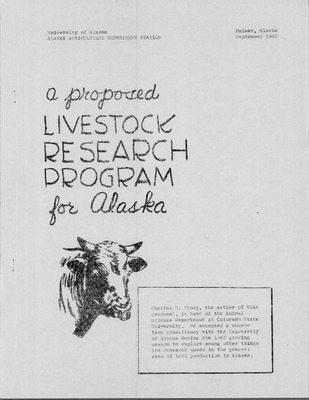
A Proposed Livestock Research Program for Alaska
Charles D. Story
This report presents, primarily, areas of research and research goals on range management and beef cattle production that 1) appear to be most urgent and 2) that appear attainable within the next few years without a great expansion of personnel, equipment and funds. Other areas of research and development in the livestock industry (not including dairy) are discussed briefly. Present trends in agricultural research and recommendations for an expanded research program in animal husbandry are given. Some of these recommendations have appeared in other reports and are singled out here to emphasize their importance to a livestock research program for Alaska.
-
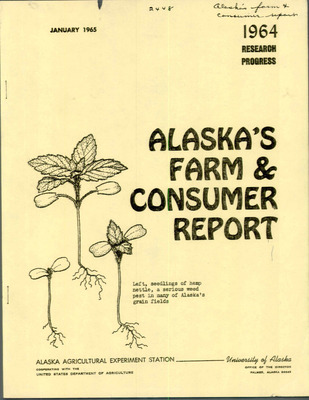
Alaska Farm & Consumer Research: 1961
N/A N/A
Agricultural research has played a major role in developing the productive efficiency of the United States, ours is a strong nation because, alone among the world powers, it is self-reliant with respect to food and fiber. The industrial strength and standard of living enjoyed by the United States rests on less than 10 per cent of its labor force which grows more than enough food and fiber for the rest of the population. One farmer in this country today feeds 23 people at home and three more abroad This astonishing productivity has released the remaining 90 per cent of the labor force for industrial and service jobs, While Russia and China demonstrate that large agrarian populations can subsist in this modern world, they also demonstrate that urban welfare depends on the.skill of rural workers in growing more than enough for their own needs. The fundamental dependence of urban populations is often overlooked — especially here in Alaska — where most people take for granted a sophisticated and complex food production system envied by all other countries.
-
Producing Beef for Alaska's Railbelt
Dale A. Saudners
The object of this report is to try and determine what it will cost to produce beef in the Kenai Peninsula and other parts of the Railbelt. Because little beef is being produced in this area, it has been necessary to project beef enterprises, rather than to cite actual case studies.
-
Costs & Returns for 15 Dairy Farms in Alaska's Matanuska Valley, 1960
Charles L. Welling
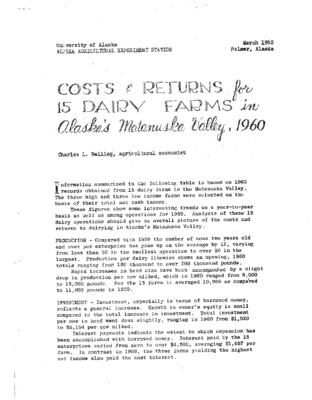
Information summarized in the following table is based on 1960 records obtained from 15 dairy farms in the Matanuska Valley. The three high and three low income farms were selected on the basis of their total net cash income.
-
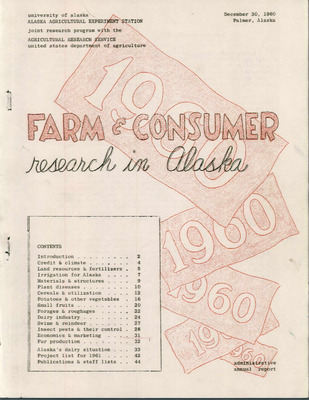
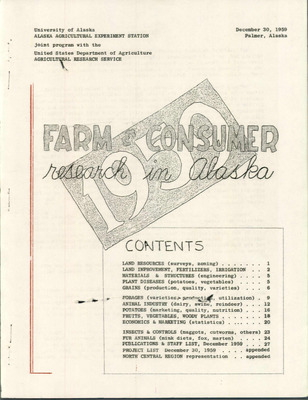
Farm & Consumer research in Alaska: 1960
N/A N/A
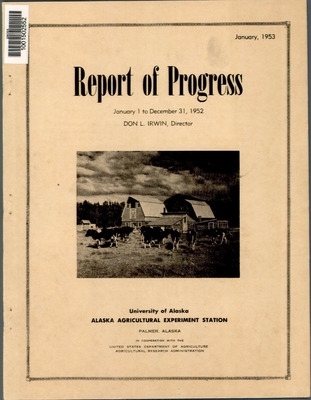
Agricultural research in Alaska is cooperatively and jointly sponsored and supported by the University and the U. S. Department of Agriculture. Since 1948 t he federal government has assumed major leadership and responsibility in this field, and has contributed generously to its financial support and technical direction, over and above the normal Hatch Act allotments to all land grant colleges and universities. Largely developmental in character, Alaska's farm and consumer research is administered from the Alaska Agricultural Experiment Station headquarters at Palmer an installation maintained by the Agricultural Research Service -- rather than from the College campus. Some plant breeding and plant pathology studies are conducted at this site, together with modest investigations of plant characteristics involving winter hardiness, cold survival, and plant responses to photoperiod and light quality. Investigations are initiated and supervised by eight senior project leaders, assisted by twelve junior leaders and a labor and clerical staff.
-
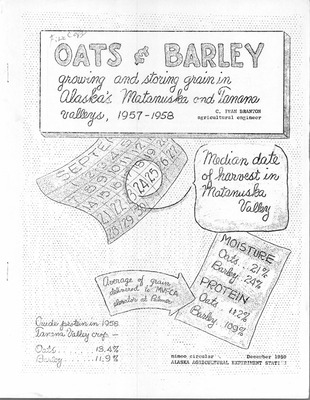
Oats and Barley growing and storing grain in Alaska's Matanuska and Tanana valleys, 1957-1958
C. Ivan Branton
Plant before June 1 for best yields and quality, and to improve chances for a September harvest. Control weeds to improve acre yields, to utilize fertilizer efficiently, and to reduce storage problems caused by wet weed seed. Do not rely on field drying grain to a safe storage moisture content. Have some means of artificial drying ready at harvest time. Plan on September harvest to utilize the best chance of favorable field drying conditions, and to reduce shattering losses.
-
Mutual Plant Disease Problems Alaska and Northern Europe: Observations and Notes of a 1958 field review
Charles E. Logsdon
Through the assistance of the Rockefeller Foundation, the Alaska Agricultural Experiment Station was enabled to continue its studies of the relations of Alaska's agricultural problems to those of Northern Europe by sending Dr. Charles E. Logsdon to Europe to investigate mutual phytopathological problems. Prior investigations consisted of a review of horticultural and general farming problems by Mr. Arvo Kallio who spent the growing season of 1956 in Northern Europe, and a three-month's review of the Alaska Station's research program by Professor 0ivind Nissen of the Agricultural College at Vollebekk, Norway. During his stay in Europe, Dr. Logsdon also presented a paper at the VII International Congress for Microbiology in Stockholm, Sweden, on one phase of Alaska’s phytopathological research— Allan H. Mick, Director.
-
Farm & Consumer research in Alaska:1959
N/A N/A
Agricultural research in Alaska is cooperatively sponsored by the University and the U. S. Department of Agriculture. Since 1948 the federal government has assumed major responsibility and leadership in this field, and has contributed generously to its financial support and technical'direction, over and above the normal Hatch Act allotments. Largely developmental in character, agriculture (including marketing) research is adminstered from the Alaska Agricultural Experiment Station headquarters at Palmer -- an installation maintained by the Agricultural Research Service -- rather than from the College Campus. Some plant breeding and plant pathology studies are conducted at this site, together with modest investigations of plant characteristics involving winter hardiness, cold survival, and plant responses to photoperiod and light quality. All investigations are supervised by eight senior project leaders, assisted by twelve junior leaders and a labor and clerical staff.
Printing is not supported at the primary Gallery Thumbnail page. Please first navigate to a specific Image before printing.