-
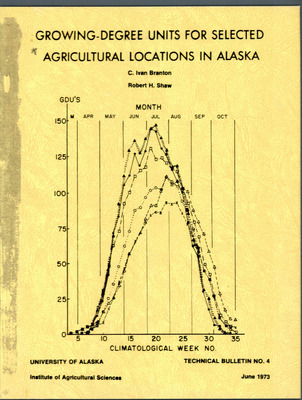
Growing-Degree Units For Selected Agricultural Locations In Alaska
C. Ivan Branton and Robert H. Shaw
It is well known that the rate at which a plant grows is influenced by air temperature. The problem is to define this relationship in a quantitative manner so that the information can be applied to agricultural problems. In places where growth of a particular crop is limited by the length of the growing season, an evaluation of the "heat-units" available is particularly important. Many heat-unit systems have evolved over the years, with certain advantages claimed for each. In crop production, heat unit systems are used to estimate the time required for a crop to go from one stage of development to another, usually from planting to harvest. Each heat-unit system produces a particular set of values, the values being determined by the relationship between temperature and growth that is assumed in the calculations. This paper lists heat-units available in six areas in Alaska, all having agricultural potential. The system used measures temperature in "growing-degree units" and is described in detail. Recent comparative studies of growing season and growing degree days leads to the conclusion that the temperature records taken at Big Delta may have been favorably affected by the nearness of the weather recording station to an extensive coated runway. The "flywheel" effect of this large heat sink appear to have reduced the occurrence of 32°F. night temperatures in both the spring and fall, making the growing degree accumulation unrealistic.
-
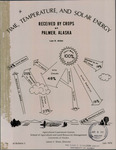
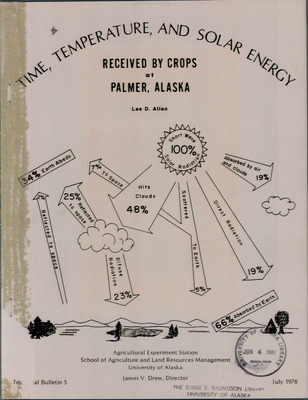
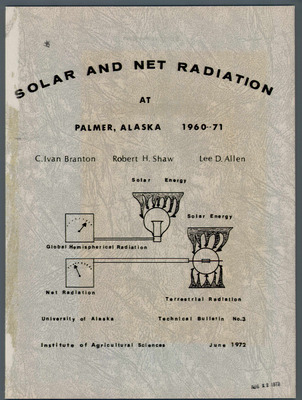
Solar and Net Radiation At Palmer, Alaska 1960-71
C. Ivan Branton, Robert H. Shaw, and Lee D. Allen
Solar and net radiation received at Palmer, Alaska (61 ° 3 6 ’ N. lat., 1 49° 0 6 ’ W. long.) have been observed fo r m ore than ten years. On a yearly basis, the daily average incoming global short wave radiation has been 219.1 langleys, and net radiation has been 70.0 langleys. From May 3 thru August 1, net radiation averages 221 .2 langleys. This is 2.571 kilowatt hours per square meter, or 8 15 .2 Btu per square foot (English units). From November 1 thru January 3 0, net radiation is negative, showing an energy loss of 54.2 langleys per day. This is equivalent to 0.63 0 kilowatt hours per square meter or 199.8 Btu per square foot.
-
Climatic Characteristics of Selected Alaskan Locations
C.E. Watson, C.I. Branton, and J.E. Newman
This publication is primarily intended to assist in the process of agricultural resource evaluation of certain areas with known positive attributes. Climatic indices, which are useful in comparing the agricultural potential such as growing degree days, length of growing season, and others, have been tabulated for selected locations for which continuous long term weather records exist. Agencies cooperating to produce this publication are: Institute of Agricultural Sciences, University of Alaska; Agricultural Research Service, United States Department of Agriculture; Environmental Data Service, National Oceanic and Atmospheric Administration.
-
Precipitation Probabilities for Selected Sites in Alaska
C. Ivan Branton and C.E. Watson
This publication is the result of cooperation between many research entities whose separate contributions have made it possible to assemble this information concerning precipitation in the nation's largest state, Alaska. The program to extract precipitation probabilities from the raw data was developed by Drs. L. D. Bark and A. M. Feyerherm of Kansas State University of Agriculture and Applied Science as a contribution to the regional research of the North Central Committee NC-26 concerned with "Weather Information for Agriculture". The program was modified and adapted to a higher speed computer by Dr. G. L. Ashcroft of the Utah State University of Agriculture and Applied Science as a contribution of the Western regional Committee W-48, concerned with "Weather and its Relation to Agriculture. The final processing of Alaskan data was made possible by the close cooperation of the Western Data Processing Center of the University of California at Los Angeles and the personnel of the computer center of the University of Alaska at College.
Printing is not supported at the primary Gallery Thumbnail page. Please first navigate to a specific Image before printing.