
-

Delivery Routes Sell More Milk in Anchorage
H.P. Gazaway and Charles Marsh
A primary objective of this study was to determine the number of households purchasing dairy products from delivery routes, and the number buying from stores. Also of interest were the amounts purchased per household and per person, family characteristics such as income, family size, and so- forth, and their preferences for home delivery versus store -purchasing.
-
Three Year Summary of Investment, Cost and Income for Dairy Farms in Alaska
A. Dale Saunders, H.P. Gazaway, and C.F. Marsh
-

MILK SALES IN ALASKA’S SCHOOLS
H.P. Gazaway and Charles March
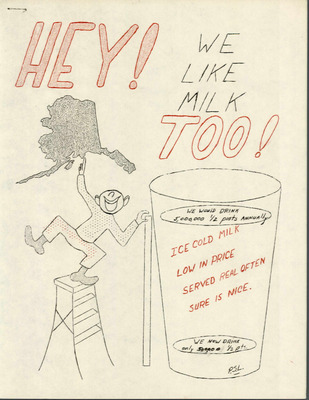
When offered more than once daily and at five cents a half-pint, Palmer school children consumed fresh milk at the rate of 1.1 half-pints per day, an increase of 138 percent over normal. Seward school children customarily eating lunch at school consumed 1.5 half-pints per day. Sixty Alaskan schools - comprising 90 percent of the Territory's school enrollment - can be supplied with fresh milk. The market potential existing in these schools is estimated at 5,000,000 half-pints (2,500,00 pounds or 300,000 gallons) annually. This is 8 to 10 times the amount now consumed in Alaskan schools. Increased consumption of fresh milk in Alaska's schools means stepping up imports from surplus producing Stateside milksheds. Alaska's dairy industry now supplies less than two-thirds of the Territory's fresh fluid milk.
-

Hey! We Like Milk Too!
H.P. Gazaway and Charles Marsh
Increased consumption of fresh milk in Alaska's schools means stepping up imports from surplus producing Stateside milksheds.
-
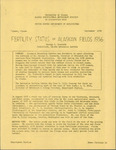
FERTILITY STATUS OF ALASKAN FIELDS 1956
George D. Scarseth
Alaska's Extension Service was fortunate in again obtaining the services of Dr. George D. Scarseth, Director of Research for the American Farm Research Association. His task during the 1956 growing season was to review the fertility status of potato fields and to diagnose the potato malady that has reduced yields in recent years. Having familiarized himself with the symptoms during the 1955 season, he came back to Alaska in August of this year to study in greater detail the onslaught of this malady and to help interpret the results of studies designed to: explore basic causes and possible corrective measures. Dr. Scarseth's report is here reproduced in full for the guidance of farmers and agencies dealing with food production in Alaska.
Printing is not supported at the primary Gallery Thumbnail page. Please first navigate to a specific Image before printing.