-
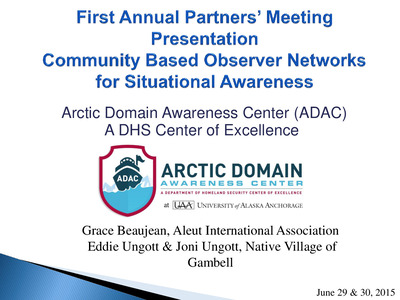
Community Based Observer Networks for Situational Awareness
Grace Beaujean, Eddie Ungott, and Joni Ungott
-
Under Ice Mapping of Oil Spills and Environmental Hazards with a Long-Range AUV
Jim Bellingham, Amy Kukulya, and Chris Reddy
-
Decentralized, Asynchronous Sensor Networks for Arctic Regions
Martin Cenek, Matthew Devins, Lance Leber, and Michael Mobley
-
Integrated Intelligent System of Systems (IISoS)
Kenneth Juengling, Collin Schroeder, and Mark Pearson
-
Integrated Framework to Identify, Track, and Communicate Sea-Ice Hazards
Andy Mahoney, Hajo Eicken, and Josh Jones
-
Yukon-Kuskokwim Storm Surge Nowcast/Forecast Model and Preliminary Norton Sound Storm Surge Model
Tom Ravens, Jon S. Allen, and Kristen Reardon
-
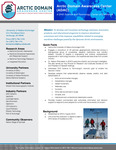
Arctic Domain Awareness Center Fact Sheet
Helena Wisniewski
Mission: To develop and transition technology solutions, innovative products, and educational programs to improve situational awareness and crisis response capabilities related to emerging maritime challenges posed by the dynamic Arctic environment.
-
Arctic Domain Awareness Center DHS Center of Excellence (COE): Project Work Plan
Helena S. Wisniewski
As stated by the DHS Science &Technology Directorate, “The increased and diversified use of maritime spaces in the Arctic - including oil and gas exploration, commercial activities, mineral speculation, and recreational activities (tourism) - is generating new challenges and risks for the U.S. Coast Guard and other DHS maritime missions.” Therefore, DHS will look towards the new ADAC for research to identify better ways to create transparency in the maritime domain along coastal regions and inland waterways, while integrating information and intelligence among stakeholders. DHS expects the ADAC to develop new ideas to address these challenges, provide a scientific basis, and develop new approaches for U.S. Coast Guard and other DHS maritime missions. ADAC will also contribute towards the education of both university students and mid-career professionals engaged in maritime security. The US is an Arctic nation, and the Arctic environment is dynamic. We have less multi-year ice and more open water during the summer causing coastal villages to experience unprecedented storm surges and coastal erosion. Decreasing sea ice is also driving expanded oil exploration, bringing risks of oil spills. Tourism is growing rapidly, and our fishing fleet and commercial shipping activities are increasing as well. There continues to be anticipation of an economic pressure to open up a robust northwest passage for commercial shipping. To add to the stresses of these changes is the fact that these many varied activities are spread over an immense area with little connecting infrastructure. The related maritime security issues are many, and solutions demand increasing maritime situational awareness and improved crisis response capabilities, which are the focuses of our Work Plan. UAA understands the needs and concerns of the Arctic community. It is situated on Alaska’s Southcentral coast with the port facility through which 90% of goods for Alaska arrive. It is one of nineteen US National Strategic Seaports for the US DOD, and its airport is among the top five in the world for cargo throughput. However, maritime security is a national concern and although our focus is on the Arctic environment, we will expand our scope to include other areas in the Lower 48 states. In particular, we will develop sensor systems, decision support tools, ice and oil spill models that include oil in ice, and educational programs that are applicable to the Arctic as well as to the Great Lakes and Northeast. The planned work as detailed in this document addresses the DHS mission as detailed in the National Strategy for Maritime Security, in particular, the mission to Maximize Domain Awareness (pages 16 and 17.) This COE will produce systems to aid in accomplishing two of the objectives of this mission. They are: 1) Sensor Technology developing sensor packages for airborne, underwater, shore-based, and offshore platforms, and 2) Automated fusion and real-time simulation and modeling systems for decision support and planning. An integral part of our efforts will be to develop new methods for sharing of data between platforms, sensors, people, and communities.
Printing is not supported at the primary Gallery Thumbnail page. Please first navigate to a specific Image before printing.